
Gorden Peredam Suara untuk Hotel di Bali: A Practical Guide for Villas & Hotels
Acoustic or sound-reducing curtains can contribute to a quieter room, but they should not be treated as a complete substitute for architectural sound insulation. Their effect depends on fabric construction, mass, folds, coverage, gaps, installation position and the type of noise entering the room.
Practical answer: acoustic curtains are most useful as part of a broader sound-control strategy. They can soften reflected sound and may reduce some direct transmission through glazed openings, but the window, wall, door and ceiling construction still determine much of a hotel's acoustic performance.
What Does “Soundproof Curtain” Actually Mean?
The term is often used broadly. In professional specification, it is safer to describe a curtain as a sound-reducing or acoustic treatment unless the complete installation has been tested for a specific acoustic performance.
Where Heavy Curtains Can Help
| Situation | Potential role |
|---|---|
| Traffic noise through glazing | Additional textile layer over the opening |
| Pool or courtyard activity | Can soften the direct opening and reflections |
| Echo in hard-surface rooms | Fabric adds an absorptive surface |
| Hotel bedroom comfort | Supports a quieter, more enclosed atmosphere |
| Meeting or lounge areas | Can help reduce reverberation with other acoustic measures |
Fabric Weight Matters, But Weight Alone Is Not Enough
Heavier fabrics provide more material mass than lightweight sheers, but acoustic behaviour also depends on construction and installation. A heavy fabric with poor coverage may perform less usefully than a well-fitted treatment covering the opening properly.
Consider density, lining, number of layers, fullness and total surface area. Fullness creates folds and more textile surface, but it also increases consumption, weight and hardware load.
Coverage and Gaps Are Critical
Noise can still pass through uncovered areas. Side gaps, the top of the opening, the bottom of the curtain and adjacent uncovered glazing can limit the benefit of a substantial curtain. For hotel bedrooms, consider glass, frame, overlap, track position and floor relationship together.
Layering for Hospitality
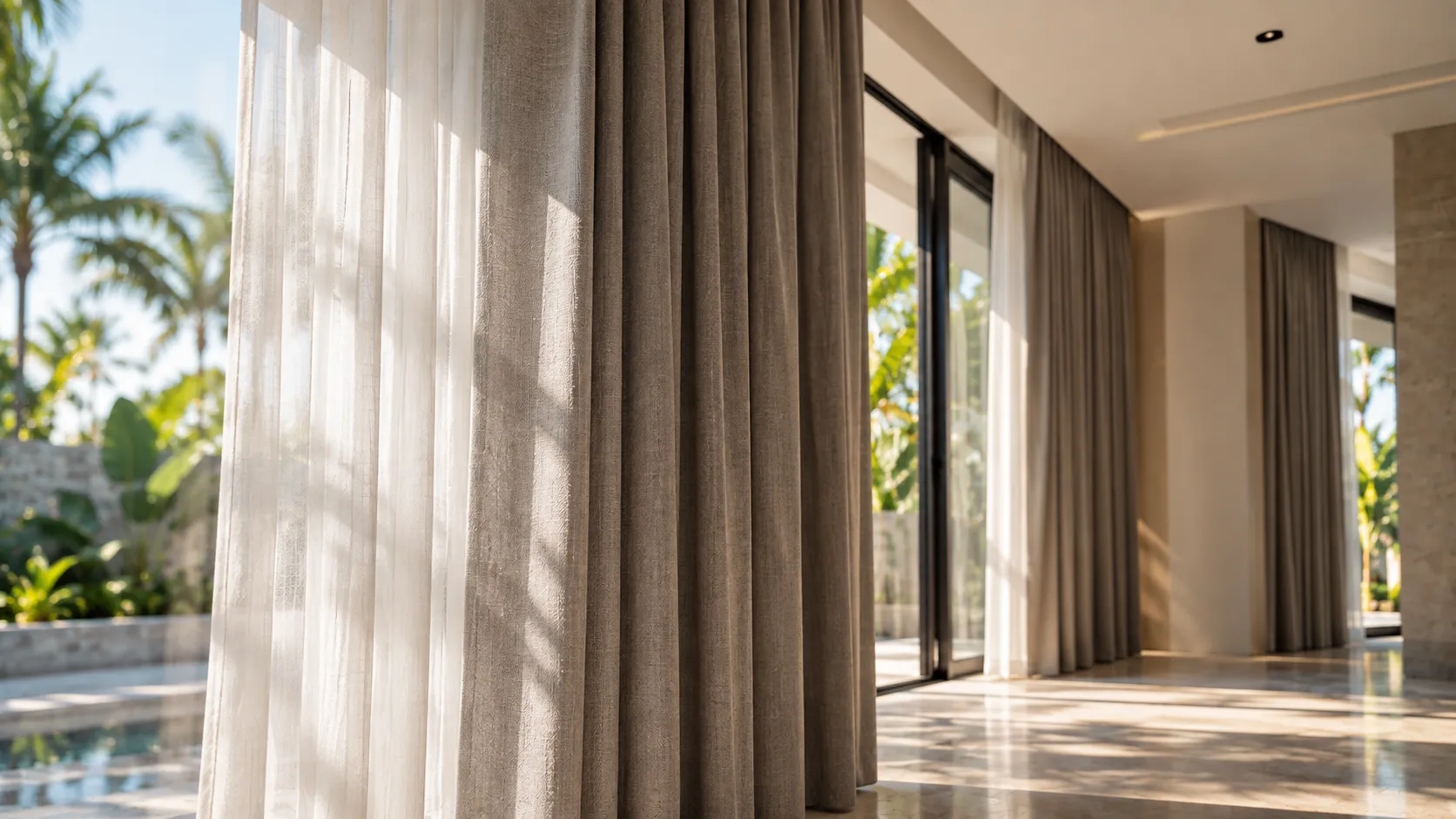
A hotel may need a room to feel bright and connected to the view during the day but enclosed and comfortable at night. A sheer plus a heavier curtain provides flexibility, while the heavier layer contributes more to the acoustic environment when closed.
Room-by-Room Applications
| Area | Possible treatment | Priority |
|---|---|---|
| Guest bedroom | Heavy curtain + optional sheer | Sleep, privacy and light control |
| Suite | Layered floor-to-ceiling curtains | Coverage and flexible operation |
| Restaurant | Decorative heavy drapery | Atmosphere and reverberation |
| Meeting room | Acoustic textile treatment | Echo and speech comfort |
| Villa bedroom | Heavy curtain with suitable lining | Privacy, light and quieter room feel |
Noise Source Matters
Identify whether the problem is road traffic, neighbouring rooms, pool areas, outdoor restaurants or mechanical equipment. If noise enters mainly through a sliding glass door, treating that opening may help. If the main path is a lightweight wall or poorly sealed door, a curtain over the window will not solve the primary problem.
Maintenance Should Be Part of the Specification
Hospitality curtains are operated frequently and must be cleaned without excessive downtime. Ask how the fabric will be cleaned, whether panels can be removed efficiently, whether the track can carry the finished weight and whether replacement panels can be produced if needed.
Motorization for Large Hotel Curtains
Motorized tracks can be useful for wide or high openings. Confirm finished curtain weight, track capacity, power provision, control method and maintenance access before production.
Common Mistakes
- Promising complete soundproofing from a curtain alone.
- Choosing the heaviest fabric without checking hardware capacity.
- Ignoring gaps around the window.
- Using fixed curtains where staff need frequent access.
- Forgetting cleaning and replacement requirements.
- Choosing fabric before identifying the noise path.
Bali Hotel Considerations
Many Bali hospitality properties combine large glazing with open-air areas, pools, gardens and close indoor-outdoor connections. Acoustic requirements should therefore be considered alongside daylight, privacy, ventilation, humidity and visual character.
Specification Checklist
- Identify the main noise source.
- Check window or door construction.
- Measure the complete opening.
- Select an appropriate heavy or layered fabric.
- Review fullness and finished weight.
- Minimise unnecessary gaps where practical.
- Confirm track or rod capacity.
- Plan cleaning and maintenance.
- Decide whether motorization is useful.
- Set realistic expectations for acoustic performance.
Almeers Living can help hospitality properties in Bali evaluate fabric, layering, coverage, hardware and installation conditions as part of a complete window-treatment specification.