
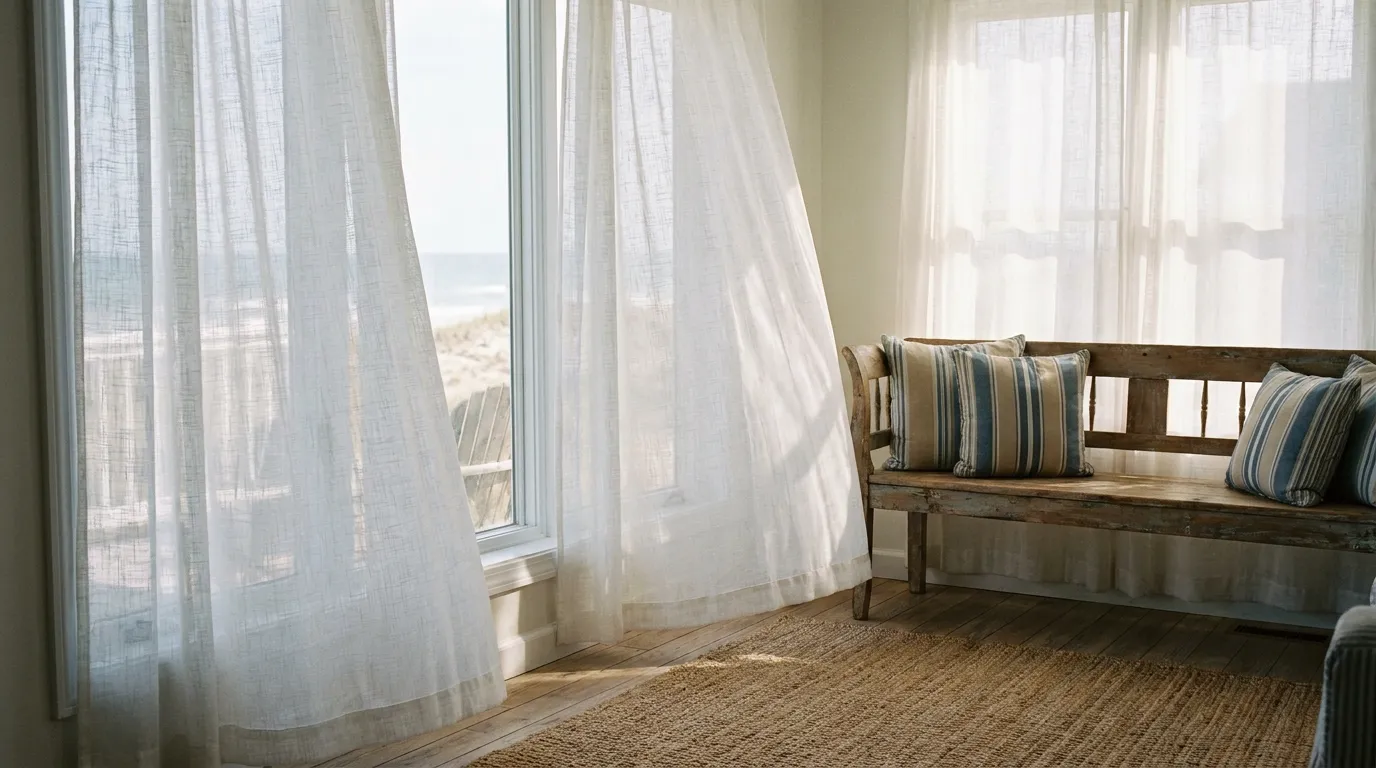
How to Choose Curtains for a Beach House
How Should You Choose Curtains for a Beach House?
The best curtains for a beach house suit the local climate as well as the interior design. Strong sunlight, coastal air, humidity and frequent use can influence fabric choice, hardware and maintenance. Start by assessing the conditions at each window.
1. Assess Sunlight and Window Orientation
Observe when direct sunlight reaches each window. Bright exposures may need stronger light control, while shaded rooms may benefit from lighter fabrics that preserve daylight. For bright bedrooms, consider lined or blackout curtains. For living areas, a sheer or light-filtering layer can soften incoming light.
2. Select Fabric for the Room
Linen-look and textured woven fabrics can create a relaxed coastal atmosphere. Sheers soften daylight, while heavier fabrics provide more coverage. The right choice depends on opacity, drape, maintenance and the desired appearance.
Request samples and assess them in the room. Check the care instructions and suitability for humid conditions. No fabric should be assumed to be immune to fading, mildew or salt-related wear.
3. Balance Privacy and Airflow
Sheer curtains can soften visibility during some daylight conditions, but they do not guarantee privacy at night when interior lights are on. For greater flexibility, layer a sheer curtain with a separate opaque or blackout curtain.
4. Consider Humidity and Salt Exposure
Coastal air can be demanding on metal hardware and fabric finishes. Ask about suitable track or rod materials and finishes for the installation environment. Maintain ventilation, avoid leaving curtains damp and follow the manufacturer care instructions.
Bathrooms and other areas exposed to regular moisture may require materials and hardware specifically suitable for those conditions.
5. Choose Hardware That Suits the Architecture
Ceiling-mounted tracks create a simple vertical line and work well with many contemporary coastal interiors. Decorative rods can complement traditional architecture. Confirm the fixing method, wall or ceiling substrate, curtain weight and access for maintenance.
For wide sliding doors, consider where the open curtain will stack. The stack-back area must not obstruct the main walkway or interfere with door operation.
6. Get Measurements Right
Measure the intended track or rod width and finished drop separately. Confirm whether the curtain should finish above the floor, just touch it or use another specified finish. Check ceiling levels and floor variation before ordering.
7. Build a Coastal Colour Palette
Warm white, sand, beige, muted blue and natural-looking textures can complement coastal interiors. Compare samples with the wall colour, flooring, timber finishes and daylight rather than selecting each colour in isolation.
Common Mistakes to Avoid
- Using delicate fabric in intense direct sunlight without checking suitability.
- Assuming sheer fabric provides nighttime privacy.
- Ignoring salt exposure and hardware maintenance.
- Choosing curtains that block access to sliding doors.
- Ordering before confirming track position and finished drop.
Beach-House Curtain Checklist
- Sunlight and privacy requirements have been assessed.
- Fabric care and suitability for local humidity have been checked.
- Hardware is appropriate for the installation environment.
- Door clearance and curtain stack-back have been measured.
- Samples have been reviewed in the actual interior.
Plan Your Coastal Window Treatments
A successful beach-house curtain scheme combines practical performance with a relaxed natural aesthetic. Almeers Living can help property owners and designers explore custom curtains and window treatments for coastal homes and villas in Bali, with selections based on measurements, room conditions and desired privacy.