The Evolution of Window Coverings: Practical Ideas for Modern Properties
Window coverings have moved far beyond their traditional role of blocking light and providing privacy. In contemporary homes, villas, hotels and commercial interiors, they are increasingly considered part of the building’s comfort, energy strategy and connected technology. The right combination of curtains, blinds, fabrics and control systems can help manage daylight, reduce unwanted solar heat, protect interior finishes and create a more considered design language.
For properties in Bali and other tropical destinations, these decisions are especially relevant. Strong sunlight, high humidity, coastal conditions and indoor-outdoor living place specific demands on window treatments. A successful solution must look refined while also being practical to operate, maintain and live with.
1. How the Role of Window Coverings Is Changing
Traditional window coverings were often selected after the main interior design decisions had been made. Today, they are more commonly planned alongside glazing, lighting, furniture layouts and climate-control systems. This integrated approach helps avoid practical issues such as curtains obstructing doors, blinds interfering with window handles or fabrics fading quickly in areas exposed to intense sunlight.
Modern window treatments are expected to perform several functions at once: regulate daylight, preserve privacy, soften acoustics, contribute to thermal comfort and complement the architecture. In hospitality settings, they also need to be intuitive for guests and durable enough for frequent use.
The evolution is not simply about adding technology. It is about matching the right product to the window, room orientation, user routine and property requirements. A manually operated sheer may be ideal for a small guest room, while a large glazed living area may benefit from motorized tracks and a layered curtain system.
2. Smart Automated Controls and Motorization
Motorized curtains and blinds allow occupants to adjust daylight and privacy without manually operating each window covering. Depending on the system, controls may be provided through a wall switch, handheld remote, mobile application or compatible smart-home platform. Some installations can also be configured around scheduled routines or sensors, subject to the equipment selected and the wider home-automation setup.
Where automation adds practical value
- Large or hard-to-reach glazing: Motorization can make tall, wide or high-level windows easier to operate.
- Consistent daily routines: Scheduled opening and closing can help occupants manage morning light, afternoon sun and evening privacy.
- Guest convenience: Clearly labelled controls can make window coverings easier for hotel and villa guests to use.
- Coordinated spaces: Multiple curtains or blinds may be grouped so that several windows respond together.
- Reduced manual handling: Automated operation can limit repeated pulling of fabric and cords during everyday use.
Planning a motorized system
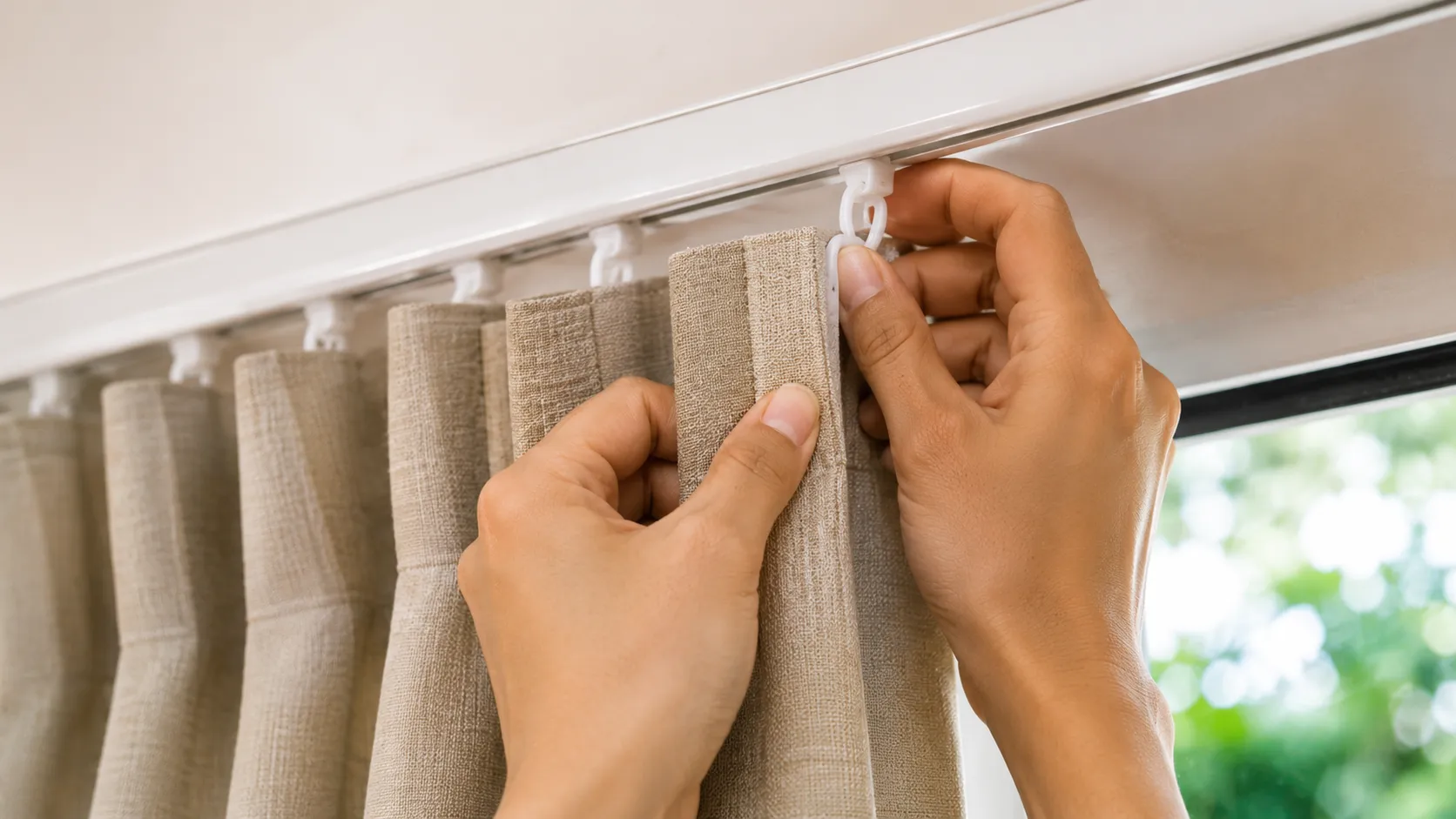
Before selecting a motor, confirm the curtain or blind type, total width, approximate weight, track configuration, power requirements and preferred control method. A motor suitable for a light sheer may not be appropriate for a wide, lined blackout curtain. The track, brackets, motor capacity and installation substrate should be considered as one system.
For renovation projects, decide early whether the motor will use a concealed power supply, accessible outlet or another approved electrical arrangement. Electrical work should be planned and completed by qualified professionals. Also consider what happens during a power interruption and whether a manual override or alternative operation method is available on the chosen product.
Design note: Automation works best when it is planned before ceiling details and joinery are finalized. Early coordination can make it easier to conceal tracks, wiring and access points without compromising future maintenance.
3. Eco-Textile Innovations and Responsible Material Choices
Interest in lower-impact interiors has encouraged designers and manufacturers to explore natural fibres, recycled yarns, improved production processes and longer-lasting textile constructions. For window coverings, material selection should consider more than the fibre name on a label. Durability, cleaning requirements, dye performance, transport, manufacturing information and expected service life all influence the overall environmental picture.
Materials and textile directions to explore
- Linen and linen blends: Valued for their natural texture and relaxed appearance. Linen can suit coastal and tropical interiors, although the appropriate construction and lining should be selected according to light exposure, privacy needs and care requirements.
- Cotton: Available in a wide range of weights and finishes. Its performance depends on the weave, treatment, colour and how the finished curtain is maintained.
- Recycled polyester: Some textile ranges use recycled content. Ask suppliers for clear documentation of the recycled proportion and relevant product information rather than assuming every polyester fabric contains recycled material.
- Bamboo-derived and other regenerated fibres: These can offer distinctive hand-feel and drape, but production methods vary. Verify the fibre composition and manufacturer’s technical information.
- Blended fabrics: Combining fibres can balance appearance, stability, drape and care needs. The actual performance depends on the blend ratio and construction.
Natural does not automatically mean suitable for every room, and synthetic does not automatically mean unsuitable. A fabric that requires frequent replacement may be a less practical choice than a durable textile that performs reliably for many years. Responsible specification therefore balances material sourcing with real-world longevity and maintenance.
Questions to ask about textile claims
When a fabric is described as sustainable, recycled, organic or environmentally responsible, request supporting details. Useful information may include fibre composition, recycled-content percentage, certification scope where applicable, care instructions and expected use conditions. Avoid relying on broad marketing terms without product-level evidence.
4. High-Performance Solar Insulation
Windows are an important point of exchange between indoor and outdoor environments. Sunlight entering through glazing can increase heat and brightness, while direct UV exposure may contribute to fading of furniture, flooring, artwork and other interior finishes. Window coverings can help manage these effects, although their performance depends on fabric construction, colour, openness, lining, installation position, glazing and the amount of exposed glass.
How different window treatments contribute
| Window treatment | Typical role | Specification points |
|---|---|---|
| Sheer curtains | Diffuse daylight and soften views while maintaining a light atmosphere. | Check openness, privacy requirements, fabric stability and cleaning needs. |
| Dimout curtains | Reduce incoming light and improve daytime privacy. | Confirm the required level of light reduction; dimout is not the same as full blackout. |
| Blackout curtains | Provide strong light blocking when paired with suitable fabric and installation details. | Consider side gaps, top gaps, track returns and lining construction. |
| Roller blinds | Offer a clean profile and selectable openness or opacity. | Choose fabric openness and colour according to glare, view and privacy needs. |
| Roman shades | Combine a tailored appearance with adjustable coverage. | Check stack height, operating clearance and fabric weight. |
| Venetian and wooden blinds | Allow adjustable control of light direction and privacy. | Consider slat material, humidity exposure, cleaning and operating mechanism. |
For improved solar control, consider the complete window assembly rather than relying on a fabric description alone. A well-fitted lined curtain can reduce direct light entering around the edges, while a blind positioned close to the glazing may provide a different type of control. In some rooms, combining a sheer with a blackout curtain gives occupants greater flexibility throughout the day.
Window coverings can support thermal comfort, but they should not be described as a guaranteed replacement for appropriate glazing, shading design, ventilation or air-conditioning. Where energy savings are a priority, evaluate the window orientation, glass specification, external shading and room-use pattern together.
5. Layering Curtains and Blinds for Flexible Performance
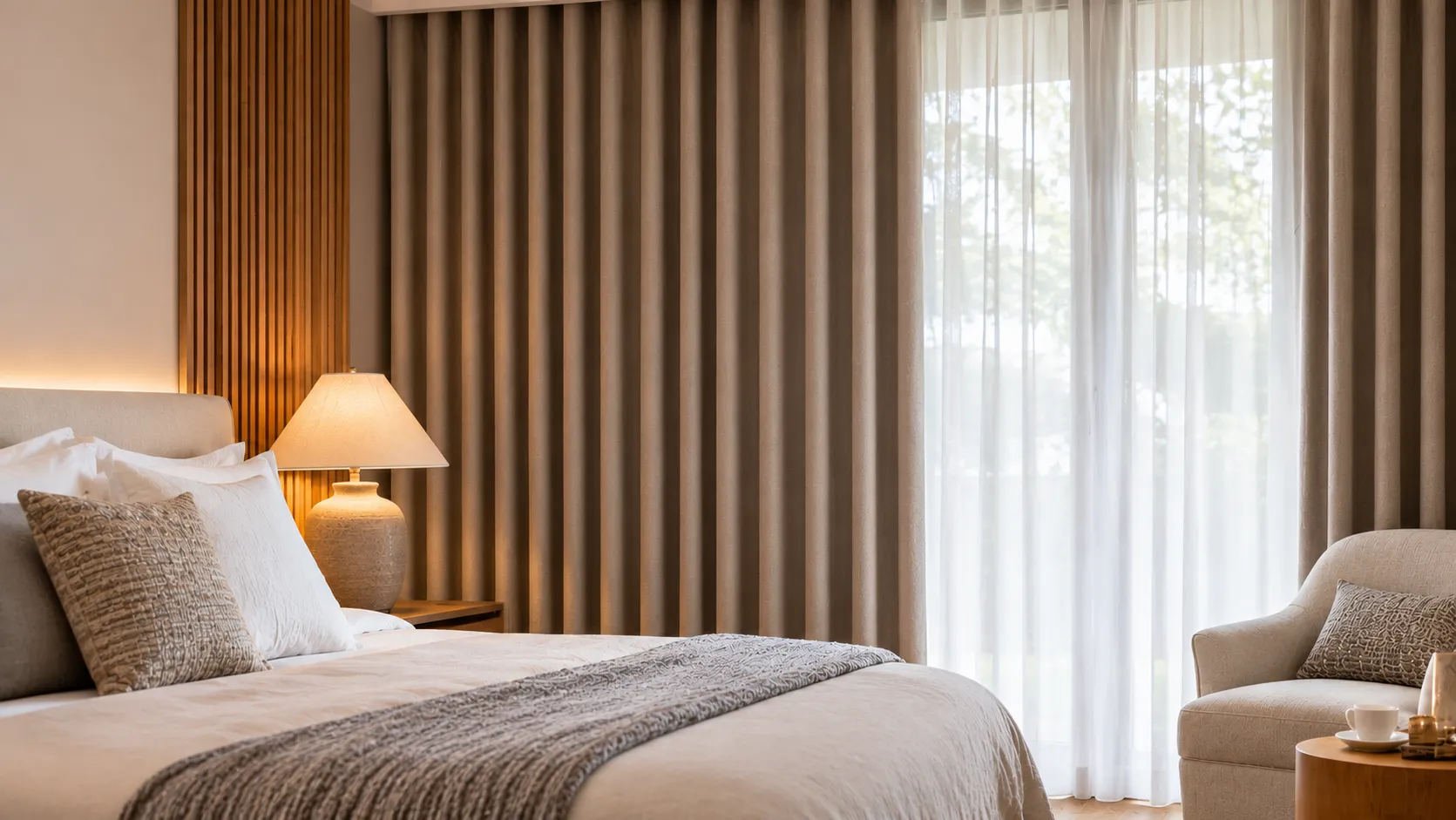
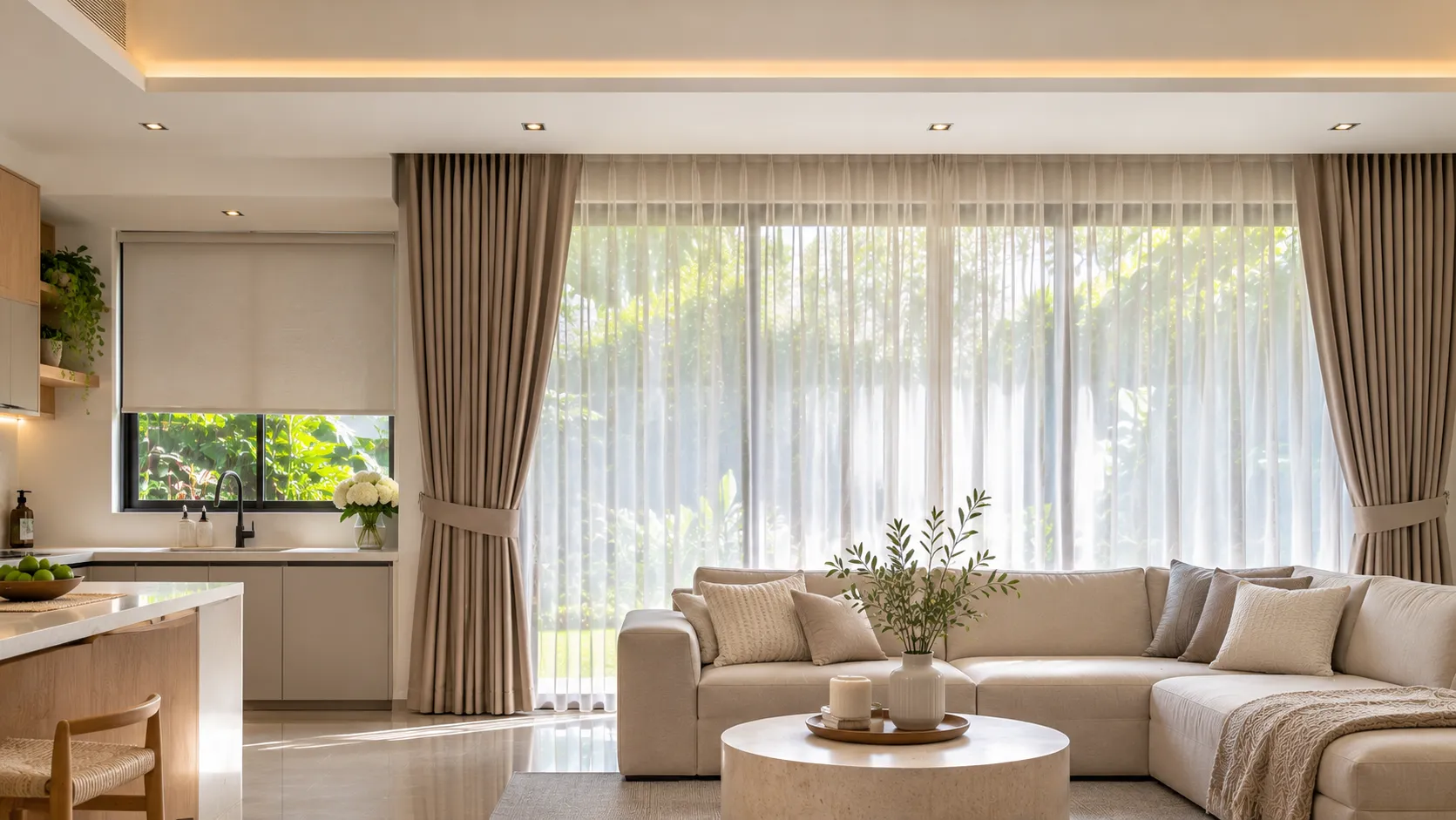
Layering is one of the most adaptable approaches in modern window design. A sheer curtain can soften daylight and create daytime privacy, while a separate blackout or dimout layer provides stronger control when required. In other spaces, a roller blind behind decorative curtains can provide a compact functional layer while preserving the softness of full-height drapery.
Common combinations
- Sheer plus blackout: Suitable for bedrooms and villas where filtered daylight and strong night-time light control are both important.
- Sheer plus dimout: Useful in living spaces where occupants want flexible light reduction without always creating a fully dark room.
- Roller blind plus decorative curtain: Combines a neat functional blind with the texture and visual warmth of curtains.
- Venetian blind plus sheer: Offers adjustable light direction with a softer visual layer.
Layering requires adequate space for brackets, tracks, fabric movement and window access. Measure the full installation area, not only the glass opening. Confirm whether the curtains will stack clear of doors, handles, cabinetry and ventilation openings when fully open.
6. What Modern Properties in Bali Should Consider
Bali’s tropical environment creates specific conditions for window coverings. Strong sunlight can affect fabric colour and interior finishes. Humidity can influence how textiles are stored, ventilated and maintained. Coastal properties may also experience salt-laden air, which makes hardware selection and routine care important.
Sun exposure and orientation
East-facing rooms often receive strong morning sunlight, while west-facing rooms can experience intense afternoon sun. North- and south-facing exposures vary with building layout, shading and season. Assess the actual conditions at each window before choosing opacity, lining and colour.
Humidity and ventilation
Allow curtains to dry properly after cleaning and avoid leaving damp fabric gathered tightly for long periods. In bathrooms, kitchens and other moisture-prone spaces, choose products specifically suited to the exposure and follow the manufacturer’s care guidance. Not every natural fabric or timber product is appropriate for a persistently humid location.
Coastal hardware considerations
For properties close to the sea, ask about the material and finish of tracks, brackets, screws, chains and other components. Corrosion resistance depends on the specific metal grade, coating, installation environment and maintenance. No hardware should be assumed to be completely corrosion-proof in every coastal condition.
Villa and hospitality use
Rental villas and hotels benefit from intuitive operation, durable components and fabrics that can be maintained consistently. Consider how guests will use the controls, how often housekeeping will handle the curtains and whether replacement fabric can be sourced if a panel is damaged. Standardizing selected fabrics and hardware across rooms may also simplify maintenance.
7. How to Choose the Right Window-Covering System
A structured selection process helps property owners, designers and project managers avoid costly changes later. Begin with the function of each room, then compare product options against the window dimensions, interior style and operating requirements.
- Define the main objective. Decide whether the priority is privacy, light filtering, blackout, glare reduction, decorative impact, automation or a combination.
- Assess each window. Record width, height, ceiling condition, opening direction, handles, nearby furniture and access constraints.
- Review sun and moisture exposure. Note the time of day when direct sun reaches the room and whether the window is near a kitchen, bathroom, pool or coastal environment.
- Select the product type. Compare curtains, roller blinds, Roman shades, Venetian blinds and layered combinations.
- Choose fabric and finish. Review texture, colour, opacity, lining, cleaning requirements and available technical information.
- Confirm operation. Decide between manual and motorized controls, then check power, access, grouping and user instructions.
- Arrange professional measurement. Confirm the finished dimensions, track position, stack space and installation details before production.
- Review samples in the property. View fabric samples in the actual room at different times of day, because natural and artificial lighting can change how colours appear.
For a project in Bali, Almeers Living can assist with product selection, on-site measurement and installation planning for curtains and blinds. Explore the curtains and blinds collection or review the curtain measuring guide before finalizing a specification.
8. Care, Maintenance and Long-Term Value
Good maintenance protects the appearance and function of window coverings. The correct routine depends on the fabric, lining, hardware and manufacturer’s instructions. Always check the care label or product guidance before using cleaning chemicals, steam or water.
- Vacuum or dust blinds and curtain surfaces gently using an appropriate attachment.
- Address spills promptly using the recommended cleaning method for the specific textile.
- Allow cleaned curtains to dry fully before closing or gathering them.
- Inspect tracks, brackets, cords and motorized components periodically.
- Keep operating areas clear so curtains and blinds do not catch on furniture or window hardware.
- For motorized systems, follow the manufacturer’s guidance for operation, troubleshooting and servicing.
- In coastal locations, check exposed hardware more frequently for signs of corrosion or finish deterioration.
Long-term value is not measured by the initial purchase price alone. A well-specified system that suits the room, is installed correctly and can be maintained may offer a better ownership experience than a cheaper option that does not meet the property’s daily requirements.
9. Frequently Asked Questions
What is the biggest difference between traditional and modern window coverings?
Modern window coverings are often planned as part of a wider interior and building-comfort strategy. They may combine decorative fabrics, adjustable light control, motorization and improved material choices rather than serving only as basic privacy screens.
Are motorized curtains worth considering for a Bali villa?
They can be useful for large windows, high ceilings, multiple curtain panels and guest-facing spaces where simple operation matters. The decision should consider motor capacity, power access, control preferences, maintenance and the overall project budget.
Which curtains are best for reducing sunlight and heat?
The suitable option depends on the glazing, room orientation and required light level. Blackout or lined curtains can provide strong light blocking, while solar-screen roller fabrics and other blind materials may be selected to manage glare and views. Ask for product-specific performance information and assess the complete window assembly.
Are natural fabrics always the most sustainable choice?
No. Fibre origin is only one part of the assessment. Durability, production methods, certifications, cleaning requirements, transport and expected service life also matter. Request clear product information before making environmental comparisons.
Can curtains and blinds be installed together?
Yes. Common combinations include sheer and blackout curtains, roller blinds with decorative curtains, and Venetian blinds with sheers. The window area must have enough room for both systems to operate without obstruction.
How should window coverings be selected for humid or coastal properties?
Consider ventilation, cleaning requirements, fabric suitability and the corrosion resistance of hardware. Ask suppliers for material details and follow maintenance guidance appropriate to the property’s exposure.
Should window coverings be measured before or after renovation?
Early planning is useful for coordinating tracks, recesses, power and ceiling details. Final production measurements should be confirmed when the relevant construction surfaces and installation conditions are ready.
Conclusion: Window Coverings Designed for the Way We Live Today
The evolution of window coverings is shaped by three connected priorities: smarter operation, more considered material choices and better management of sunlight. Automated controls can make large or complex installations easier to use. Eco-textile innovation gives designers more options to evaluate, provided claims are supported by clear product information. Solar-control strategies help balance daylight, privacy and indoor comfort when selected for the actual glazing and climate.
For modern properties in Bali, the most successful solution is rarely a single product chosen in isolation. It is a coordinated specification that accounts for architecture, orientation, humidity, coastal exposure, daily routines and maintenance. By planning these details early, homeowners, villa operators and designers can create window treatments that look cohesive and perform reliably.
To discuss a custom window-treatment project, explore Almeers Living products or contact the team for guidance on curtains, blinds, fabric selection, measurement and installation in Bali.