Gorden Custom vs. Siap Pakai di Bali: What Changes Beyond the Price?
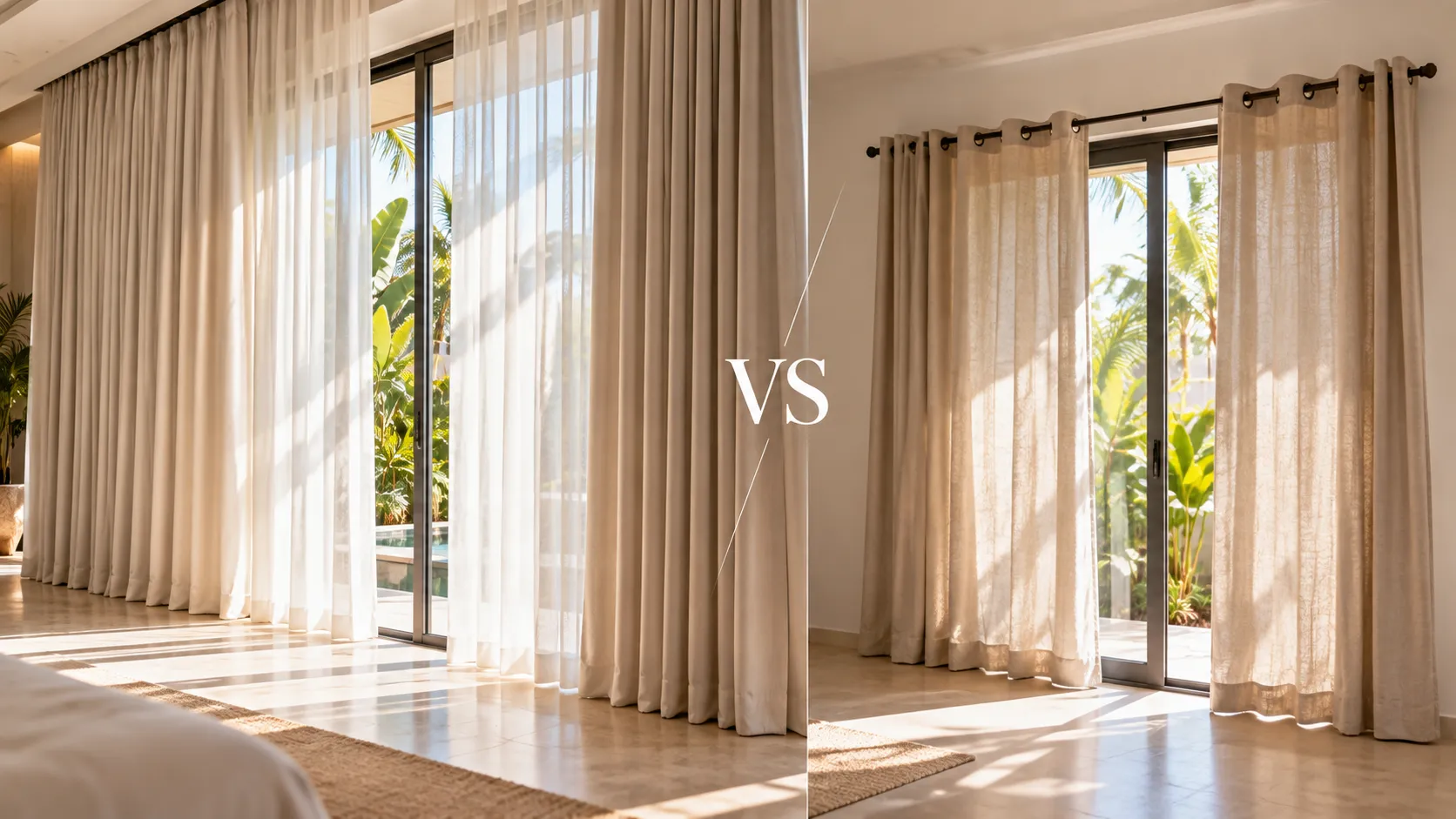
Custom and ready-made curtains solve different purchasing problems. Ready-made curtains can work when standard sizes and simple installation are suitable. Custom curtains become more useful when the window, room proportions, fabric, fullness, hardware and installation need to be specified together.
For Bali villas and homes, the decision should not be based on price alone. Large glazing, high ceilings, sliding doors, uneven openings, layered treatments and strong tropical daylight can make the final fit and installation just as important as the fabric itself.
What Is the Practical Difference?
| Consideration | Ready-made | Custom |
|---|---|---|
| Size | Limited to available standard sizes | Made for the measured opening |
| Fabric selection | Usually limited to the collection | Wider choice of fabric, lining and texture |
| Fullness | Based on the supplied product | Can be specified according to fabric and appearance |
| Hardware | Often separate or standard | Can be coordinated with track, rod and layering |
| Installation | Often simple or self-managed | Can include professional measurement and fitting |
| Unusual windows | More difficult to accommodate | Can be planned around the opening |
Why Window Size Changes the Decision
A standard curtain can look acceptable on a small conventional window but become less convincing on a full-height opening. Wide glazing may require additional fabric fullness, larger track capacity, a planned stack-back and a finished drop checked against the actual floor condition.
For sliding doors, the curtain also has to clear handles and moving panels. In these situations, custom measurement is less about making the fabric look expensive and more about making the whole system work correctly.
Custom Does Not Automatically Mean Better for Every Window
A practical specification starts with the opening. If a small window accepts a standard size without awkward gaps, a ready-made curtain may be sufficient. Custom fabrication becomes more relevant when the desired finished height, width, fabric behaviour or hardware arrangement cannot be achieved with standard dimensions.
Fabric and Fullness Matter
Two curtains with the same finished width can use different amounts of fabric depending on fullness and heading style. Lightweight sheers, linen-look fabrics and heavier blackout materials also behave differently when gathered.
For a refined result, specify the fabric and heading together rather than choosing a curtain size first and trying to make the fabric adapt later.
Think About the Hardware Too
Custom curtains are often part of a larger window-treatment system. A ceiling track, wall track, double track or decorative rod changes how the curtain opens, stacks and sits relative to the architecture.
For layered installations, the available projection is particularly important. A sheer layer and blackout layer need enough separation to operate without rubbing or obstructing each other.
Room-by-Room Starting Point
| Space | Useful starting point | What to check |
|---|---|---|
| Bedroom | Custom blackout or layered curtain | Night privacy, darkness and side coverage |
| Living room | Linen, sheer or layered system | Daylight, view and proportions |
| Large sliding door | Custom full-height system | Stack-back and door movement |
| High ceiling | Custom track and finished drop | Access, weight and operation |
| Rental villa | Durable, easy-to-operate specification | Cleaning and repeated use |
Common Mistakes
- Comparing only the price per curtain panel.
- Measuring the glass but ignoring the intended hardware position.
- Ignoring stack-back on wide windows and sliding doors.
- Choosing fabric before checking the required light and privacy level.
- Assuming a standard drop will work for a floor-to-ceiling installation.
- Forgetting that layered curtains require additional hardware space.
When a Site Survey Adds Value
A site survey is particularly useful when there are multiple rooms, large glazing, unusual window shapes, high ceilings, layered treatments or motorized systems. The objective is to verify the opening, mounting surface, hardware position, finished dimensions and operating requirements before production.
For a broader explanation of custom window treatments, see our custom curtains guide and our window treatment buying guide.
Final Checklist
- Measure the complete intended treatment area.
- Confirm fabric, lining and fullness.
- Choose the heading and hardware together.
- Check stack-back and clearance.
- Confirm finished height and floor clearance.
- Consider the room's light and privacy requirements.
- Verify installation conditions before production.
Planning Curtains in Bali?
Almeers Living provides custom window-treatment consultation, measurement, fabrication and professional installation for villas, residences and hospitality properties in Bali. A site survey can help determine the appropriate specification before production.