
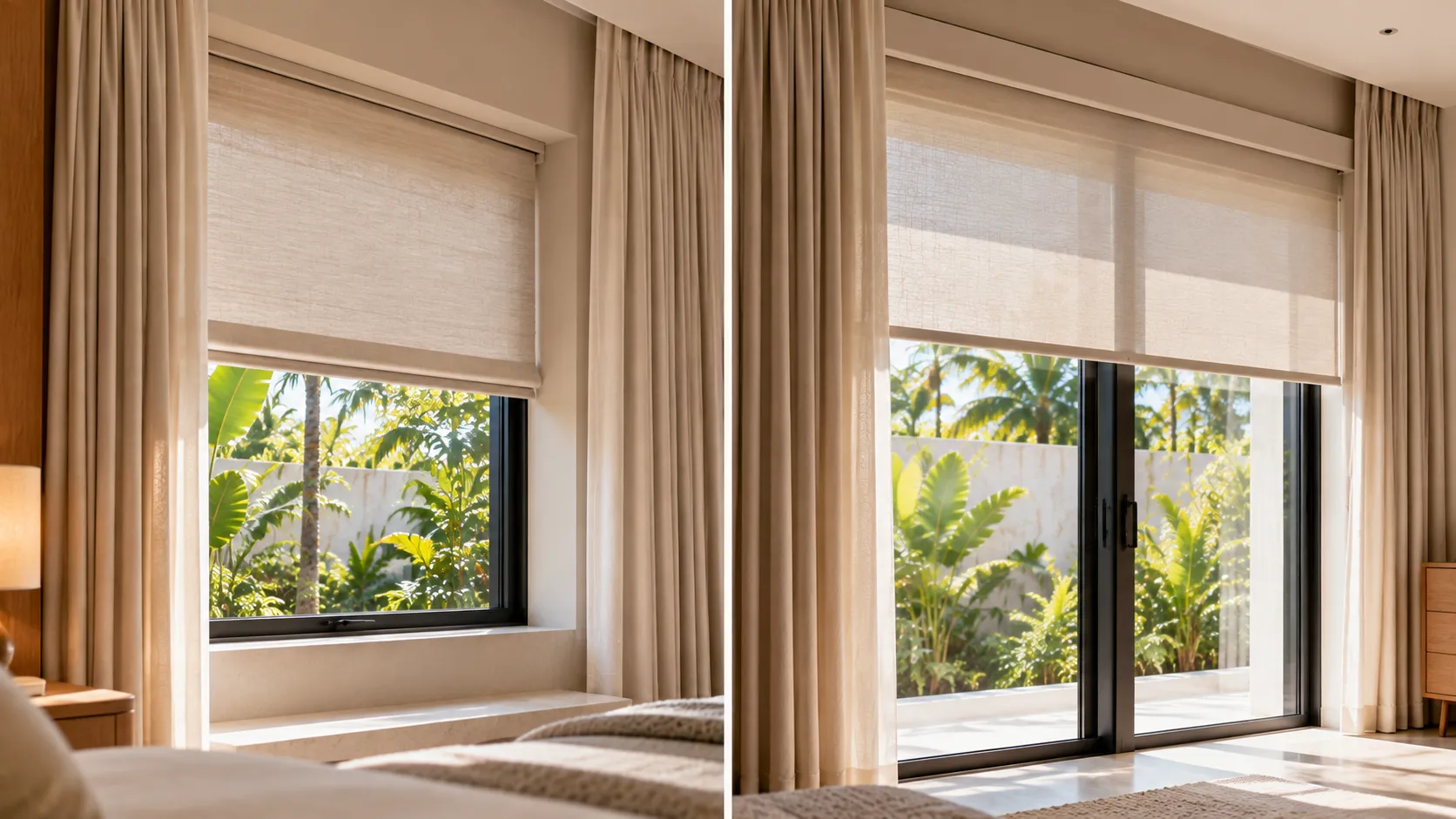
Inside vs Outside Mount Blinds: How to Coordinate Them With Curtains, Handles and Light Gaps
The right blind mounting method is not only a question of whether the blind fits inside the recess. For a finished window treatment, the blind also needs to work with curtain tracks, rods, handles, doors, wall space and light-control requirements.
Inside mount can create a clean integrated appearance when the recess is suitable. Outside mount can provide broader coverage when light gaps, shallow recesses or surrounding obstructions make an internal installation less practical. The best specification is the one that works as a complete window system.
Inside Mount vs Outside Mount: The Practical Difference
| Consideration | Inside mount | Outside mount |
|---|---|---|
| Visual effect | More integrated into the opening | More visible and architectural |
| Recess depth | Requires suitable depth for the system | Less dependent on recess depth |
| Light gaps | Edge gaps can remain around the recess | Can cover beyond the recess |
| Handles / obstructions | May restrict mechanism or fabric | Often easier to clear |
| Coordination with curtains | Usually compact | Needs careful projection planning |
Start With the Window Recess
Measure the recess at several points rather than assuming it is perfectly square. Check width, height, depth, frame projections, handles and any changes in the wall or ceiling. A small irregularity can affect whether the blind mechanism sits correctly.
Check Handles, Sliding Panels and Doors
A blind can look correct on paper but become difficult to operate if the handle projects into its path. Sliding doors need extra attention because the blind, curtain and door movement all share the same space. Confirm clearances before choosing the mounting position.
When Curtains Are Layered With Blinds
Layering is where mounting decisions become especially important. An outside-mounted blind projects farther into the room, while a curtain track or rod may also occupy the same zone. The two systems should be measured together so that the curtain can open, close and stack without hitting the blind.
For floor-to-ceiling curtains, confirm the curtain hardware line first and then establish the blind projection. This is particularly useful for large villa glazing where a small spacing mistake can become visually obvious.
Light Gaps Matter More Than the Label
Calling a fabric “blackout” does not mean every installation will produce identical darkness. Mounting geometry, side gaps, top gaps and the surrounding opening all influence the result. Outside mounting can increase coverage, but the exact improvement depends on the system and how it is installed.
Decision Guide
- Check the recess depth and condition.
- Record handles, locks and other projections.
- Decide whether maximum coverage or an integrated appearance is the priority.
- Check the position of curtains, rods or tracks.
- Confirm stack-back and opening direction.
- Choose the mounting method only after the whole window system has been considered.
Common Mistakes
- Measuring only the glass.
- Ignoring handle projection.
- Choosing outside mount without checking wall space.
- Installing blind and curtain hardware at conflicting depths.
- Assuming the same mount works for every room.
Bali Villa Considerations
Large glazed openings, sliding doors and layered treatments are common in Bali properties. Sun exposure, privacy, indoor-outdoor views and ceiling conditions can all influence the final mounting decision. A site measurement is often more reliable than estimating from photographs.
Before Fabrication
- Final blind dimensions confirmed
- Mounting position confirmed
- Recess and wall fixing condition checked
- Handle and door clearance checked
- Curtain hardware position coordinated
- Light-control expectations confirmed
- Installation access confirmed
For custom projects, Almeers Living can assess the opening, coordinate blinds with curtains and confirm the practical installation condition before production.