
Panduan Budget Gorden untuk Hotel & Vila: How to Estimate Your Window Treatment Cost
One of the most confusing parts of a curtain project is comparing quotations. Two suppliers can quote for the same window and produce very different totals—not necessarily because one is expensive and the other is cheap, but because the specifications may be different.
The short answer: build the budget from the complete window-treatment system. Separate fabric, fabric consumption, making, heading, lining, track or rod, motorization where required, installation and project-specific conditions.
Why the Same Window Can Have Different Curtain Costs
Final cost can change because of fabric width, fullness, fabric weight, lining, heading style, hardware, operating method, installation difficulty, ceiling height and site access.
This is why comparing only a price per metre can give the wrong impression.
Step 1: Calculate the Opening
Start with the finished width and height of each opening. For example:
3 m width × 2.8 m height = 8.4 m² opening area.
This is useful for project planning, but it is not automatically the amount of fabric required.
Step 2: Understand Fabric Consumption
Finished curtain width and fabric quantity are different measurements. Fullness, fabric width, seams, pattern repeat, hems and production requirements can all affect consumption.
For example, a fabric supplied in a narrower width may require more joins than a wider fabric. A fuller curtain may also require more fabric than a simpler treatment.
Step 3: Split the Budget Into Components
| Component | What It Covers |
|---|---|
| Fabric | Selected curtain material and required quantity. |
| Making | Cutting, sewing and finishing. |
| Heading | Chosen heading/tape or construction method. |
| Lining | Additional performance or finishing layer where required. |
| Track / Rod | Hardware needed to support and operate the curtain. |
| Motorization | Motorized operation where the project requires it. |
| Installation | Site installation and project-specific requirements. |
Step 4: Let the Room Function Drive the Budget
Not every window deserves the same specification. Bedrooms may justify stronger light-control performance. A large living-room glass opening may justify upgraded hardware or motorization. Decorative areas may prioritize appearance and drape.
This approach helps prevent overspending on low-priority windows while protecting the rooms where performance matters most.
A Practical Budget Worksheet
For every opening, record:
- Width.
- Height.
- Quantity.
- Curtain type.
- Fabric.
- Fullness.
- Lining.
- Hardware.
- Operating method.
- Installation complexity.
Then calculate the subtotal for each opening before comparing suppliers. This gives the project owner a clearer view of where the money is actually going.
Why the Cheapest Quotation May Not Be the Cheapest Solution
A low fabric price can be offset by higher consumption, unsuitable hardware, difficult operation, poor installation conditions or earlier replacement.
For a hotel or rental villa, the cost of inconvenience can also matter. A curtain that guests cannot operate easily, or one that requires frequent repair, may create a bigger long-term problem than a slightly higher initial specification.
How to Control a Project Budget
- Standardize suitable fabric families where practical.
- Prioritize higher-performance specifications for bedrooms and major openings.
- Use simpler manual solutions where automation adds little value.
- Confirm dimensions before production.
- Compare complete specifications rather than single line-item prices.
- Coordinate hardware and installation requirements early.
Example: Budgeting a Villa by Function
Imagine a villa with several bedrooms, a large living-room glass opening and smaller service windows. Giving every opening the same specification may not be the most efficient approach.
A more practical allocation could be stronger light control for bedrooms, upgraded hardware or motorization for the large opening if justified, and simpler treatments for low-priority windows.
The point is not to make one room “cheap.” It is to make the overall budget reflect how each window will actually be used.
What a Professional Quotation Should Make Clear
A useful quotation should allow the owner or project team to understand the scope. At minimum, clarify the relevant product or fabric specification, quantity/opening, hardware, operating method, installation and any special project conditions.
Clear scope makes supplier comparison much more meaningful than comparing a single “gorden per metre” number.
When a Site Survey Becomes Valuable
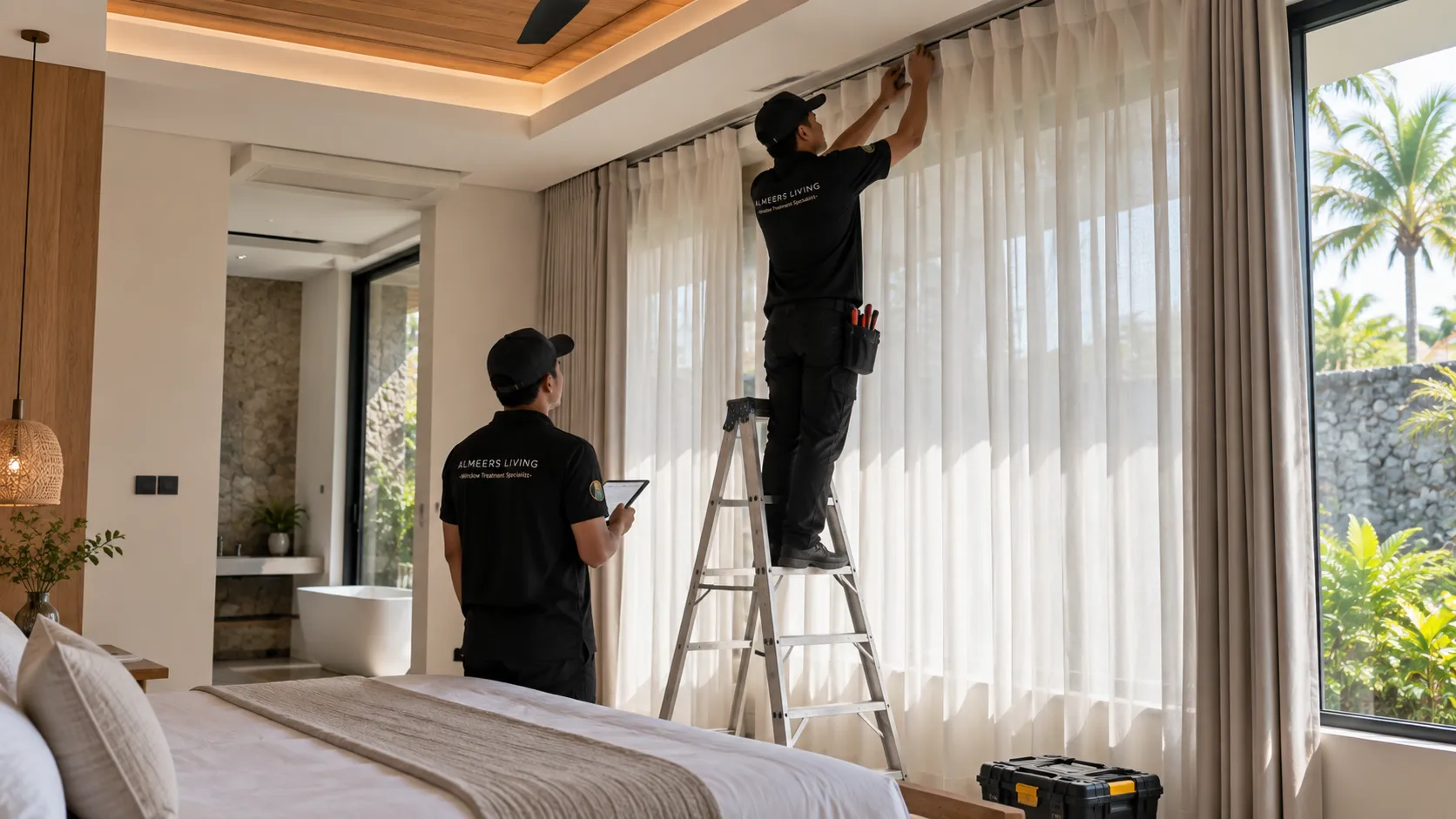
A site survey can identify actual dimensions, mounting conditions, ceiling details, access constraints and installation requirements before the final quotation or production.
This is especially useful for villas and hotels with large windows, high ceilings, multiple curtain layers, concealed tracks or motorized systems.
Final Takeaway
A good window-treatment budget is a specification exercise first and a price exercise second. The clearer the requirements, the easier it becomes to compare quotations, control the project budget and avoid expensive surprises.
If you are planning curtains or blinds for a villa or hotel in Bali, Almeers Living can help assess the actual window conditions and build the specification around the property's needs rather than using a one-size-fits-all approach.