Roller Blinds vs. Curtains: Which is Best?: What to Know Before You Choose
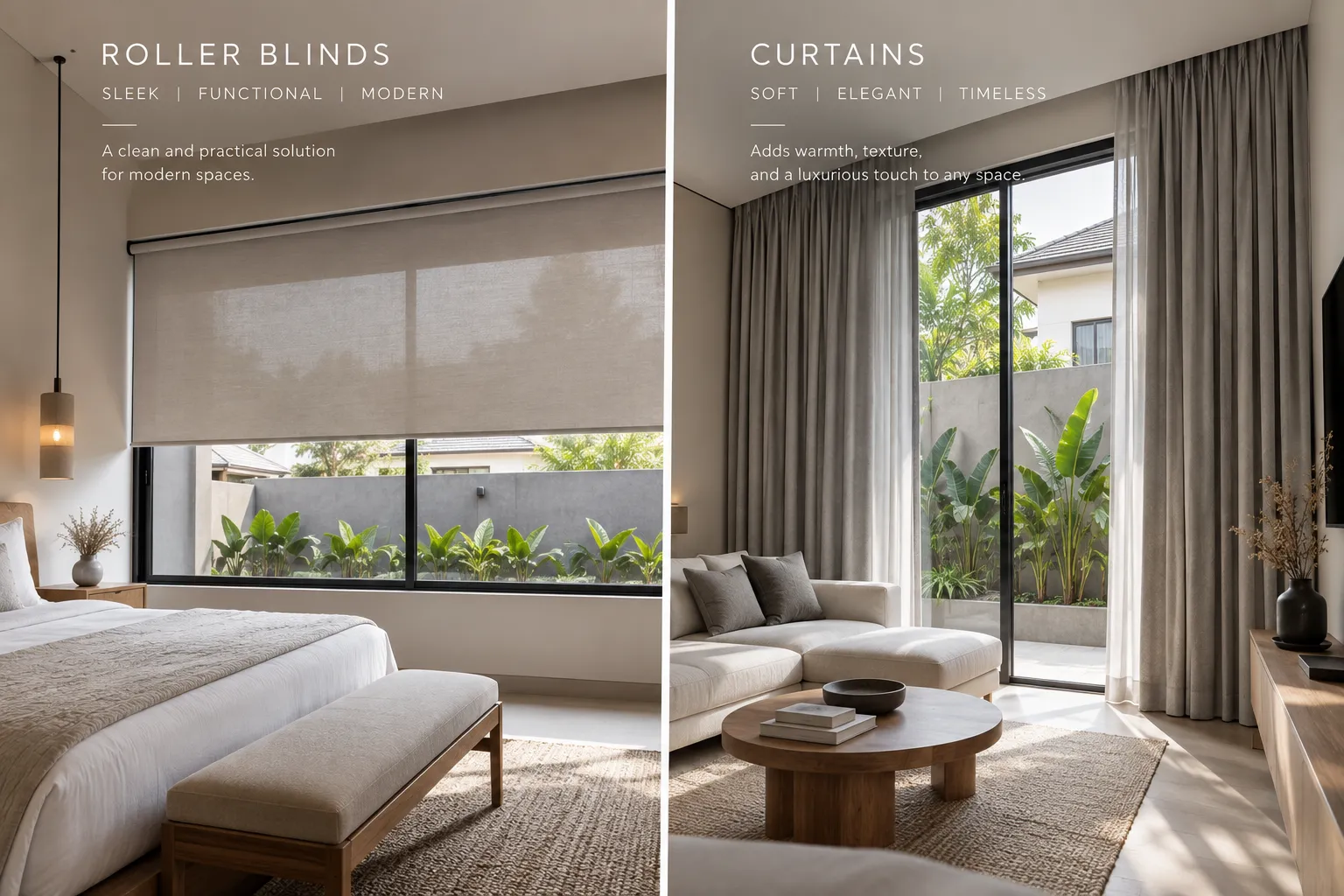
Short answer: Roller blinds are usually stronger when you want a clean profile, precise daylight control, and a compact treatment. Curtains are usually stronger when you want softness, visual height, flexible coverage, and decorative impact. For many Bali villas, combining both can provide the most adaptable result.
Roller Blinds vs. Curtains at a Glance
| Need | Roller Blinds | Curtains |
|---|---|---|
| Minimal appearance | Excellent | Depends on fabric and fullness |
| Large sliding doors | Good with suitable systems | Excellent |
| Soft interior texture | Limited | Excellent |
| Precise solar control | Excellent with suitable fabric | Good |
| Blackout | Available with suitable fabrics | Excellent with blackout fabric |
| Layering | Pairs well with curtains | Can layer with blinds |
1. Choose Roller Blinds When
- You prefer a streamlined, modern appearance.
- The window is small or medium-sized.
- You need controlled daylight without fabric extending far into the room.
- You want a practical solution for offices, kitchens, or compact rooms.
- You want solar-control fabric while retaining some outward visibility.
2. Choose Curtains When
- The opening is wide or floor-to-ceiling.
- You want softness and resort-style character.
- You need a strong decorative element.
- You need a large blackout surface for bedrooms.
- You want to frame a view and visually increase ceiling height.
3. Why Layering Can Be More Flexible
A roller blind can manage sunlight during the day while curtains add softness, privacy, and stronger evening darkness. This is particularly useful when one opening needs different performance at different times of day.
4. Think About the Window, Not Just the Product
Large sliding doors, corner windows, and unusually tall openings need different planning from standard windows. Hardware span, panel weight, stacking space, door operation, and access can determine whether a roller, curtain, or combination is practical.
5. Heat and Glare: What Actually Matters
Both systems can contribute to solar control, but performance depends on fabric, opacity, colour, orientation, and coverage. Selecting a treatment only because it looks attractive may not solve a strong afternoon-sun problem.
6. Room-by-Room Starting Point
| Room | Common Starting Point | Main Priority |
|---|---|---|
| Master bedroom | Blackout curtain or layered system | Darkness and privacy |
| Living room | Roller, sheer, or layered system | Daylight and glare |
| Home office | Roller blind | Compact profile and screen comfort |
| Large villa opening | Full-height curtain or layered system | Scale and flexible coverage |
7. Common Mistakes to Avoid
- Choosing the treatment before checking finished dimensions.
- Ignoring sunlight direction and timing.
- Expecting sheer fabric to provide full night privacy.
- Leaving large side gaps around blackout treatments.
- Forgetting where curtains stack when doors are open.
Practical Takeaway
There is no universal product that suits every opening. The right specification depends on dimensions, sunlight, privacy, room function, architecture, and available installation space.
Almeers Living can assess the opening, recommend a suitable window-treatment combination, and handle custom measurement and professional installation across Bali.