Sheer + Blackout Curtains: Which Pleat and Fullness Should You Choose?
When a client chooses sheer + blackout curtains, the conversation often starts with fabric and colour. But two less visible decisions can change the finished result just as much: pleat style and fullness.
These choices influence the curtain’s rhythm, stack-back, fabric consumption, track requirements and how the sheer and blackout layers look together.
There is no single “best” pleat or fullness ratio. The correct combination depends on the fabric, window size, track system, room style and desired operation.
Why Pleat and Fullness Should Be Chosen Together
Pleat style determines how the fabric is organised at the top of the curtain. Fullness determines how much fabric is used relative to the finished track width.
Changing one without considering the other can produce an unbalanced result.
What Is Curtain Fullness?
Fullness describes the amount of fabric used to create folds across a finished curtain width.
For example, a 300 cm finished curtain track may require more than 300 cm of fabric because the fabric must form folds.
The exact amount depends on the heading system, fabric, desired appearance and manufacturer’s construction method.
Common Pleat Styles
| Pleat / Heading | Visual Character | Typical Consideration |
|---|---|---|
| Ripple Fold | Continuous, regular waves | Works well with compatible track systems and clean contemporary interiors |
| Pinch Pleat | Structured, tailored folds | More formal and decorative appearance |
| Double / Two-Pleat | Moderately structured | Can work well where a balanced tailored look is desired |
| Triple Pleat | Deeper, more decorative folds | Uses more fabric and creates a fuller visual effect |
| Eyelet / Grommet | Casual and contemporary | Requires suitable rod and is less typical for some hotel-style systems |
What Works Well for Sheer Curtains?
Sheer fabric is usually lighter and more visually delicate than blackout fabric.
A fuller sheer can create a soft, continuous appearance and help avoid a sparse or flat look when the curtain is closed.
However, very high fullness also increases fabric consumption and stack volume.
What Works Well for Blackout Curtains?
Blackout fabric can be heavier and more structured. The fullness therefore needs to be considered with the track, carrier system and motor load where applicable.
A blackout curtain does not necessarily need the same fullness as the sheer layer.
The final decision should consider the actual fabric and desired appearance rather than applying a fixed ratio automatically.
Should Sheer and Blackout Use the Same Fullness?
Not necessarily.
In layered installations, the two fabrics can have different visual densities and different construction characteristics.
The important issue is visual balance.
If the sheer is extremely full while the blackout is much flatter, the two layers can appear mismatched when stacked or viewed together. Conversely, making both layers identical can waste fabric or create unnecessary bulk depending on the system.
What About Two-Pleat vs Two-and-a-Half Pleat?
Clients sometimes ask whether a half-pleat difference will produce a better result.
The answer depends on the fabric and heading construction.
A small change in fullness can affect the fold depth, spacing and visual density. It should therefore be judged from the actual fabric sample and the proposed track width rather than treated as a universal upgrade.
Ripple Fold for Layered Curtains
Ripple fold can be attractive when a clean, continuous wave is desired.
It also creates a predictable rhythm across a large opening, which can work particularly well in modern villas and hospitality interiors.
However, ripple fold requires a compatible track and carrier spacing. The track system should therefore be selected before the fabric quantity is finalised.
Pinch Pleat for a More Tailored Look
Pinch pleats can create a more traditional or tailored appearance.
They can work well when the interior uses more formal furniture, classical details or a refined luxury aesthetic.
For tropical villas, the decision should be based on the overall architecture. A structured pleat can be beautiful, but it may feel too formal in an extremely relaxed interior.
How Fullness Changes Fabric Consumption
More fullness generally means more fabric.
That affects:
- Material cost
- Production time
- Panel weight
- Stack-back volume
- Motor load
- Track capacity
This is particularly important for large villa windows where a small percentage change can become a significant amount of fabric.
How Fullness Changes Stack-Back
When curtains are opened, the fabric gathers at the sides. A fuller curtain usually requires more space to stack.
This matters when a client wants the curtains to open completely away from a large glass view.
Before finalising fullness, check the available wall space on each side of the window.
How to Choose for a Bedroom
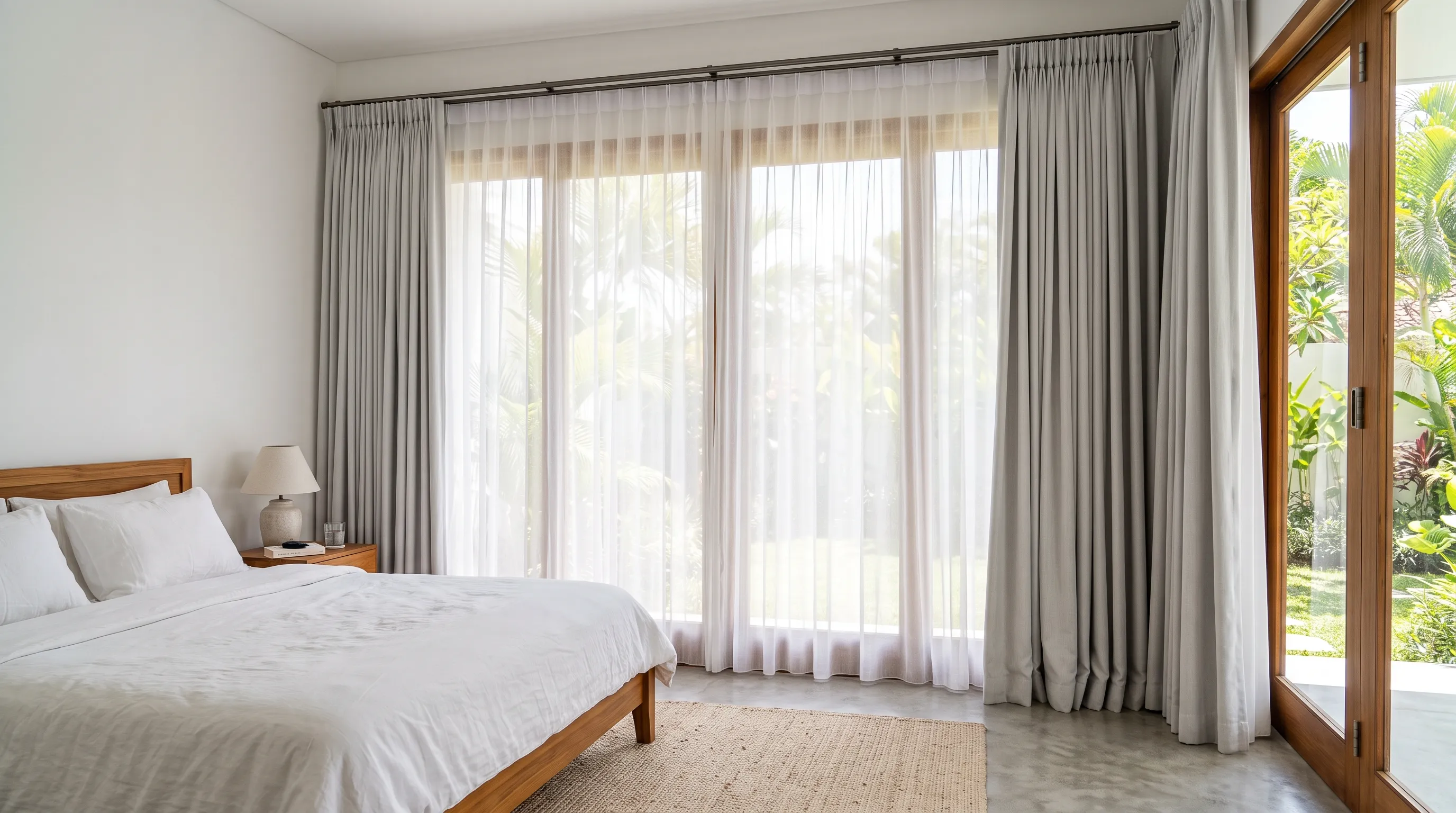
A bedroom often benefits from a layered system:
- Sheer layer for daytime atmosphere and privacy.
- Blackout layer for stronger darkness and privacy.
For a calm contemporary bedroom, a simple ripple or tailored pleat can work well. The exact fullness should be matched to the fabrics.
How to Choose for a Large Villa Living Room
Large living-room openings require more attention to proportion.
Consider:
- Ceiling height
- Window width
- Stacking space
- Track length
- Fabric weight
- Outdoor view
- Furniture position
Very full curtains can look luxurious, but only if the architecture has enough space to support them.
Common Mistakes
- Choosing the pleat before selecting the track.
- Using the same fullness for every fabric.
- Ignoring stack-back space.
- Using very full blackout fabric on an underspecified track.
- Assuming a higher fullness ratio is always more luxurious.
- Making sheer and blackout layers visually unbalanced.
- Calculating fabric from window width alone.
A Practical Decision Framework
- Select the room function.
- Choose the sheer and blackout fabrics.
- Check fabric width and weight.
- Decide the track system.
- Choose the desired pleat style.
- Evaluate an appropriate fullness range.
- Check stacking space.
- Confirm finished width and drop.
- Review the two layers together.
- Only then finalise fabric consumption.
Why Professional Measurement Matters
Large layered curtains are not simply a larger version of a small curtain.
The track, fabric weight, fullness, panel configuration and installation all interact. A professional measurement can identify constraints before fabric is cut.
Final Takeaway
The best pleat is the one that works with the fabric, track, fullness and architecture as a complete system.
For sheer + blackout curtains, visual balance is usually more important than forcing both layers into exactly the same construction.
Planning Sheer + Blackout Curtains in Bali?
Almeers Living provides custom layered curtain solutions for Bali villas, residences and hospitality properties.
We can help you compare fabric, pleat, fullness, track and installation options according to the actual opening.
Our layered window treatment guide provides additional background on combining window-treatment layers.
Request a free site survey before finalising the specification.