The Best Curtains for a Tropical Climate: What Works Best in Bali — Breathable Linen Materials, UV Solar Heat Barriers, and Coastal Salt Air Durability
Choosing the best curtains for a tropical climate is not simply a matter of selecting a light fabric or a colour that suits the interior. In Bali, window treatments need to respond to bright sunlight, warm temperatures, humidity, seasonal rainfall and, in coastal locations, salt carried in the air. The right solution balances appearance, daylight, privacy, heat management, ease of care and the durability of the complete curtain system.
For villas, hotels, apartments and private residences across Bali, there is no single curtain fabric that is ideal for every room. A breathable linen-look sheer may work beautifully in a living area, while a bedroom exposed to strong afternoon sun may need a lined curtain or a layered system. A coastal property may also need closer attention to track materials, brackets, screws and other metal fittings.
This guide explains how to choose curtains for tropical conditions, including breathable linen materials, UV and solar heat control, blackout and sheer combinations, and hardware considerations for properties exposed to coastal salt air.
What Makes Bali’s Tropical Climate Different for Curtains?
Bali has a warm tropical climate, with high humidity and seasonal rainfall. Sun exposure varies according to building orientation, surrounding landscape, window size, shading and local site conditions. A property near the coast may also experience salt-laden air, especially where windows and doors are frequently left open.
These conditions affect different parts of a window-treatment system in different ways:
- Fabric: Dust, moisture, sunlight and repeated handling influence appearance and cleaning needs.
- Colour: Strong direct sunlight can contribute to fading over time, depending on fibre, dye, fabric construction and exposure.
- Room comfort: Large areas of unshaded glass can allow substantial solar heat into a room. Curtains can help manage light and solar gain, but performance depends on fabric construction, colour, lining, coverage and how the window is used.
- Hardware: Moisture and salt exposure can increase corrosion risk for unsuitable or poorly maintained metal components.
- Maintenance: Ventilation, cleaning access and regular inspection help keep curtains and tracks in good condition.
Before choosing a fabric, assess each room individually. Consider window direction, direct sunlight, proximity to the sea, ventilation, air-conditioning use, privacy needs and how often the curtains will be opened and closed.
1. Breathable Linen and Linen-Look Curtains
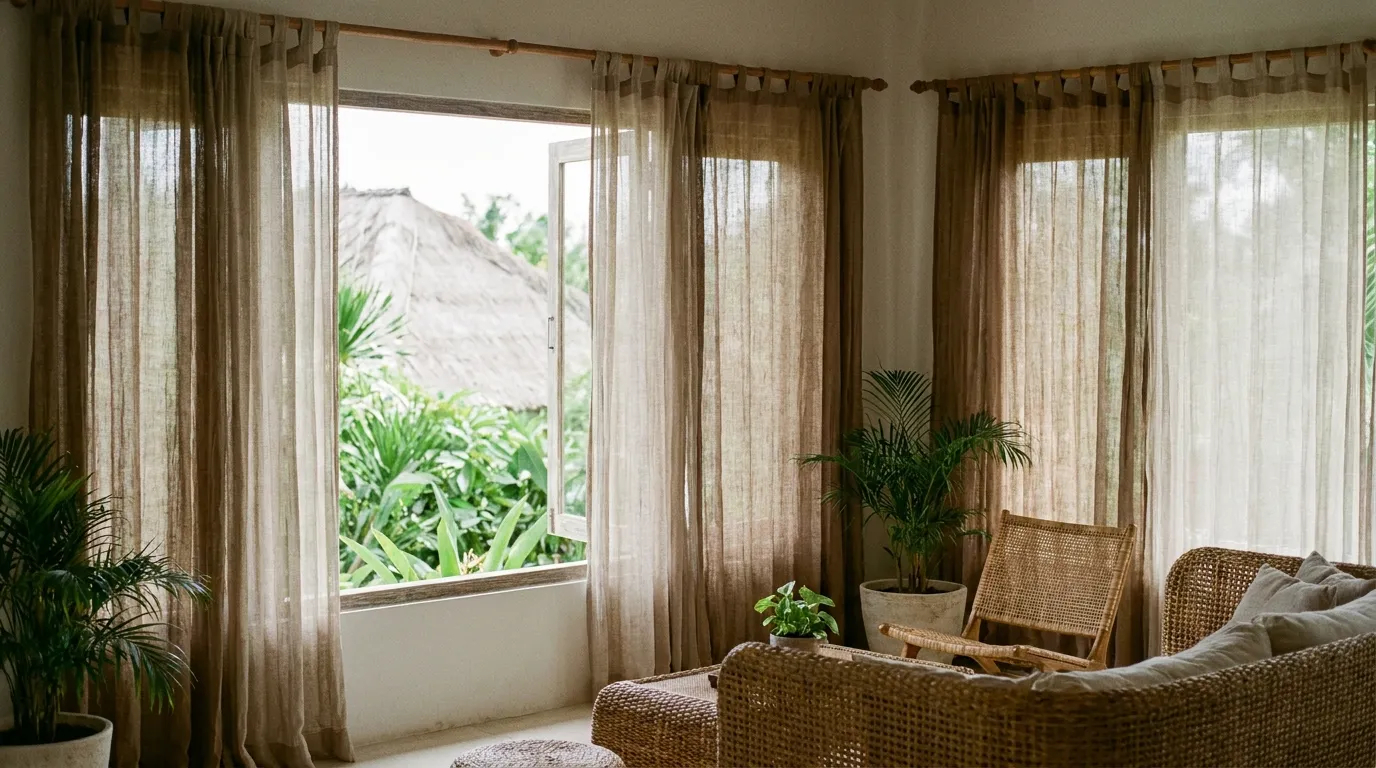
Linen is popular in tropical interiors because of its natural texture, relaxed drape and light, airy appearance. Its woven construction can create a breathable, understated look that works well in villas and homes where daylight and a connection to the outdoors are important.
However, the word “linen” covers a range of fabric constructions and blends. Pure linen, linen blends and synthetic linen-look fabrics can behave differently. Performance depends on fibre content, weave density, weight, finishing and care instructions.
When linen-style curtains work well
- Living rooms where filtered daylight is preferred over complete darkness.
- Bedrooms where a natural look is desired and a separate lining or second curtain layer can provide additional light control.
- Villas with natural materials such as timber, stone, rattan and textured plaster.
- Interiors where a relaxed, elegant finish is more appropriate than a heavy formal drape.
What to consider before choosing linen
- Light transmission: Many linen and linen-look fabrics are not blackout materials. Check the actual sample against daylight.
- Wrinkling and texture: Natural linen can crease, which may be part of its character. Confirm whether that appearance suits the project.
- Care: Ask for the recommended cleaning method. Do not assume every linen blend can be machine-washed or steamed in the same way.
- Sun exposure: Consider lining or a separate solar-control layer for windows that receive strong direct sun.
- Moisture management: Breathability does not make a fabric mould-proof. Good ventilation and moisture control remain important.
For a natural Bali-inspired interior, linen or linen-look curtains can be paired with a suitable lining where more privacy or light control is required. Review the fabric composition and care label rather than relying on appearance or product name alone.
2. Sheer Curtains for Soft Daylight and Privacy
Sheer curtains are lightweight window coverings designed to soften incoming daylight while maintaining a visual connection with the outdoors. They are often used in living rooms, dining areas and bedrooms where a bright, open atmosphere is preferred.
In Bali, sheers can work particularly well in spaces with garden, pool or ocean views. They diffuse daylight and can provide a degree of daytime privacy, depending on the brightness inside and outside the room. They do not provide complete privacy at night when interior lights are on.
- Diffuse daylight and soften the appearance of bright windows.
- Preserve an airy interior atmosphere.
- Work well as the front layer of a double-curtain arrangement.
- Offer a soft visual finish without making a room feel heavy.
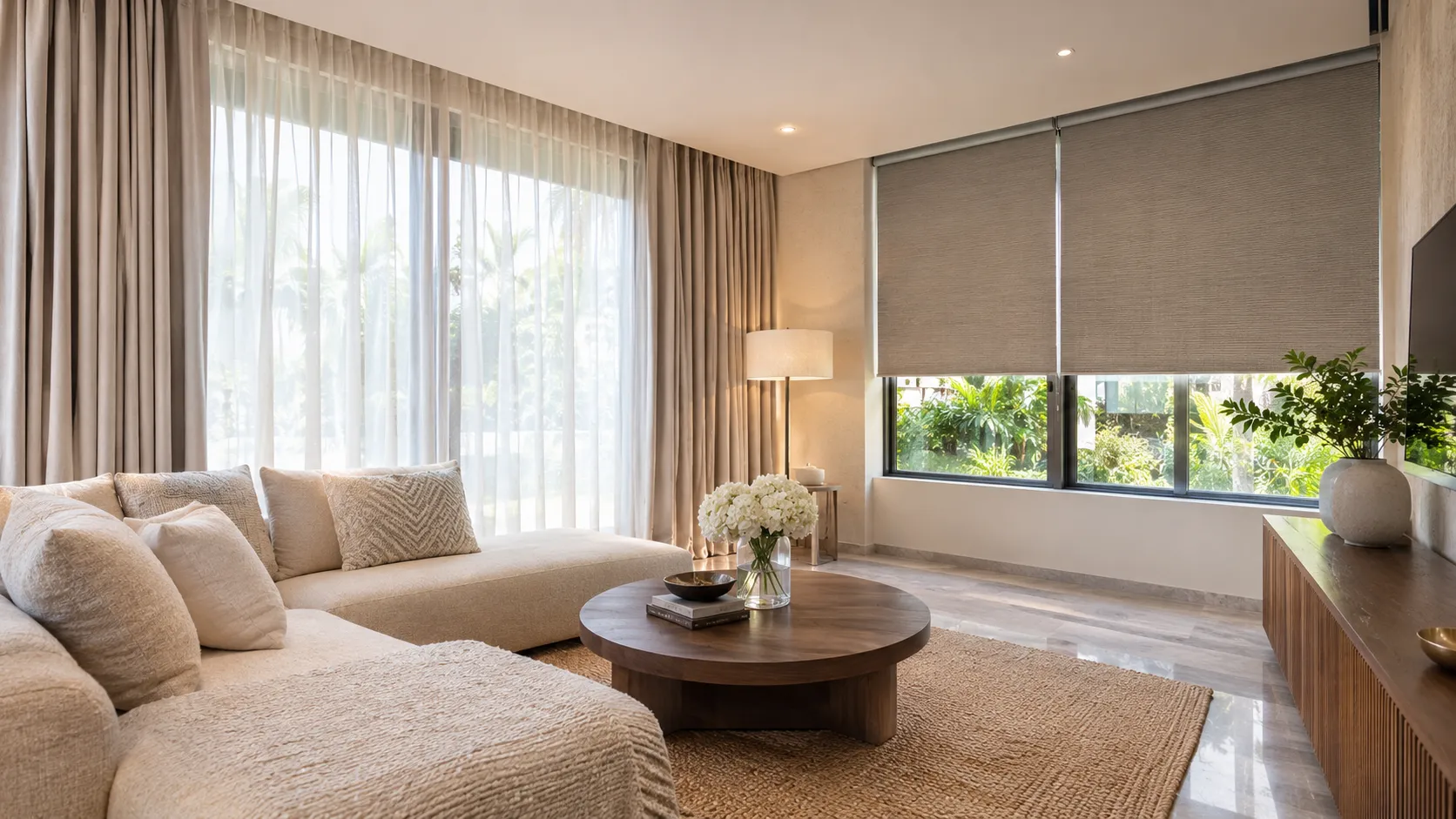
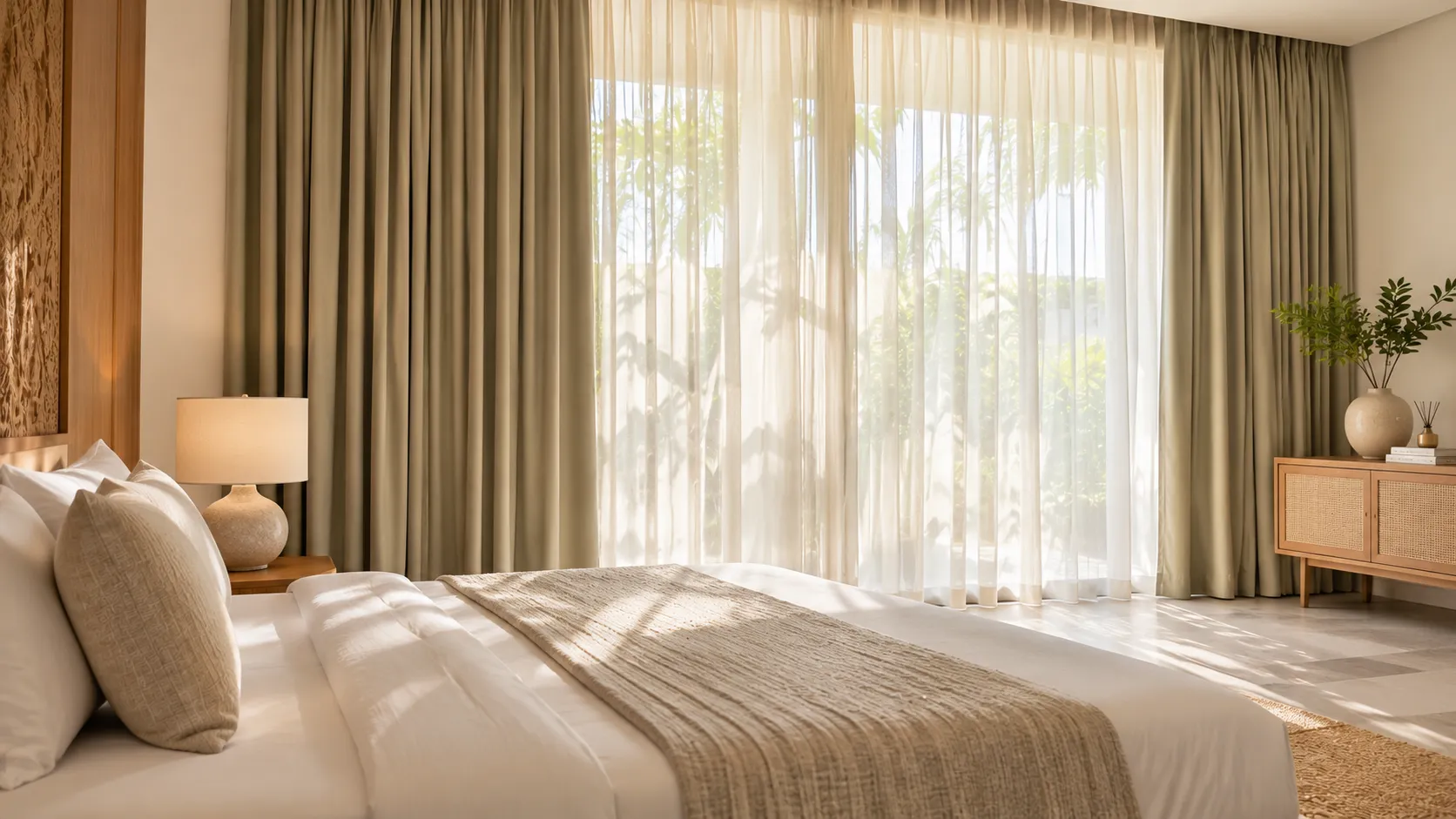
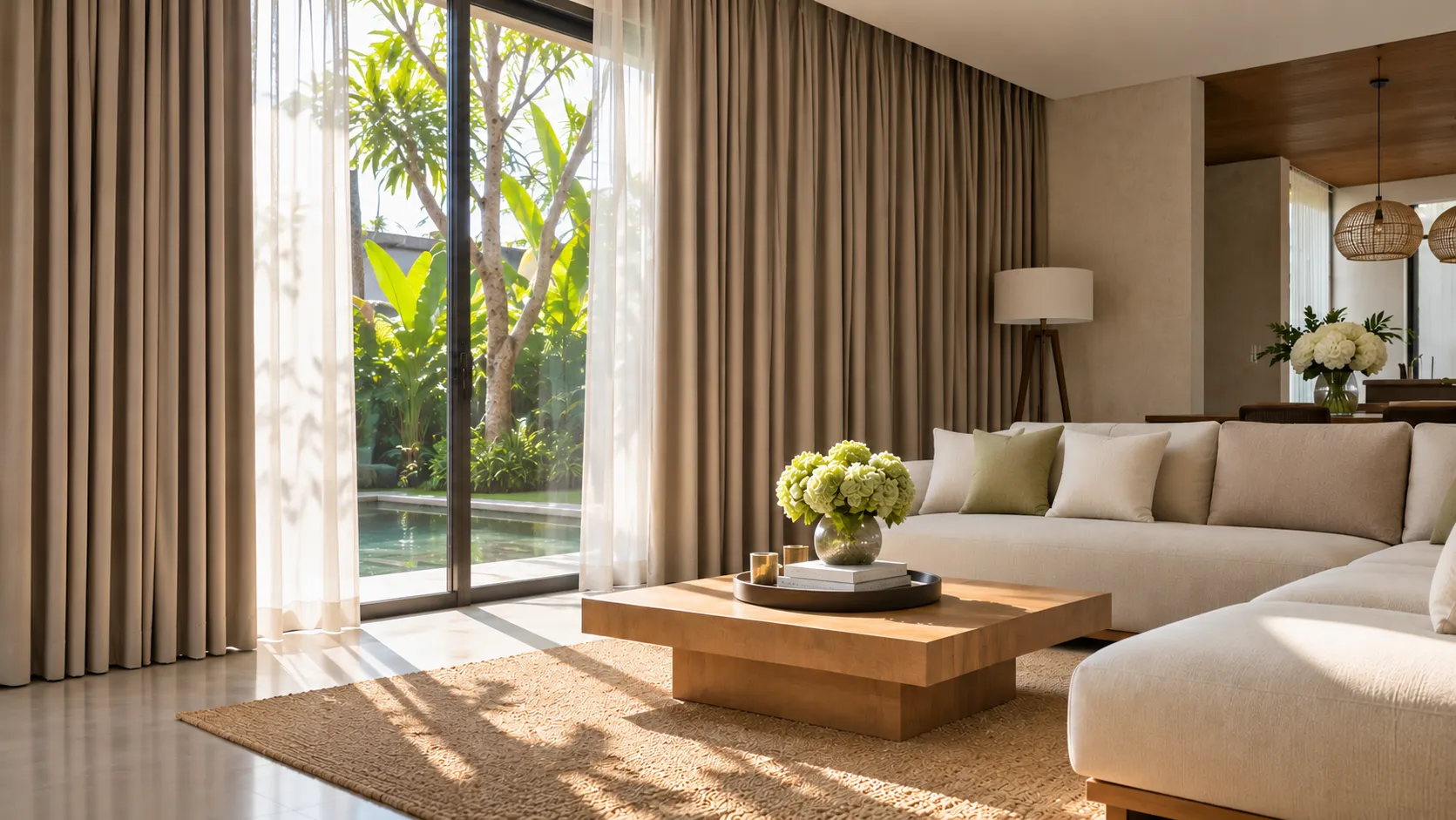
For stronger privacy after dark or more control over sunlight, combine a sheer with a dimout or blackout curtain on a separate track. This layered approach allows the room to remain bright during the day and more private when needed.
3. UV Protection and Solar Heat Control: Understand the Difference
UV protection and solar heat control are related, but they are not the same thing. Ultraviolet radiation can contribute to fading and material ageing. Solar heat gain is influenced by the broader solar energy entering through the glass, including visible light and infrared energy. A curtain that looks thick or dark does not automatically provide a verified level of UV protection or solar performance.
How curtains can help
- Coverage: A well-fitted curtain can reduce direct sunlight entering the occupied space when closed.
- Fabric construction: Density, weave, backing and specialist coatings affect how light and solar energy pass through the material.
- Colour: Colour can influence light transmission and solar behaviour, but colour alone is not a reliable performance specification.
- Layering: A sheer and a lined curtain offer flexible control over daylight, privacy and room darkening.
- External shading: Exterior awnings, shutters or screens can reduce solar exposure before sunlight reaches the glass. This may be more effective for heat control than relying on an interior curtain alone.
Questions to ask about UV and solar fabrics
- Is there a tested UV transmission or UV-blocking rating for the fabric or system?
- Is the product designed for glare reduction, UV management, solar heat control, privacy or room darkening?
- Are performance figures available for the complete glazing and shading combination, rather than the fabric alone?
- Will the fabric be installed inside the room or as part of an external shading system?
If protecting artwork, timber flooring, upholstery or other furnishings is a priority, ask for documented product performance rather than relying on general descriptions such as “UV protection” or “sun-blocking”. A specialist solar screen or external shading solution may be appropriate for some windows.
4. Blackout and Dimout Curtains for Bedrooms and Media Rooms
Bedrooms, nurseries and media rooms often need more light control than a living area. Blackout curtains are designed to block most incoming light through the fabric itself, while dimout materials reduce light without necessarily creating complete darkness. Actual room darkness also depends on light entering around the edges.
Blackout curtains
Blackout curtains are useful where strong room darkening is required, such as bedrooms, guest suites and projector rooms. They may use a blackout backing, specialised construction or a separate blackout lining. Ask whether the stated blackout performance refers to the fabric, the lining or the complete installed system.
Dimout curtains
Dimout curtains reduce incoming light while allowing some light to pass through. They can be a good compromise for bedrooms where complete darkness is not necessary or for living spaces that need softer light control.
How to improve room-darkening performance
- Use sufficient curtain width and fullness for the selected heading style.
- Extend the track beyond the window opening where the design and site allow.
- Consider a ceiling-mounted track or suitable pelmet to reduce light gaps at the top.
- Review side returns and overlaps, especially on wide windows and doors.
- Check whether the curtain can close fully without obstruction from handles, furniture or architectural details.
A blackout fabric does not automatically make a room completely dark. Track position, side gaps, top clearance and installation details are just as important as fabric selection.
5. Choosing Curtains for Coastal Properties and Salt Air Exposure
Properties near the sea may experience salt deposits carried by wind and moisture. Salt and persistent dampness can contribute to corrosion on unsuitable metal parts, particularly where protective finishes are damaged or maintenance is neglected.
For coastal villas and beachfront properties, assess the full hardware specification—not only the visible curtain track. Brackets, screws, gliders, connectors and other small components also matter.
Hardware considerations
- Material identification: Ask the supplier to identify the actual material used for tracks, brackets and fasteners.
- Stainless steel grade: Stainless steel grades differ in corrosion resistance. Grade 316 generally provides better resistance to chloride exposure than grade 304, but suitability depends on the component, exposure and product specification.
- Aluminium systems: Aluminium tracks may be suitable for many applications. Check the alloy, surface finish, brackets and fasteners as a complete system.
- Protective coatings: Coated components should be inspected for scratches, chips and exposed edges that may compromise the finish.
- Fasteners: Do not overlook screws and fixing accessories. A suitable track paired with unsuitable fasteners can still create maintenance problems.
- Cleaning access: Choose a system that can be inspected and cleaned safely and conveniently.
There is no universal rule that every curtain track in Bali must use one particular metal grade. The appropriate specification depends on distance from the sea, exposure to wind and salt, whether the space is enclosed, component design and manufacturer guidance. Ask for written specifications and avoid treating a generic “anti-rust” label as proof of coastal suitability.
Coastal hardware maintenance
Inspect exposed hardware periodically for salt residue, discolouration, pitting, loose brackets or rough movement. Clean components using the manufacturer’s recommended method and fresh water where appropriate. Avoid abrasive tools and harsh chemicals unless the product supplier specifically approves them.
6. Why a Layered Curtain System Often Works Best
For many Bali homes, a double-layer curtain system offers more flexibility than relying on a single fabric. The two layers can serve different functions and can be operated independently.
- Sheer + blackout: Soft daylight and daytime atmosphere, with stronger room darkening when required.
- Sheer + dimout: Filtered daylight with moderate light reduction and privacy options.
- Linen-look + blackout lining: A natural decorative appearance with additional light control, subject to the chosen fabric and lining construction.
- Decorative side panels + solar screen: A design-led arrangement where glare or solar exposure is managed by a separate technical shade.
Layering requires enough space for two tracks and for both curtains to stack without interfering with doors, handles or each other. Confirm the track arrangement, fabric fullness and stack position before production.
7. Track, Heading and Installation Choices
The curtain heading and track influence the final appearance, movement and practical operation of the system. Wave or S-fold headings create a regular, contemporary ripple. Pinch pleats create a more tailored appearance. Eyelet or grommet headings have a different visual character and require a compatible rod or system.
- Track capacity: The track, brackets and fixings must support the weight of the finished curtain.
- Operating method: Decide whether manual draw, cord operation or motorisation is appropriate for the window size and daily use.
- Ceiling and wall conditions: Confirm the substrate and fixing method before installation.
- Stacking space: Allow room for the opened curtain so it does not unnecessarily cover glass or obstruct access.
- Serviceability: Make sure gliders and other components can be accessed if adjustment or replacement is needed.
Accurate measurements are essential for a neat result. Review the curtain measuring guide before ordering. For roller blinds and other shade products, use the shade measuring guide. Where the curtain stack may affect the usable opening, the curtain stacking calculator can help with early planning.
8. Maintenance Tips for Curtains in Bali
Even well-selected curtains need routine care. A practical maintenance plan helps manage dust, moisture, sunlight and normal wear.
- Vacuum or dust fabric gently using an attachment suitable for the material.
- Follow the manufacturer’s instructions before washing, steaming or spot-cleaning.
- Keep curtains from remaining in contact with wet floors, damp walls or leaking window frames.
- Allow air to circulate around curtains and avoid leaving damp fabric tightly folded.
- Check tracks, brackets and fasteners for loose fittings, corrosion or rough operation.
- Inspect the back of curtains and areas near window frames periodically.
- Arrange professional cleaning when the fabric-care instructions or level of soiling requires it.
Do not assume that all fabrics can be treated with the same cleaning product. Strong chemicals, bleach, excessive heat or unsuitable steam can damage fibres, colour, coatings and linings.
Room-by-Room Curtain Recommendations
Living room
For a bright living room, consider a sheer or linen-look layer to soften daylight. If the windows receive strong direct sun, assess whether a lined curtain, solar screen or external shading is also needed.
Bedroom
Choose dimout or blackout curtains according to the required darkness. A sheer layer can provide daytime softness while the main curtain is open. Pay attention to side gaps and track extension if room darkening is important.
Villa with ocean or coastal exposure
Prioritise a hardware system with documented material and finish specifications suitable for the site. Establish an inspection routine and select fabrics with realistic cleaning requirements.
Bathroom and high-moisture areas
Standard decorative curtains are not automatically suitable for wet or persistently damp areas. Consider whether a curtain is necessary, whether the space can be ventilated and whether a product specifically intended for the environment is required.
Large sliding doors
Consider track length, panel weight, stacking space and how the curtains interact with door operation. Motorisation may be worth evaluating for wide or frequently used openings, provided the system is specified and installed correctly.
How to Select the Best Curtains for Your Bali Property
- Define the purpose: Decide whether the priority is daylight, privacy, room darkening, glare reduction, decorative appearance or a combination.
- Assess the exposure: Note direct sunlight, window direction, coastal proximity, ventilation and moisture conditions.
- Compare real samples: View fabric samples in the room at different times of day.
- Check technical details: Confirm fibre content, lining, care instructions, documented performance and hardware materials.
- Plan the installation: Confirm measurements, track location, fullness, clearance and stack space.
- Plan maintenance: Make sure the owner or property team can clean and inspect the system appropriately.
Frequently Asked Questions
What is the best curtain fabric for Bali’s tropical climate?
There is no single best fabric for every room. Linen and linen-look fabrics are popular for their natural appearance and relaxed drape. Sheers work well for filtered daylight, while lined dimout or blackout curtains are useful where more light control is needed. The right choice depends on exposure, room use, care requirements and the desired finish.
Are linen curtains suitable for humid weather?
Linen can be used in tropical interiors, but it is not mould-proof or maintenance-free. Check the exact fibre composition and care instructions, provide suitable ventilation and avoid allowing the fabric to remain damp.
Do curtains block UV rays?
Some fabrics and specialised window coverings can reduce UV transmission, but performance varies. Ask for documented test results or product specifications if UV protection is important. Do not assume that every blackout or dark-coloured curtain has a verified UV rating.
Do curtains reduce heat in a Bali villa?
Interior curtains can reduce direct sunlight and improve comfort, but the result depends on fabric, lining, colour, coverage, glazing and installation. External shading can reduce solar exposure before it reaches the glass and may be more effective for some windows.
Which curtain track material is best near the sea?
The best choice depends on actual exposure and the complete hardware specification. Ask about the track, brackets, screws, connectors and protective finish. Stainless steel 316 can offer better chloride resistance than grade 304, but it is not automatically required or a guarantee against corrosion in every application.
Are blackout curtains too heavy for tropical homes?
Not necessarily. Blackout curtains can be suitable for bedrooms and media rooms when the track and fixings are designed for the finished curtain weight. Consider the fabric, lining, track capacity and ease of operation.
Should I choose one curtain layer or two?
A single layer may be sufficient for a room with simple light and privacy needs. A double layer—often sheer plus dimout or blackout—offers more flexibility, but requires additional track space and careful planning.
Find the Right Curtains for Your Bali Home or Villa
The best curtains for a tropical climate are not defined by one fabric name. They are selected as a complete solution: fabric and lining suited to the room, appropriate control of sunlight, hardware matched to site exposure, accurate installation and a realistic maintenance plan.
Almeers Living provides custom curtains and window-treatment solutions for residences, villas and hospitality properties in Bali. From breathable sheer and linen-look fabrics to dimout, blackout and layered curtain systems, the right combination can be planned around your windows, interior style and practical requirements.
Explore Almeers Living products or visit the Almeers Living blog for more window-treatment guidance. For a project-specific recommendation, arrange a consultation to review measurements, fabric samples and suitable track options.
Technical note: UV, solar-control and corrosion-resistance performance varies by product and installation. Confirm claims against current manufacturer specifications and relevant test documentation. This article provides general selection guidance and is not a substitute for product-specific engineering or building advice.