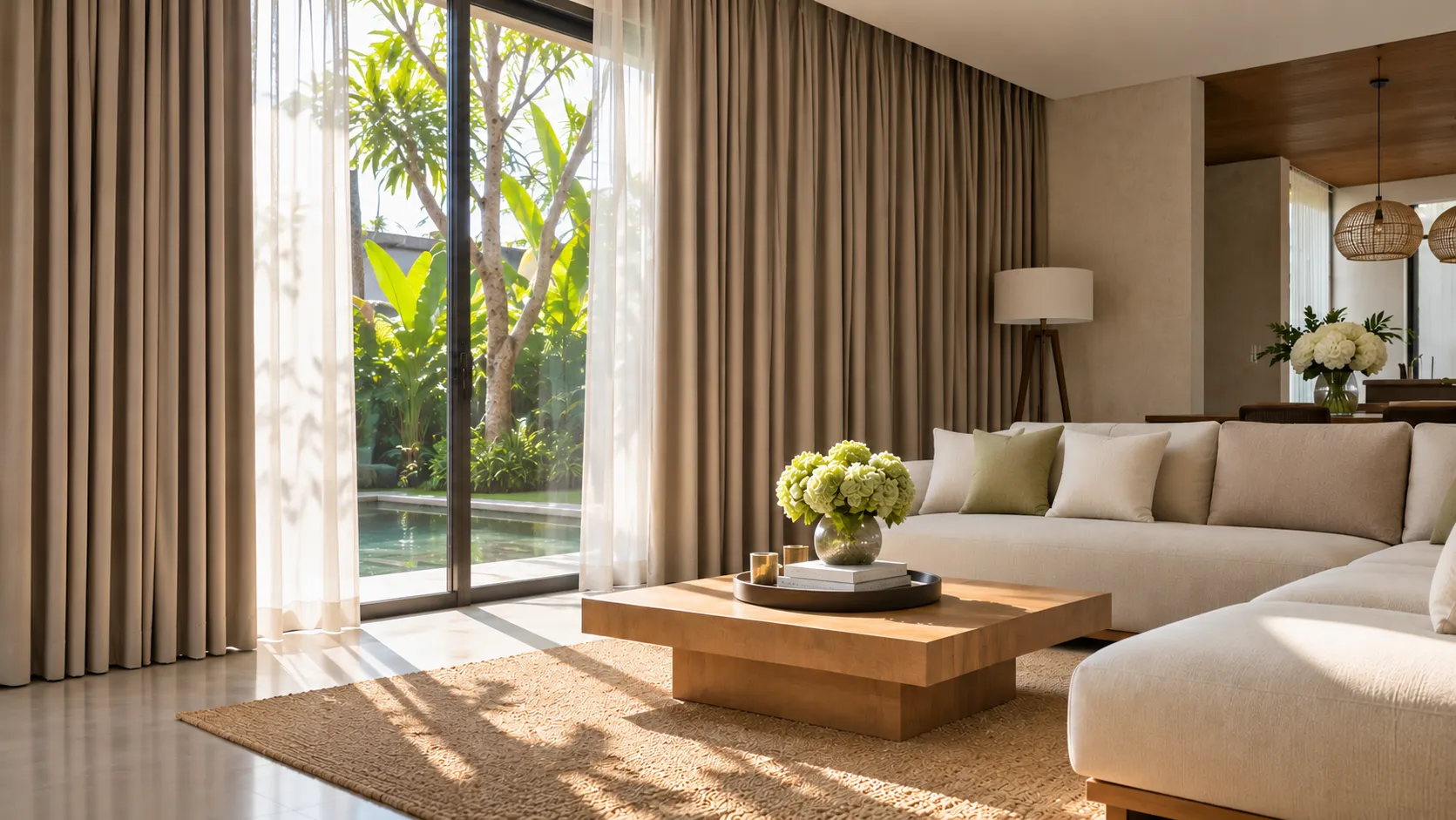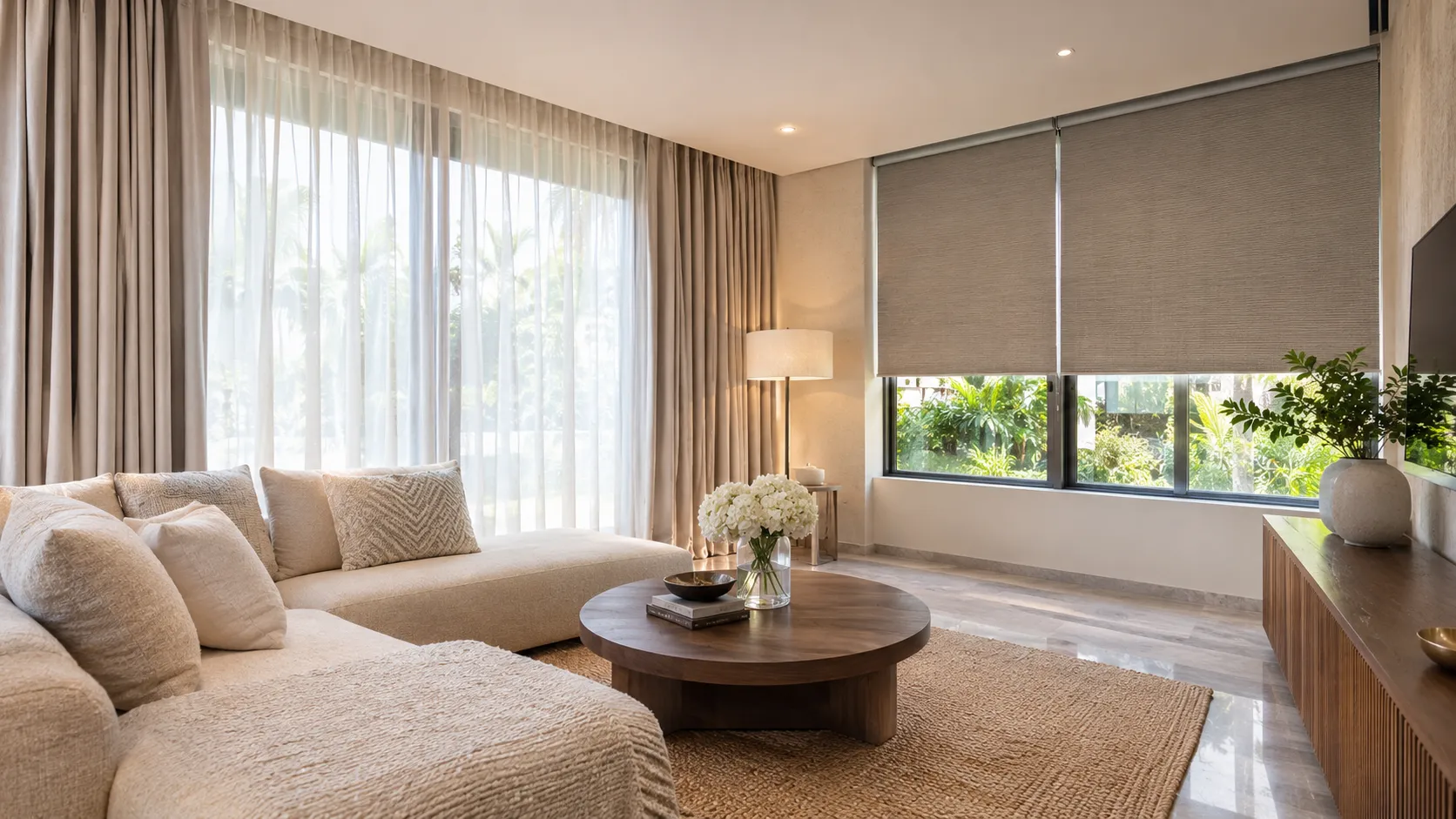
A well-designed window treatment should feel like a natural part of the room rather than an accessory chosen at the end of a project. Combining curtains and blinds gives designers greater flexibility to manage daylight, privacy and visual softness, while creating a consistent look across different windows. The key is to coordinate the systems through proportion, colour, texture, hardware and the architecture surrounding each opening.
For villas, homes and hospitality properties in Bali, this approach can be especially useful. Large glazed doors, garden-facing windows, timber details and open-plan interiors often require more than one type of window covering. A sheer curtain can soften the view, a roller blind can provide practical solar control, and a decorative outer curtain can add warmth and depth. When planned together, the result can be functional and visually balanced.
Key takeaway: A cohesive scheme does not mean identical products on every window. It means a consistent design language—complementary colours, compatible textures, aligned proportions and integrated hardware—while choosing the right function for each room.
1. Why Combine Curtains and Blinds?
Curtains and blinds perform different roles, which is why pairing them can create a more adaptable window treatment. Curtains bring softness, movement and a decorative finish. Blinds offer a compact format for managing daylight, glare and privacy close to the glass. Together, they can respond to changing conditions throughout the day.
- Flexible light control: Adjust the blind for daytime glare and use the curtain for softer filtered light or a more enclosed atmosphere.
- Privacy: A blind can provide screening close to the window, while curtains add another layer when required.
- Visual softness: Fabric panels balance the clean lines of glass, aluminium, timber or concrete frames.
- Design continuity: Coordinated colours and textures connect different window types across a property.
- Room-specific performance: Each opening can be adapted to its orientation, use and exposure.
Layering is not automatically best for every window. A compact bathroom or study may work better with a single blind. Combining treatments is most valuable when a room benefits from both practical control and decorative softness.
2. Dual Layering Techniques
Dual layering usually means installing two systems at one opening. The blind typically sits close to the glass, while curtains are positioned farther into the room. The order, spacing and mounting depth should be planned together so that both treatments operate without catching, rubbing or obstructing one another.
Blind closest to the glass, curtains outside
This common arrangement allows the blind to manage daylight while the curtain frames the opening. A roller blind can reduce direct glare during the day, while curtains can be drawn for privacy or a softer evening appearance. Confirm that the reveal has enough depth and that handles do not interfere with the blind.
Sheer curtain with a practical blind
A sheer softens the view and diffuses daylight, while a roller blind provides more controlled screening. This can work well in living rooms where the view is important but direct sunlight can be uncomfortable.
Decorative curtain with a solar screen blind
A solar screen blind can help manage glare while retaining some outward visibility, depending on its openness and lighting conditions. A decorative curtain adds texture and a residential finish. Select the blind based on the actual orientation and performance requirements.
Plan the operating sequence
Check that the blind travels fully without touching curtain fabric. Make sure curtain folds do not obstruct the chain, motor, brackets or bottom rail. If both systems are motorized, confirm control compatibility and independent operation where needed.
3. Choosing the Right Layer Combination
The best pairing depends on the room's light, privacy and styling requirements. Use this comparison as a starting point, then confirm the fabric and blind specifications with physical samples and product information.
| Combination | Design effect and use | Considerations |
|---|---|---|
| Sheer curtains + roller blinds | Soft, airy finish for living and dining areas | Choose blind openness and sheer density according to glare and privacy. |
| Blackout curtains + roller blinds | Layered finish for bedrooms and media rooms | Check side gaps, overlaps and light-control performance. |
| Linen-look curtains + solar screen blinds | Natural texture paired with a clean technical layer | Compare tones in daylight; solar screens do not guarantee night privacy. |
| Dimout curtains + sunscreen blinds | Balanced softness and daytime glare management | Dimout is not necessarily full blackout. |
| Decorative curtains + Roman shades | Tailored styling for selected lounges and bedrooms | Allow for shade stack and curtain hardware clearance. |
For a consistent property-wide scheme, repeat a small number of combinations rather than introducing a different treatment at every window. This keeps the design coherent while allowing each room to retain the function it needs.
4. Create Colour Harmony Across the Room
Colour coordination is one of the strongest ways to make curtains and blinds look intentional. The two layers do not need to match exactly. A subtle contrast often creates more depth than using the same shade for both components.
Start with fixed finishes
Review wall colour, flooring, ceiling finish, timber, stone, upholstery and large furniture pieces before selecting window-treatment colours. These elements form the foundation of the palette. Curtains and blinds should connect with that palette rather than introduce unrelated tones.
- Warm neutral interiors: Pair ivory, oatmeal, sand or warm beige curtains with a related neutral blind.
- Cool contemporary interiors: Consider soft grey, stone or muted greige, checking undertones against flooring and walls.
- Timber-rich spaces: Warm whites and natural beige complement teak without trying to reproduce the exact wood colour.
- Minimalist rooms: Two tones from the same colour family add depth while preserving a calm appearance.
- Strong accent colours: Keep one layer relatively quiet so the window treatment does not compete with artwork or upholstery.
Choose a dominant and supporting tone
Decide which layer should be visually dominant. If curtains are the main decorative feature, use a quieter blind colour behind them. If the blind has a visible texture or colour, let the curtains provide a restrained frame. Compare physical samples in the actual room because daylight and artificial lighting can change how beige, grey and white appear.
5. Coordinate Textures and Materials
Texture creates visual interest even when the colour palette is restrained. A woven curtain can soften the smooth surface of a roller blind, while a subtle blind texture can complement a plain curtain. The aim is contrast that feels deliberate rather than busy.
- Linen-look curtains: Pair well with plain roller blinds when the curtain should bring warmth and tactile character.
- Sheer fabrics: Work with simple blinds because their translucent appearance already adds softness.
- Textured blackout fabrics: Balance with a blind that has a quieter surface.
- Natural woven shades: Pair with plain curtains so the combined textures do not overwhelm the room.
- Smooth contemporary fabrics: Suit interiors with clean architectural lines and minimal detailing.
For Bali properties, natural-looking materials can connect interiors to timber, stone, rattan and greenery. However, appearance and fibre content are not the same. If a fabric is described as linen-look or bamboo-look, confirm whether it is actual linen, bamboo-derived fibre, a synthetic blend or another construction. This matters for care and durability.
Keep pattern under control
If the curtain has a pronounced weave, slub or pattern, a plain blind often provides a calmer counterpart. If both layers are patterned, keep their scale and contrast compatible. Let one layer carry most of the visual detail while the other supports it.
6. Integrate Treatments with Window Frames and Architecture
A cohesive treatment should look connected to the opening itself. Frame colour, reveal depth, handle position, mullions and ceiling details influence the most suitable installation. The design should respect how doors and windows open, how people move through the room and where fabric will sit when retracted.
Recess-fit blinds
Where the reveal has sufficient depth and suitable fixing points, a blind can sometimes be installed within the frame. This creates a compact appearance and leaves the surrounding wall available for curtains. Accurate measurement is essential because width, depth, handles and obstructions affect the fit.
Outside-mounted blinds and curtains
Where a recess is too shallow or unsuitable, an outside-mounted blind may be more practical. Curtains can frame the opening, but check that the combined projection does not interfere with doors, handles, cabinetry or furniture.
Coordinate visible hardware
Track colour, brackets, rods, pelmets and exposed fittings should be considered alongside the window frame. A concealed ceiling track creates a quiet architectural line, while a visible rod may be appropriate when it is part of the design. Avoid introducing several unrelated metal finishes in the same visual area.
For large glazing or full-height doors, consider the ceiling line and curtain stack position. Poor placement can create awkward gaps or reduce the usable opening.
7. Get Proportions, Fullness and Stacking Right
Even well-matched colours can look unbalanced if proportions are wrong. Curtain width, fullness, finished drop, blind dimensions and stacking space influence the final appearance. Coordinate these details before products are ordered.
Curtain fullness
Fullness describes the amount of fabric used in relation to the track or window width. The desired fullness depends on heading style, fabric weight, wave or pleat specification and the intended look. Fuller curtains create richer folds but require more fabric and more stacking space.
Stacking space
When curtains are open, fabric gathers to one or both sides of the window. If the stack is not considered, panels may cover too much glass, overlap a door opening or interfere with furniture. A blind also needs clearance from the curtain stack to operate smoothly.
Use the Almeers Living Stacking Calculator as a planning aid, and confirm final dimensions with the selected track and heading specifications.
Finished drop and blind alignment
Decide whether curtains should finish just above the floor, lightly touch it or create a deliberate break. Consider floor condition, cleaning routine and fabric behaviour. When several blinds are visible together, align their top positions where practical to create a more orderly appearance.
8. Room-by-Room Design Ideas
| Room or area | Suggested combination | Design priority |
|---|---|---|
| Living room | Sheer curtains + roller or solar screen blinds | Filtered daylight, views and welcoming softness |
| Master bedroom | Blackout or dimout curtains + suitable roller blind | Privacy, darkness and comfortable operation |
| Guest bedroom | Textured curtains + simple roller blind | Easy operation and coordinated appearance |
| Dining area | Light-filtering curtains + discreet blind | Daylight control without visual heaviness |
| Home office | Solar screen blind + optional side curtains | Screen glare management and visual comfort |
| Media room | Blackout curtain + compatible blind | Light control, including edge gaps |
| Large sliding doors | Wide curtain track + compatible blind | Clear access, smooth operation and stacking space |
These are starting points rather than fixed specifications. A living room facing strong afternoon sun may need a different blind from a shaded room. A street-facing bedroom may need more privacy than one overlooking a private garden.
9. Considerations for Bali Villas and Hotels
In Bali, treatments should be selected with the local environment and property use in mind. Strong sunlight, humidity, seasonal rain and coastal air can affect fabrics and hardware. Exposure varies significantly between a sheltered bedroom, a covered terrace and an opening directly exposed to outdoor conditions.
Sunlight and heat
For windows with strong sun exposure, consider solar screen blinds, suitable linings, external shading or a layered approach. Performance depends on product specification and installation. A decorative curtain alone should not be treated as a guaranteed solution for overheating.
Humidity and cleaning
Choose fabrics with care instructions that suit the property's cleaning routine. Allow damp materials to dry fully and avoid placing fabric where it repeatedly contacts wet floors or surfaces. Good ventilation and routine maintenance help protect appearance.
Coastal hardware
For coastal villas and hotels, ask suppliers to confirm the material and finish of tracks, brackets, screws and fittings. Corrosion resistance depends on the specific material, coating, exposure and maintenance. Confirm suitability rather than relying on generic claims such as “rust-proof.”
Guest and staff operation
For hospitality spaces, keep controls intuitive and consistent. Where motorization is used, plan handover, support contacts and backup operation according to the selected system.
10. Common Coordination Mistakes to Avoid
- Matching every layer exactly: Identical colours can flatten the design; subtle tonal contrast often looks more considered.
- Combining too many textures: Let one layer provide the main visual interest.
- Ignoring the window frame: Frame depth, handles and opening direction affect blind type and mounting position.
- Forgetting clearance: Blind cassette, brackets and curtain stack must not collide.
- Using the same opacity in every room: Different spaces have different daylight, privacy and darkness requirements.
- Overlooking night privacy: Sheers and some solar screens may not provide adequate privacy when the interior is illuminated.
- Choosing products before measuring: Confirm recess dimensions, track position, finished drop and obstructions.
- Ignoring maintenance: Consider cleaning access, track servicing and fabric care.
11. Designer’s Planning Checklist
- Identify the primary function of each treatment: light control, privacy, decoration or a combination.
- Record window dimensions, frame depth, handles, opening direction and nearby obstructions.
- Decide whether the blind will sit inside the recess or outside the frame.
- Select curtain heading, fabric weight, fullness and finished drop.
- Choose a dominant colour and a supporting tone that coordinate with fixed finishes.
- Compare curtain and blind samples together in the actual room.
- Check that textures and patterns complement rather than compete.
- Plan track, bracket, cassette and control positions.
- Confirm stacking space and ensure both layers can operate independently.
- Review cleaning instructions, hardware suitability and maintenance.
- Arrange accurate measurement and professional installation where required.
For measurement preparation, visit the Curtain Measuring Guide and Shade Measuring Guide. Explore styles in the Almeers Living product range.
12. Frequently Asked Questions
Can curtains and blinds be used on the same window?
Yes. A blind can provide practical light or privacy control close to the glass, while curtains add softness and another layer. The opening needs enough space for both systems to fit and operate without interference.
Which should be installed first, blinds or curtains?
The sequence depends on the mounting design. In many arrangements, the blind is positioned closer to the glass and the curtain track sits farther into the room. Confirm brackets, clearances and access before installation.
Should curtains and blinds be the same colour?
They do not have to match exactly. Related tones or complementary neutrals often create a more layered appearance. Compare samples against walls, flooring, timber and furniture.
What blinds work well with sheer curtains?
Roller blinds and solar screen blinds are common options, depending on glare, view-through and privacy needs. Check the blind's openness and performance for the actual window orientation.
Are layered curtains and blinds suitable for Bali villas?
They can be suitable when fabrics, hardware and installation are selected for the property's exposure and maintenance conditions. Consider sunlight, humidity, coastal air and rain exposure.
How do I stop curtains from interfering with roller blinds?
Plan the projection and position of the blind cassette, brackets and curtain track together. Allow clearance for curtain folds and the blind bottom rail, then test full operation.
Do solar screen blinds provide privacy at night?
Not necessarily. Visibility may reverse after dark when the interior is brighter than outside. Add a suitable curtain or privacy layer if night-time screening is important.
How much space should I allow for curtain stacking?
Stacking space depends on track width, fabric weight, fullness, heading style and panel count. Estimate it during planning and confirm against the selected system. The Almeers Living Stacking Calculator can help with initial planning.
Conclusion: Make Every Layer Feel Intentional
A cohesive curtains-and-blinds design comes from coordinating function and appearance from the beginning. Dual layering provides flexible light control and privacy, while a thoughtful colour palette and balanced textures help treatments connect with the room. Integrated frames, aligned proportions and carefully planned hardware complete the composition.
For Bali villas and hotels, the best result also accounts for sunlight, humidity, coastal exposure, cleaning and daily operation. Rather than applying one combination to every window, assess each opening and select the layers that suit its purpose.
Almeers Living provides customised curtains and blinds in Bali, with consultation, measurement and installation options for residential and hospitality projects. Visit Almeers Living or browse the product range to explore window-treatment solutions for your property.