Curtains in a rental property do more than complete the interior design. They help guests manage daylight, privacy, and comfort, while also influencing how well a room photographs and how consistently the property presents itself between bookings. Unlike a private home, a holiday villa or serviced apartment may experience frequent guest turnover, regular housekeeping, repeated opening and closing, and different patterns of use. Window treatments therefore need to look attractive while remaining practical to operate and maintain.
For Bali rental properties, the selection process has additional considerations. Strong daylight, humidity, open doors, garden-facing windows, and a relaxed indoor-outdoor lifestyle can all affect fabric choice and maintenance. A beautiful but delicate curtain may not be the most suitable option for a frequently occupied villa. Equally, a highly durable fabric still needs to suit the architecture and create a welcoming guest experience.
This guide explains how property owners, villa managers, hotel operators, contractors, and interior designers can choose custom curtains with durability, stain care, universal styling, and long-term value in mind. Almeers Living provides custom window treatment solutions in Bali, including curtains, sheers, blackout options, blinds, measurement, and installation. Explore our curtain and blind collections or browse more ideas in the Almeers Living blog.
1. What Rental Properties Need from Curtains
A rental property's window treatments should satisfy several requirements at once. They need to complement the interior, provide the appropriate level of light control and privacy, withstand regular handling, and fit into the property's housekeeping routine. Thinking about these needs before choosing a fabric can reduce avoidable replacement and maintenance costs.
Guest comfort and ease of use
Guests should be able to understand and operate curtains without instructions. Panels should move smoothly, be easy to reach, and provide enough coverage for the window. Bedrooms may require effective light reduction, while living areas may benefit from daylight-filtering sheers paired with decorative drapery.
Consistent appearance between stays
Rental properties are often photographed for booking platforms and marketing. Curtains that hang evenly, maintain their shape, and coordinate across rooms help create a consistent visual identity. Selecting a coordinated palette and repeatable hardware specification can also make future room updates easier.
Maintenance that fits the operation
Consider how often the property is cleaned, who is responsible for curtain care, and whether the fabric can be professionally cleaned locally. A practical specification should include the manufacturer's care instructions, expected cleaning method, and any limitations related to water, heat, or chemicals.
2. Choosing Durable Hospitality Fabrics
Fabric durability depends on more than the material name. Fiber composition, yarn quality, weave construction, fabric weight, finishing, and intended use all influence how a curtain performs. Ask suppliers for technical information where available, particularly for high-use rooms and hospitality projects.
| Fabric direction | Design character | Points to assess for rental use |
|---|---|---|
| Polyester and polyester blends | Available in many colors, textures, and weights | Check construction, abrasion performance, cleaning instructions, and resistance to fading |
| Linen-look woven fabrics | Relaxed, natural texture suited to tropical interiors | Confirm fiber content, crease behavior, cleaning method, and how the weave handles frequent use |
| Dimout fabrics | Decorative appearance with reduced incoming light | Confirm the actual light-reduction level and whether it meets the room's requirements |
| Blackout fabrics or lined curtains | Suitable for rooms where substantial light control is important | Check the blackout specification, side coverage, top gap, and installation method |
| Sheer fabrics | Light, airy appearance that softens daylight | Assess snagging risk, cleaning requirements, privacy expectations, and whether a second layer is needed |
| Velvet and heavier decorative fabrics | Rich texture and a more formal visual effect | Check weight, track capacity, dust care, cleaning requirements, and suitability for the room |
Request performance details, not just a color sample
For a hospitality or rental project, ask about abrasion resistance, colorfastness, dimensional stability, cleaning instructions, and any relevant fire-performance requirements that apply to the property. Not every decorative fabric is tested to the same standards, and a supplier should not be assumed to offer a particular certification unless documentation is available.
Choose fabric weight for the intended application
Very lightweight fabrics can create a soft, flowing appearance, but they may not provide the coverage or durability required in every room. Heavier fabrics can feel substantial and provide better visual coverage, but they need suitable tracks, brackets, and installation. The best choice is a balanced specification rather than simply selecting the thickest fabric.
3. Stain Resistance and Practical Curtain Maintenance
Rental properties may encounter food or drink splashes, sunscreen transfer, dust, hand marks, and general handling. Stain-resistant finishes can be useful in selected applications, but they do not make fabric stain-proof. Their effectiveness depends on the finish, fabric construction, type of stain, cleaning response, and the manufacturer's care instructions.
Understand what a stain-resistant treatment can do
Some textile finishes are designed to help liquids bead on the surface or make certain stains easier to remove. Before specifying a treated fabric, confirm what the treatment is designed to resist, whether it affects the fabric's hand or appearance, and how it should be cleaned. Avoid using unapproved chemicals or aggressive spot treatments, which may damage the finish or cause color changes.
Plan for routine care
- Follow the fabric supplier's instructions for vacuuming, dust removal, spot cleaning, and professional cleaning.
- Use suitable low-suction vacuum attachments where the care guidance permits it.
- Address spills promptly using the recommended method; avoid rubbing a stain deeper into the weave.
- Do not apply bleach, solvents, or strong detergents unless the manufacturer specifically approves them.
- Inspect curtain hems, hooks, gliders, and tracks during scheduled room maintenance.
- Keep fabric care information with the property's housekeeping or maintenance records.
Make replacement planning easier
For multi-room properties, record the fabric name, color code, supplier, heading style, finished dimensions, and installation details for each room. If a panel becomes damaged or a room is renovated, these records make it easier to identify a matching or compatible replacement. Where possible, discuss future availability with the supplier before finalizing a large project.
4. Universal Curtain Styling for Different Guests
Rental interiors need broad appeal. Guests may have different tastes, so a timeless base palette is often a practical starting point. This does not mean every room must look identical. Instead, use a consistent family of colors and textures, then introduce restrained differences through cushions, artwork, rugs, or selected feature rooms.
Warm neutrals for broad design compatibility
Ivory, warm white, oatmeal, sand, beige, and taupe coordinate with many common interior materials, including timber, stone, rattan, textured plaster, and neutral upholstery. These colors can help a property feel welcoming without competing with its architecture or views. Check undertones against the actual finishes because a beige that looks neutral in a sample book may appear yellow or pink in a particular room.
Texture adds interest without relying on bold color
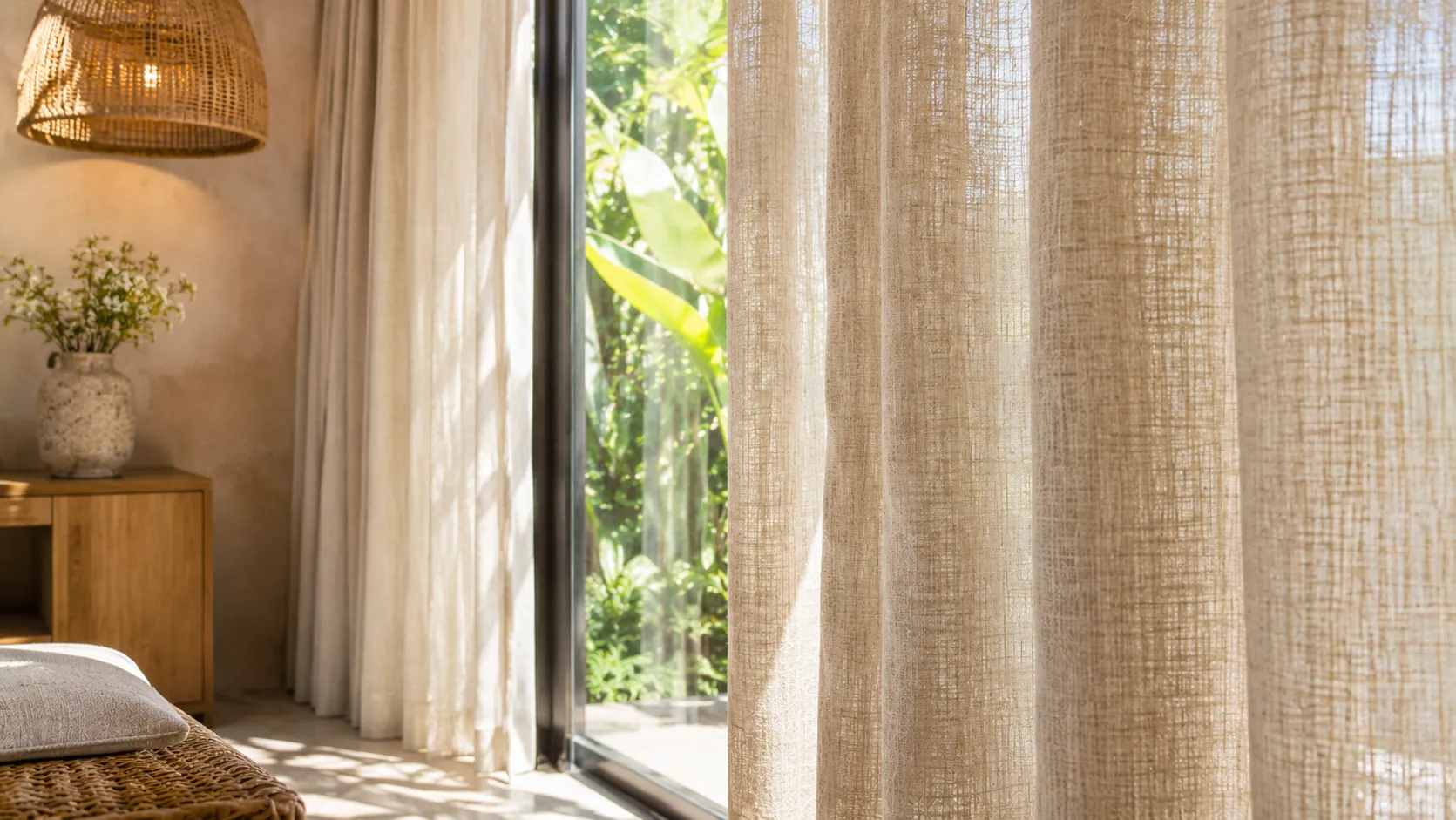
A textured linen-look weave, subtle vertical pattern, or soft woven surface can make a neutral curtain feel considered and premium. Texture is especially useful when the walls and furniture are simple. Keep patterns and strong contrasts controlled if the property is intended to appeal to a wide range of guests.
Use accent colors selectively
Muted olive, soft blue, terracotta, or charcoal can add character in a feature bedroom or lounge. Repeat the accent in a few details elsewhere in the room to make the palette feel intentional. Avoid introducing a different dominant curtain color in every space unless the property has a clear design concept.
5. Balancing Light Control and Privacy
Color and style are important, but rental guests also expect window treatments to perform. Assess the orientation of each window, nearby buildings, outdoor lighting, and the way each room is used before selecting a curtain system.
Bedrooms: consider blackout or dimout options
Bedrooms may benefit from blackout curtains when guests need substantial darkness for sleeping. Actual results depend on fabric construction, lining or backing, track placement, and the amount of light entering around the edges. Dimout fabrics reduce incoming light but should not be described as fully blackout unless the product specification supports that claim.
Living spaces: combine sheers and decorative curtains
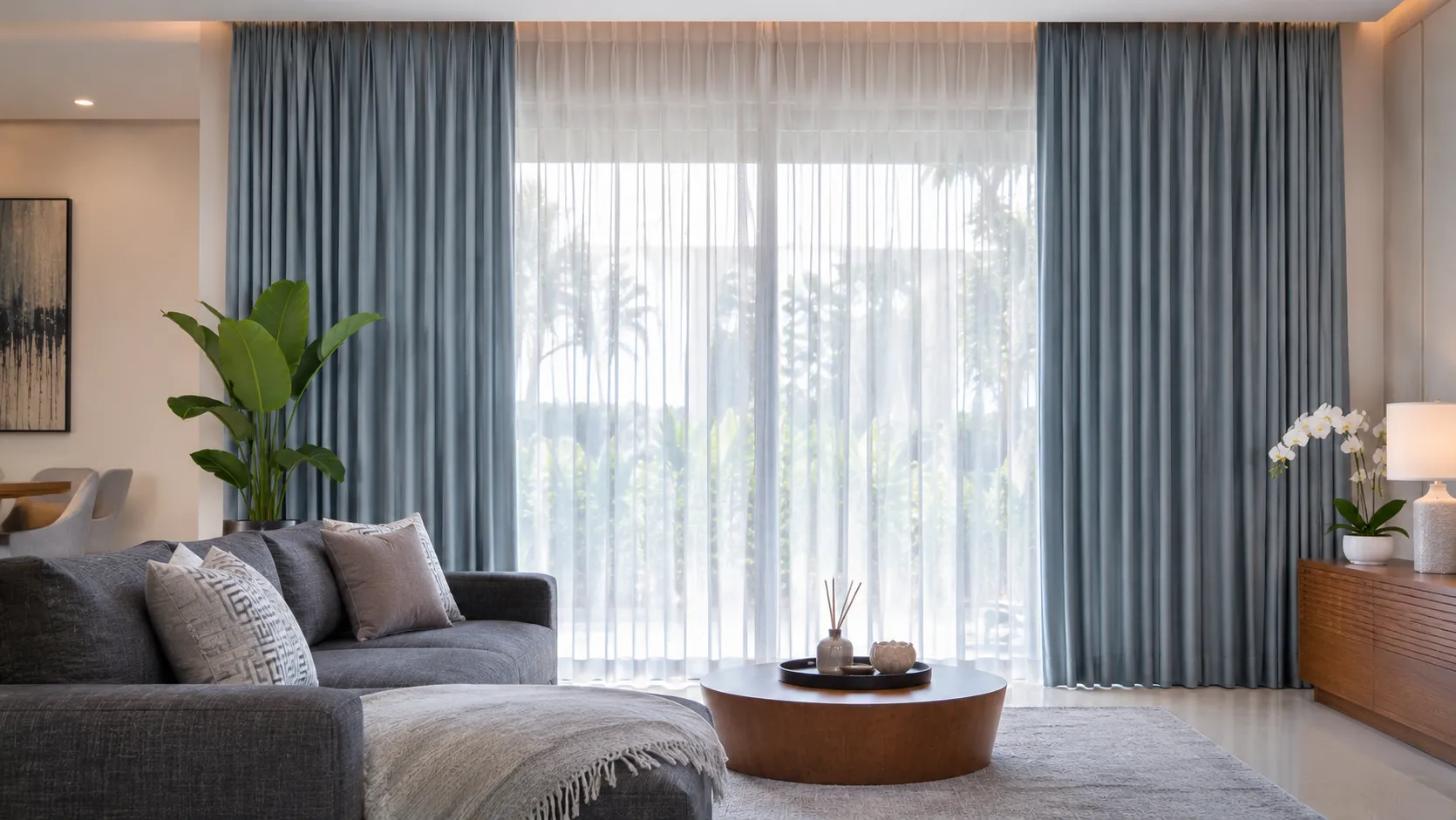
A double-layer arrangement can give guests more control. Sheer curtains soften daylight during the day, while a heavier curtain can provide additional privacy and light reduction when required. This layered approach also adds depth to the interior and can be coordinated with the property's furniture and finishes.
Bathrooms and overlooked windows
For bathrooms and windows close to neighboring properties, privacy should take priority. Depending on the room's ventilation, moisture exposure, and window configuration, a suitable blind or privacy-focused window treatment may be more practical than a full-length fabric curtain. Confirm the material's suitability for the environment before installation.
6. Tracks, Headings, and Installation Details
Even a well-selected fabric can look untidy or operate poorly when the track and installation are not suitable. Rental properties benefit from hardware that is appropriate for the curtain weight, securely fixed, and easy to operate. Track selection should consider span, support points, ceiling or wall construction, access, and the desired visual finish.
Choose a heading that suits the property
Pinch pleat, wave fold, and other heading styles create different visual effects and require compatible tracks or hooks. Wave-style curtains can provide a regular, contemporary appearance, while pinch pleats create a more tailored and traditional finish. Confirm the selected heading, fullness, and track system together before production.
Allow enough space for curtains to stack back
When open, curtains gather to the side of the window. The amount of space required depends on fabric thickness, width, fullness, and heading style. Insufficient stack-back space can cover part of the glass and reduce the usable opening. Use the curtain stacking calculator as a planning aid, then confirm the final arrangement with the installer.
Prioritize secure installation and smooth operation
Check that brackets and fixings are appropriate for the wall or ceiling substrate and the expected load. Tracks should be level, gliders should move smoothly, and curtain lengths should be consistent. For tall windows or large spans, professional measurement and installation help reduce alignment and operating issues.
7. Curtain Ideas by Rental Space
Villa bedrooms
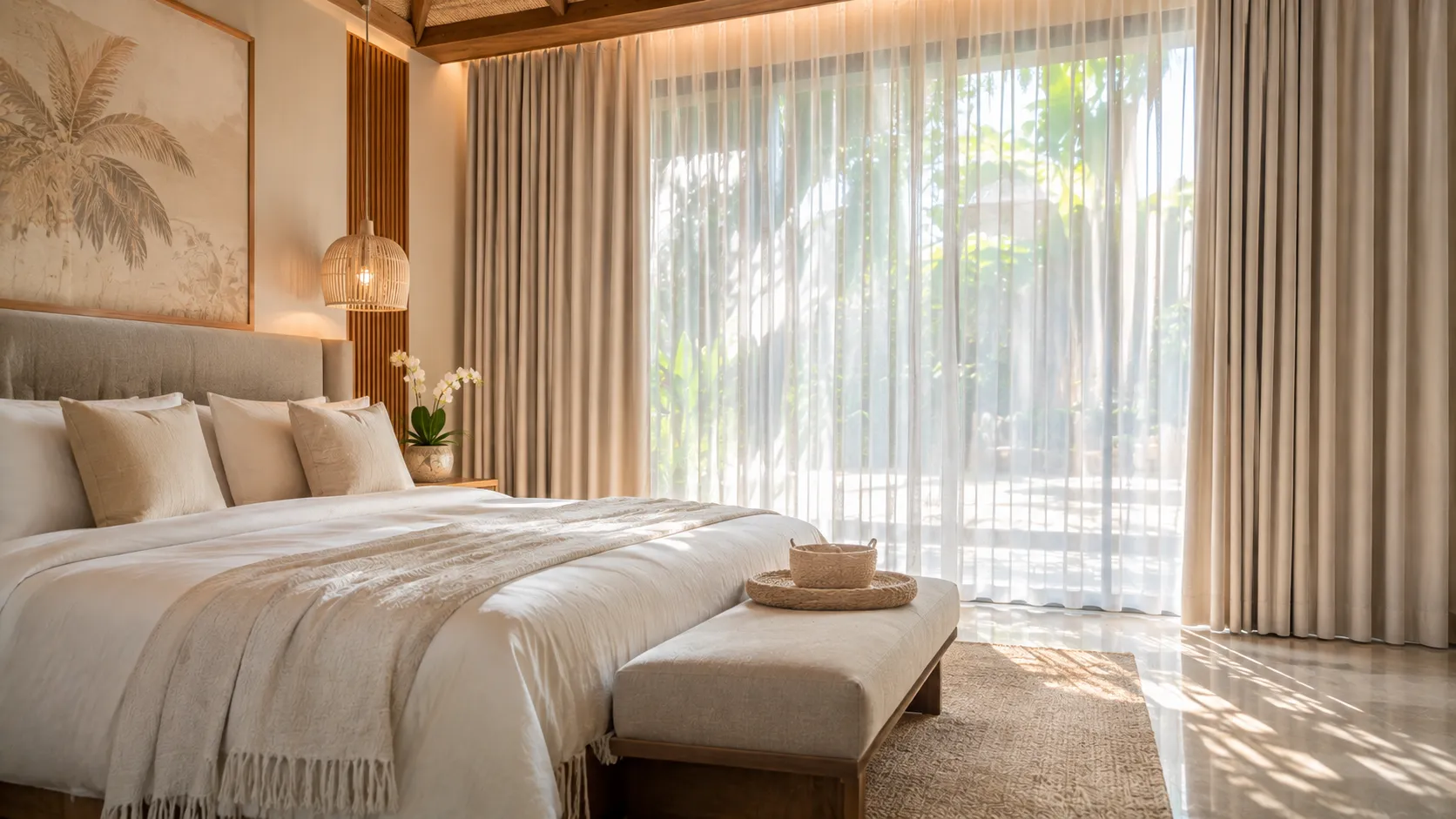
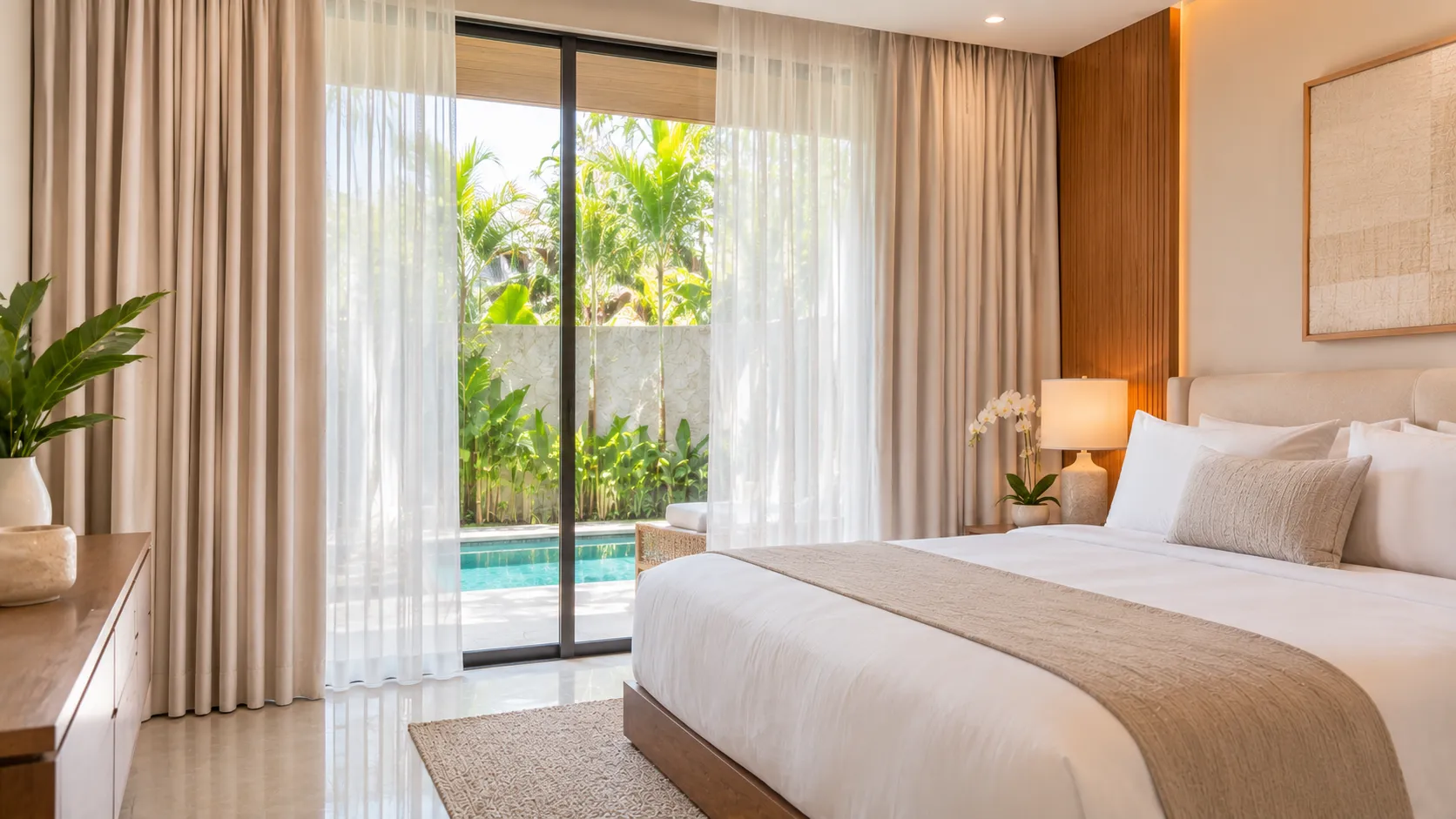
Use a calm neutral palette with a suitable blackout or dimout layer where needed. A sheer layer can soften daylight and create a relaxed daytime atmosphere. Choose a fabric that complements the bed, headboard, flooring, and any timber or stone finishes.
Open-plan living and dining areas
Coordinate the curtain color across connected windows to create a unified interior. Warm neutrals and textured fabrics can work well with open-plan layouts. Consider how the curtains look when both open and closed, especially if the windows form a major feature in property photography.
Serviced apartments
Prioritize simple operation, easy-care materials, and a versatile palette. A consistent curtain specification across similar units can simplify maintenance and future replacements. Where layouts differ, keep the color family consistent while adjusting dimensions and track details to each window.
Hotel rooms and boutique accommodation
Develop a repeatable specification for fabric, lining, heading, track, and finished length. This helps maintain consistency across rooms and makes maintenance planning more predictable. Check any project-specific hospitality requirements before purchasing fabrics or hardware.
Outdoor-facing and garden rooms
Windows facing gardens or pool areas may receive strong daylight and have different privacy needs from internal-facing rooms. Consider colorfastness, exposure, and whether the window needs a sheer, a privacy layer, or a combination. Fabrics intended for indoor use should not automatically be assumed suitable for exposed outdoor conditions.
8. Practical Considerations for Bali's Climate
Bali's tropical environment makes ventilation, moisture management, and sunlight exposure important parts of window treatment planning. The conditions can vary significantly between coastal, urban, hillside, and garden properties, so there is no single fabric specification that suits every location.
Manage humidity and ventilation
In rooms with limited ventilation or recurring condensation, allow the space to dry and follow the fabric's care recommendations. Avoid keeping damp curtains gathered tightly for long periods. If a room has persistent moisture issues, address the underlying ventilation or building condition rather than expecting the curtain fabric to solve it.
Consider sunlight exposure
Strong direct sunlight can contribute to fading or material degradation over time. Ask about colorfastness and consider the window orientation, glazing, shading, and curtain use. In exposed rooms, a suitable lining or layered window treatment may help manage light, depending on the product specification.
Plan cleaning around occupancy
Set a practical inspection and cleaning schedule based on occupancy, dust levels, and the supplier's care instructions. Avoid assuming that every curtain can be machine washed or wet cleaned. Some fabrics and linings require professional care to maintain their shape and finish.
9. A Property Owner's Curtain Selection Checklist
- Map every window. Record room names, window dimensions, orientation, ceiling height, and nearby obstructions.
- Define the room's performance needs. Identify where blackout, dimout, daylight diffusion, or privacy is required.
- Choose a coordinated palette. Start with the property's fixed finishes and select versatile colors that support the overall design.
- Review fabric specifications. Ask about composition, durability, colorfastness, cleaning, and any relevant project requirements.
- Test physical samples. View the fabric beside the actual wall, floor, furniture, and window under different lighting conditions.
- Confirm heading and hardware. Match the fabric weight with the track, gliders, brackets, and chosen pleat style.
- Plan stack-back and coverage. Check that curtains will clear the glass when open and provide suitable coverage when closed.
- Document the specification. Keep color codes, product details, measurements, and care instructions for future maintenance.
- Arrange professional measurement and installation. Confirm finished dimensions and fixing conditions before production.
For accurate planning, review the curtain measuring guide. If the project includes roller blinds, Roman shades, or other shade systems, see the shade measuring guide. For decorative pelmets and cornices, refer to the valances and cornices measuring guide.
10. Custom Curtains for Rental Properties in Bali
Custom window treatments make it possible to coordinate fabric, color, dimensions, heading style, and hardware with the property's actual architecture. This is valuable for villas and hospitality spaces where windows may be wide, tall, arched, or arranged across open-plan rooms. A planned specification can also help create a consistent look across several rooms or units.
Almeers Living supports property owners, villa managers, hotels, contractors, and interior designers in Bali with fabric selection, on-site measurement, custom curtain and blind solutions, and installation coordination. For international owners visiting Bali, fabric samples can be reviewed locally and the project can be arranged around the property's schedule.
To discuss a rental property or hospitality project, explore the Almeers Living product range and contact the team to arrange a consultation.
Frequently Asked Questions
What are the best curtain fabrics for Bali rental properties?
There is no single best fabric for every property. Polyester blends, selected linen-look weaves, dimout fabrics, and blackout constructions may all be suitable depending on the room, expected use, cleaning routine, and design requirements. Review the product specification and care instructions before deciding.
Are stain-resistant curtains stain-proof?
No. Stain-resistant treatments may help with certain spills or make cleaning easier, but they do not guarantee that every stain can be prevented or removed. Confirm the treatment's stated performance and follow the supplier's cleaning guidance.
Which curtain colors are safest for holiday rental interiors?
Warm white, ivory, oatmeal, beige, taupe, and soft greige are versatile starting points because they coordinate with many interior materials. The right shade should still be tested against the property's actual wall, floor, and furniture finishes.
Should rental villa bedrooms have blackout curtains?
Blackout curtains can be a useful option for bedrooms where guests need substantial light reduction. Confirm the fabric specification and pay attention to installation details such as side returns, track position, and gaps around the window.
Are sheer curtains enough for privacy?
Sheers can soften views and provide some daytime screening when outdoor light is stronger than indoor light. They generally do not provide dependable privacy at night when the room is illuminated. A second curtain or suitable blind may be needed.
How often should curtains in a rental property be cleaned?
Cleaning frequency depends on occupancy, dust, exposure, fabric type, and the manufacturer's care instructions. Establish a routine inspection schedule and arrange cleaning when needed rather than applying one fixed interval to every fabric.
Why is professional measurement important for rental properties?
Accurate measurements help ensure consistent curtain lengths, suitable coverage, correct track placement, and adequate stack-back space. This is particularly important for large windows, high ceilings, and projects with multiple rooms.
Conclusion: Design for Guests, Maintenance, and Long-Term Value
The best curtains for a Bali rental property balance visual appeal with everyday performance. Durable fabric construction, realistic stain-care expectations, versatile colors, suitable light control, and reliable hardware all contribute to a better result. A coordinated specification also makes future maintenance and replacement easier.
By assessing each room's use, testing fabric samples in the actual space, and confirming measurements before production, property owners can select window treatments that feel welcoming to guests and practical for ongoing operation. Almeers Living can help plan custom curtains and blinds for villas, hotels, apartments, and rental properties across Bali.