Curtain Tracks for Modern Interiors: Ceiling, Wall and Large-Window Planning
A curtain track is not simply a rail that makes a curtain move. It affects the visual line of the room, operating comfort, curtain weight, stack-back and the way the fabric sits against the architecture. The correct specification starts with the opening, finished curtain, mounting surface and operating method.
What to Check Before Buying a Curtain Track
| Decision | Why it matters |
|---|---|
| Ceiling or wall mount | Changes the visual line and fixing method. |
| Track length | Controls coverage and open stack-back. |
| Curtain weight | Determines the appropriate profile and support. |
| Opening shape | Bends and corners may require specific systems. |
| Control | Manual, wand or motorized operation changes the specification. |
Ceiling-Mounted Tracks
Ceiling mounting creates a clean architectural line and works particularly well with floor-to-ceiling curtains. Before installation, confirm the actual fixing condition behind the finished ceiling or pelmet.
Wall-Mounted Tracks
Wall mounting can be practical where the ceiling cannot be accessed or where the design requires the track above the opening. Check clearance from window handles, sliding doors, insect screens and other projections.
Track Length and Stack-Back
The track does not always need to stop at the glass edge. Extending beyond the opening can improve coverage and allow the curtain to stack clear of the glazing. The open position should be planned before the track length is finalized.
Heavy Curtains Need Proper Support
Blackout, lined and full-height curtains can become considerably heavier than a sheer. Specify the track for the finished curtain, not only the fabric sample. Fixing points are also important on long spans.
Single vs Double Tracks
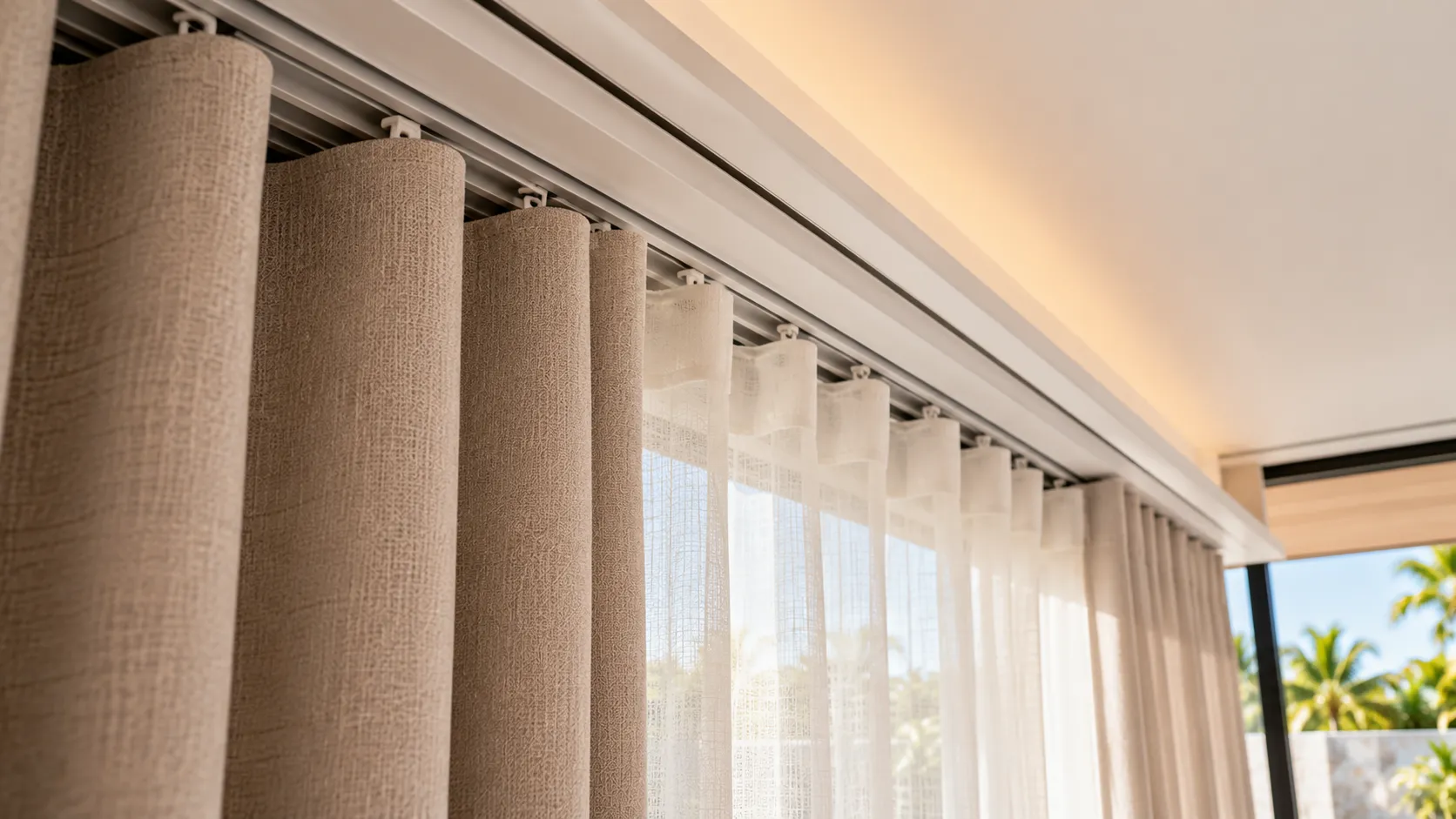
Use a single track when one layer is sufficient. A double track allows independent sheer and blackout layers, but requires additional depth and clearance around handles, doors and pelmets.
Wave-Fold and Heading Compatibility
Wave-fold curtains depend on compatible carriers and heading tape. Track specification, carrier spacing, fullness and fabric width should be treated as one system so the finished folds remain consistent.
Common Installation Mistakes
- Fixing into a weak surface.
- Ignoring handles and door clearance.
- Stopping the track at the glass edge when broader coverage is required.
- Choosing a profile without considering curtain weight.
- Forgetting stack-back space.
- Using a double track without enough layer clearance.
Modern Interior Checklist
- Confirm finished width and drop.
- Confirm heading and fullness.
- Estimate finished curtain weight.
- Check wall or ceiling fixing.
- Check handle and door clearance.
- Plan stack-back.
- Select single, double or motorized operation.
- Confirm finish and visual alignment.
For Villas and Large Openings
Wide glazing, high ceilings and sliding doors require the track to be coordinated with architecture. A site survey can confirm mounting, span, clearance and operating requirements before fabrication. Almeers Living provides custom measurement and installation for Bali properties.