In a holiday villa, curtains do more than complete the interior design. They help guests sleep comfortably, enjoy privacy, manage tropical daylight and feel at home. For owners and property managers, they also need to withstand frequent use, housekeeping routines, sunlight and the practical demands of short-stay accommodation. The most effective curtain trends for villa rentals therefore combine a refined appearance with durability, easy maintenance and reliable everyday performance.
Across Bali, villa interiors often feature large glazed openings, sliding doors, high ceilings and a strong connection between indoor and outdoor spaces. These architectural features create beautiful natural light, but they can also introduce heat, glare, fading and privacy challenges. Selecting curtains for a rental property requires a balance between the design vision and the realities of hospitality operations.
This guide explains how to choose hospitality-suitable fabrics, evaluate stain-resistant treatments, plan layered window coverings and improve guest comfort without relying on trends that are difficult to maintain. It is intended for Bali villa owners, holiday-rental operators, developers, interior designers and property managers.
1. The New Priorities in Villa-Rental Curtains
Hospitality design is increasingly judged by how well a space works as well as how it looks. Guests may notice a beautiful fabric first, but they remember whether the bedroom was dark enough, whether the living area felt private at night and whether the curtains were easy to operate. For owners, the best solution is one that continues to look presentable after repeated opening, closing and cleaning.
Three priorities should guide the selection process:
- Guest experience: suitable light control, privacy, smooth operation and a comfortable atmosphere.
- Operational durability: fabrics and hardware that can tolerate regular handling and an appropriate cleaning routine.
- Design consistency: colours, textures and proportions that support the villa's architecture and brand identity.
A useful trend is the move away from choosing curtains on appearance alone. Property owners are increasingly considering fabric performance, maintenance instructions, replacement availability and the cost of ownership over time.
2. Choosing Durable Hospitality Fabrics
There is no single fabric that is best for every rental villa. The right choice depends on the room, exposure to sunlight, frequency of occupancy, cleaning method and desired visual character. A fabric that performs well in a shaded bedroom may not be the most practical option for a bright living room with wide glass doors.
Polyester and polyester blends
Well-constructed polyester fabrics and suitable blends are common practical options for hospitality environments. They can offer good dimensional stability and a wide choice of colours and textures. Their actual performance still depends on yarn quality, weave, weight, construction and the manufacturer's care instructions. Do not assume every polyester fabric is automatically stain-proof or suitable for every cleaning process.
Textured and linen-look fabrics
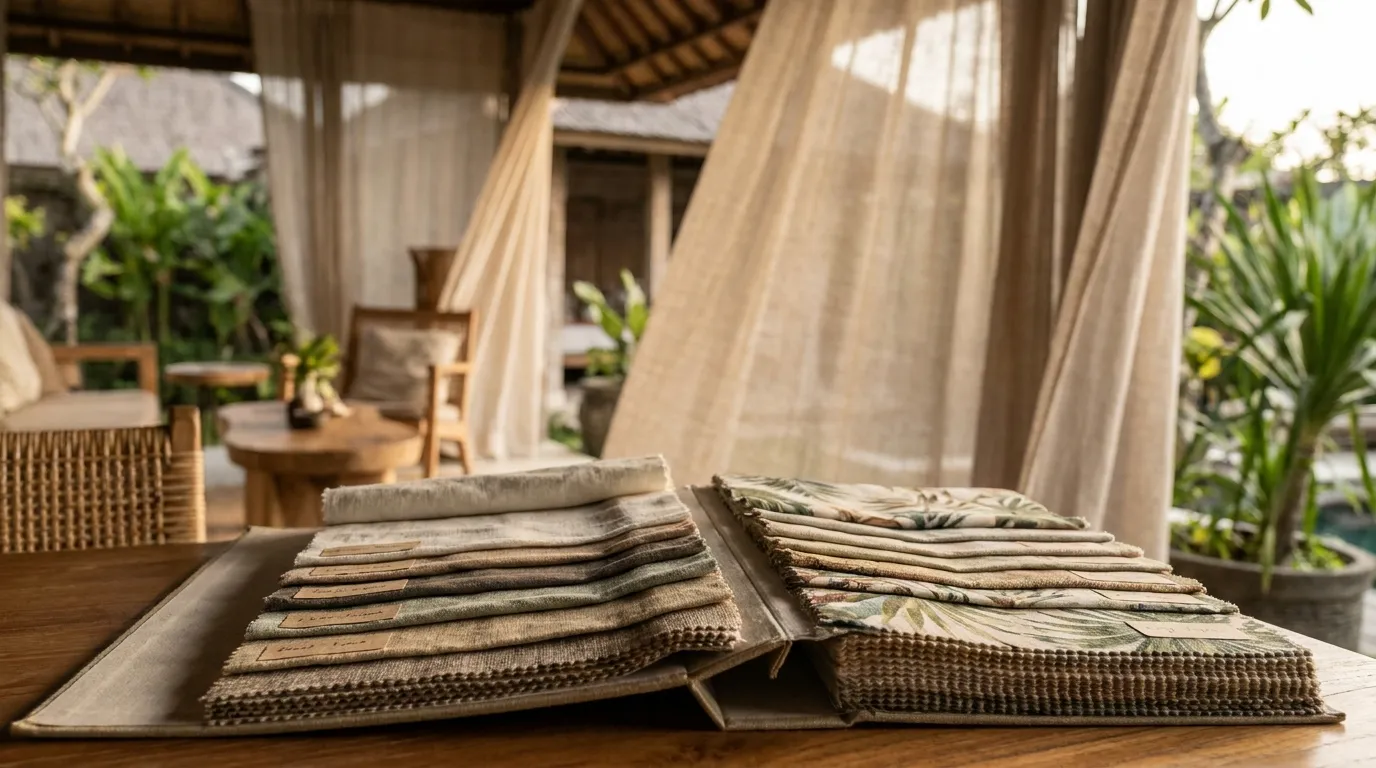
Linen-look textiles bring a relaxed, natural appearance that works well with Bali's tropical and contemporary villa styles. They can create visual warmth without requiring the property to use pure linen. When evaluating these materials, check the fabric composition, snag resistance, cleaning requirements and how the texture looks under direct daylight.
Actual linen and natural fibres
Natural fibres can provide an appealing hand feel and distinctive texture, but they may require more careful maintenance and can respond differently to moisture, sunlight and laundering. If selecting pure linen or another natural fibre for a high-turnover rental, confirm the recommended cleaning method and ask for a sample to assess creasing, drape and colour behaviour.
Fabric performance comparison
| Fabric direction | Design character | Points to evaluate | Potential application |
|---|---|---|---|
| Polyester or polyester blend | Versatile, from plain to textured | Weave strength, colourfastness, care instructions and drape | Bedrooms, living rooms and frequently used spaces |
| Linen-look textile | Relaxed, natural and contemporary | Composition, snagging, crease appearance and cleaning method | Living areas and bedrooms with a natural palette |
| Pure linen | Distinctive natural texture | Wrinkling, shrinkage risk, maintenance and light exposure | Selected premium spaces where care requirements are manageable |
| Sheer or voile | Light, soft and airy | Delicacy, snagging, transparency and washing instructions | Daytime privacy layers and softened daylight |
| Dimout or blackout fabric | Substantial, functional and often layered | Opacity, backing, weight, drape and edge-light gaps | Guest bedrooms and media or relaxation rooms |
3. Stain Resistance and Practical Maintenance
Rental properties experience more varied use than private homes. Guests may bring food and drinks into bedrooms, children may touch the fabric, and housekeeping teams need to prepare rooms within a limited turnaround time. Stain-resistant finishes can be useful, but they should be understood as a maintenance aid rather than a guarantee that a curtain cannot be stained.
What a stain-resistant finish can and cannot do
Depending on the product and treatment, a finish may help liquids bead on the surface temporarily or make certain marks easier to remove. Performance varies by chemistry, fabric construction, stain type and cleaning response. Some finishes can reduce effectiveness after repeated washing or inappropriate cleaning products. Always request the manufacturer's technical information and care guidance.
Practical steps for stain management
- Choose colours and textures that suit the property's use. Mid-tone neutrals and subtle textures can be more forgiving of minor everyday marks than very pale, perfectly smooth surfaces.
- Keep spare fabric or replacement panels from the same dye lot where possible, especially for large or signature installations.
- Train housekeeping staff to follow the fabric's care label and avoid aggressive rubbing, bleach or unapproved chemicals.
- Address spills promptly using the cleaning method approved by the supplier.
- Inspect curtain hems, leading edges and areas near handles or seating where contact is frequent.
For high-occupancy villas, removable or serviceable curtain panels can make maintenance planning easier. However, the heading system, hooks and fabric construction must be selected so that removal and rehanging do not damage the material or create inconsistent drops.
4. Blackout, Dimout and Sheer Layering
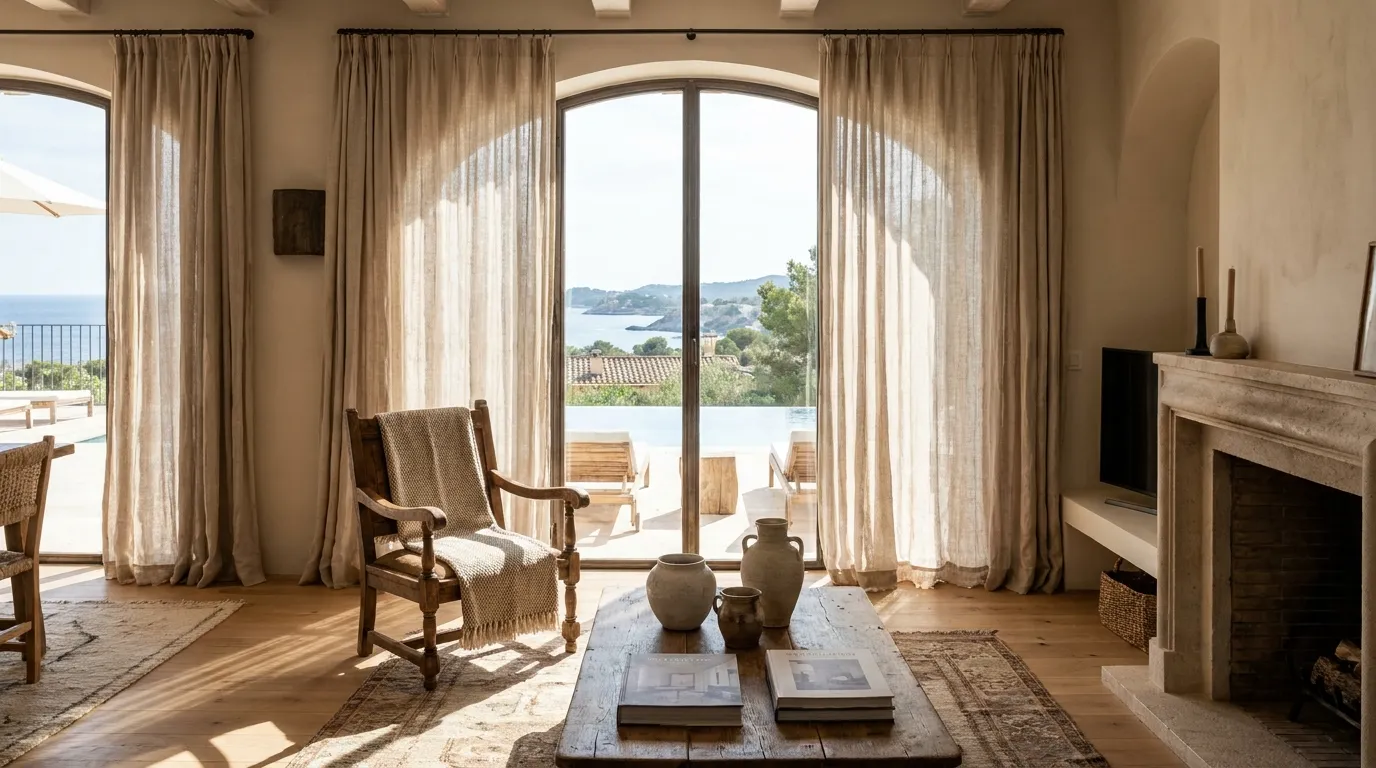
Layered window treatments remain a strong choice for villas because they allow one room to serve different needs throughout the day. A sheer layer can soften daylight and provide a degree of daytime screening, while a heavier dimout or blackout curtain can improve darkness and privacy when closed.
Sheer curtains for daytime ambience
Sheers diffuse direct daylight and reduce the exposed feeling of large glazed openings while preserving a bright atmosphere. They are especially useful in living and dining spaces. Their privacy performance depends on the difference between indoor and outdoor light levels; at night, when the room is illuminated, silhouettes may be visible from outside. Sheers should not be presented as a complete privacy solution.
Dimout curtains for flexible light reduction
Dimout fabrics reduce incoming light but do not necessarily create a fully dark room. They can be suitable where guests need softer light control without the heavier appearance of some blackout constructions. The correct choice depends on the bedroom's orientation, external lighting and guest expectations.
Blackout curtains for bedrooms
Blackout fabric is often a practical choice for guest bedrooms, particularly where early sunrise, outdoor lighting or nearby activity may disturb sleep. The result depends on the complete installation, not only the fabric. Light can still enter through the sides, top and bottom if the curtain does not adequately cover the opening. Consider track position, overlap, return details and the distance between the fabric and the wall.
| Layer | Main role | Planning note |
|---|---|---|
| Sheer / voile | Soft daylight and a lighter daytime atmosphere | Check transparency and night-time privacy expectations |
| Dimout | Reduced light and a softer room environment | Do not describe it as complete blackout |
| Blackout | Strong light blocking for sleep and media use | Plan coverage and installation details to minimise light gaps |
For a layered solution, a double track or another suitable dual-layer system allows guests to operate each curtain independently. Explore the available curtain and blind options to match the functional requirements of each room.
5. Guest Comfort: Privacy, Sleep and Temperature
Comfort is a combination of several factors. Curtains can help manage daylight, glare and the feeling of exposure, but they should be considered alongside glazing, ventilation, shading, air-conditioning and the villa's overall building design.
Sleep quality and bedroom darkness
Guests have different sleep preferences. A well-planned bedroom should offer a reliable way to reduce unwanted light, especially in rooms facing sunrise, gardens with pathway lighting or neighbouring properties. Blackout curtains with appropriate coverage are one option. Check the opening dimensions and curtain position before finalising the specification.
Privacy without losing the connection to the outdoors
In tropical villas, large windows and sliding doors often frame gardens, pools and outdoor living spaces. A combination of sheer and opaque curtains gives guests more control over privacy during different times of day. Consider sightlines from neighbouring villas, pathways and shared facilities before choosing the fabric opacity.
Managing solar heat and glare
Window coverings can reduce direct glare and may help limit solar heat entering a room, depending on fabric properties, colour, lining, glazing and how the curtain is used. They are not a substitute for correctly designed external shading or an efficient cooling system. For strong afternoon sun, assess the window orientation and consider whether a suitable blind, solar screen or lined curtain would work best.
6. Curtain Styles That Suit Rental Properties
Current villa design often favours calm palettes, tactile materials and clean architectural lines. For rental properties, these styles can remain attractive across changing décor trends and make it easier to maintain a consistent appearance between rooms.
Natural neutrals and understated texture
Warm white, ivory, oatmeal, sand, taupe and soft grey work well with timber, stone, rattan and other natural finishes. A textured weave adds depth without relying on a strong print that may date quickly or compete with the interior.
Wave or S-fold curtains
Wave-style curtains create regular, flowing folds and a contemporary finish. They are particularly effective across wide openings when paired with a compatible track and correctly calculated fabric fullness. The track, gliders, fabric weight and installation height should be considered together to achieve consistent waves.
Floor-to-ceiling proportions
Full-height curtains can make a room feel taller and create a more finished appearance. Accurate measurements are essential, especially where ceilings, floor levels or tracks are not perfectly even. For guidance before ordering, see the curtain measuring guide.
Quiet visual consistency
Using a coordinated fabric family across bedrooms and living spaces can strengthen the villa's identity. It does not mean every room must have identical curtains. The same colour direction with different opacity or texture can create a cohesive result while responding to each room's needs.
7. Tracks, Operation and Installation Details
Even a high-quality fabric can disappoint if the track is difficult to operate or poorly installed. In rental properties, hardware is handled by many different guests, so smooth movement and secure fixing matter.
- Track capacity: confirm that the track and brackets are suitable for the total curtain weight and span.
- Glider compatibility: match the heading style and gliders to the selected track system.
- Secure fixing: assess the ceiling or wall substrate and use suitable fixings for the installation conditions.
- Operating clearance: make sure curtains do not obstruct door handles, furniture, air-conditioning units or access routes.
- Maintenance access: consider how staff can remove panels and reach tracks safely for cleaning or repairs.
- Motorisation: for selected large or hard-to-reach openings, motorised curtains may improve convenience. Plan power, controls, manual operation requirements and servicing access before installation.
For wide windows, high ceilings or multiple connected panels, a site measurement is recommended. It helps confirm the track length, stacking space, curtain drop, fixing points and how the fabric will sit when open and closed. The curtain stacking calculator can also help estimate how much space the opened curtains may occupy.
8. Room-by-Room Recommendations
| Villa area | Suggested direction | Key consideration |
|---|---|---|
| Guest bedroom | Blackout or suitable dimout, optionally paired with a sheer | Sleep comfort, coverage and easy operation |
| Living room | Sheer with a coordinated opaque layer where needed | Daylight, views, privacy and large opening access |
| Dining area | Easy-care textured fabric or sheer depending on exposure | Proximity to food, seating and frequent handling |
| Media / projector room | Blackout solution with carefully planned edge coverage | Control of stray light and compatibility with the room setup |
| Bathroom or dressing area | Moisture-appropriate window covering selected for the conditions | Ventilation, privacy and distance from direct water contact |
| Sliding doors | Ceiling-mounted track or suitable blind system | Door clearance, stacking space and frequent movement |
These are starting points rather than fixed rules. A bedroom with deep external shading may need a different specification from one exposed to direct morning sun. Likewise, a living room facing a neighbouring property may need more privacy than a room opening onto a secluded garden.
9. Cleaning, Inspection and Replacement Planning
Maintenance should be considered before the curtains are installed. A fabric that looks excellent but requires a cleaning process unavailable to the property team may become an operational problem. Ask for written care instructions and share them with the housekeeping or maintenance team.
Simple maintenance routine
- Include a visual curtain check in room-turnover or scheduled housekeeping inspections.
- Look for visible stains, loose hooks, uneven hems, snagging and track resistance.
- Use gentle dust removal methods appropriate to the fabric.
- Arrange deeper cleaning according to the manufacturer's instructions and actual occupancy.
- Record repairs and recurring issues so that fabric or hardware problems can be addressed early.
For replacement planning, retain the product name, colour reference, composition, supplier details and installation measurements. Keeping a small quantity of matching spare fabric can be valuable for properties where continuity of appearance is important. If the original fabric is discontinued, having the specification makes it easier to select a close alternative.
10. A Practical Selection Checklist for Villa Owners
Before approving a curtain order, review the following points with your designer, supplier or installer:
- Identify the purpose of each window: privacy, sleep, glare reduction, decoration or a combination.
- Record accurate width, height, ceiling level, opening direction and nearby obstructions.
- Confirm fabric composition, usable width, weight, opacity and care instructions.
- Request physical samples and view them in the actual room under daytime and evening lighting.
- Ask what stain-resistant treatment is applied, what it is designed to do and how it affects cleaning.
- Choose sheer, dimout or blackout according to the real light-control requirement.
- Check track strength, glider compatibility, fixing method and operating clearance.
- Confirm whether the curtains can be removed and rehung for maintenance.
- Agree on production, installation, warranty and after-sales arrangements in writing.
- Keep the final fabric and hardware specifications for future repairs or replacements.
For a complete window-treatment plan, compare curtains and blinds based on the opening, room function and maintenance needs rather than selecting one product type for every window. Additional options and product directions are available on the Almeers Living products page.
11. Frequently Asked Questions
What are the best curtains for a Bali villa rental?
The best choice depends on the room, sunlight exposure, occupancy and cleaning routine. Durable polyester blends or suitable textured fabrics may be practical for frequently used areas, while bedrooms often benefit from dimout or blackout curtains. Always check the actual fabric specification and care instructions.
Are stain-resistant curtains completely stain-proof?
No. Stain-resistant treatments may make certain spills easier to manage, but they do not guarantee protection against every stain. Results depend on the treatment, fabric, spill type, cleaning method and age of the finish.
Should every villa bedroom have blackout curtains?
Not necessarily, but blackout curtains are worth considering where guests need strong light reduction. The installation must also provide suitable coverage at the top, sides and bottom; blackout fabric alone cannot eliminate every light gap.
Are sheer curtains enough for privacy at night?
Usually not. When the interior is brighter than the exterior, people outside may see silhouettes or activity through sheer fabric. Pair sheers with an opaque curtain or another suitable privacy solution when night-time privacy is required.
Which curtain style is practical for wide sliding doors?
A well-specified track system with wave or another compatible heading can work well. The design should account for the door's movement, the space needed for stacked curtains, track capacity and how frequently guests will operate the panels.
How often should rental villa curtains be cleaned?
There is no universal interval. Follow the fabric manufacturer's care instructions and set an inspection and cleaning schedule based on occupancy, visible soiling, local conditions and the property's housekeeping procedures.
Can curtains help reduce heat in a tropical villa?
They can help manage glare and may reduce some solar heat gain, depending on fabric, lining, colour, glazing and usage. Their effectiveness varies, and they should complement rather than replace suitable external shading, ventilation and cooling design.
Conclusion: Design for the Guest and the Property
The strongest curtain trend for villa rentals is not simply a particular colour or heading style. It is a performance-led approach: attractive fabrics that suit the interior, practical maintenance requirements, appropriate light control, dependable hardware and a comfortable experience for guests. In Bali's tropical environment, each window should be assessed for its exposure, privacy needs and daily use.
By planning fabric, opacity, track systems and maintenance together, villa owners can create interiors that look considered while remaining easier to operate and care for. Almeers Living provides custom curtains and blinds for villas and hospitality properties in Bali, with solutions tailored to each opening and design brief. To discuss a project, explore our window-treatment range or review the curtain measuring guide before arranging measurements.