1. Why Curtains Can Work as Art
Windows naturally attract attention because they connect the interior with the outside world. Curtains add another layer to that visual relationship: they introduce colour, rhythm, movement and texture around an architectural opening. When selected with intention, they can function like a large-scale artwork while remaining useful as a window covering.
Unlike a framed picture, curtains change as they are opened, drawn or moved by a breeze. Their folds create highlights and shadows, while the fabric’s surface can look different in morning daylight, strong afternoon sun and warm evening lighting. This changing quality makes drapery particularly effective in living rooms, bedrooms, dining areas and hospitality spaces where atmosphere matters.
A statement curtain does not have to be loud. A restrained botanical motif, a distinctive woven texture, a rich solid colour or a sculptural pleat can all create a focal point. The important distinction is intention: the window treatment should feel like a considered part of the interior composition, rather than an accessory added at the end.
2. Choosing a Statement Pattern
Pattern is one of the most direct ways to turn a window into a visual feature. Florals, botanical prints, geometric designs, abstract marks and traditional motifs each create a different mood. Before choosing a fabric, consider the character of the room and the visual language already present in its furniture, flooring, artwork and finishes.
Match the pattern to the interior direction
- Botanical and organic patterns: Leaf forms, branches and flowing shapes can complement natural materials, garden views and relaxed tropical interiors.
- Geometric patterns: Repeated lines, grids and angular shapes often suit contemporary rooms with clean furniture profiles and structured architecture.
- Abstract patterns: Irregular shapes and painterly marks can introduce movement and individuality, particularly in otherwise simple spaces.
- Traditional motifs: Decorative repeats can bring a sense of heritage and detail to classic, eclectic or layered interiors.
- Textured solids: A fabric with a visible weave, slub or subtle tonal variation can create impact without a printed motif.
Look at the pattern in the context of the full room, not only as a small fabric sample. A design that appears subtle on a hand-sized swatch may become much more prominent when repeated across several metres of curtain. Whenever possible, view a larger sample vertically and observe it in the actual room’s natural and artificial light.
Use colour relationships rather than exact matching
A statement pattern can include a colour already present in a rug, cushion, artwork or timber finish. This creates a visual connection without requiring every item to match exactly. A useful approach is to select one dominant neutral, one supporting colour and one accent tone. The curtain can carry the accent, while smaller objects repeat it elsewhere in the room.
3. Getting Pattern Scale and Proportion Right
Pattern scale affects how a curtain reads from across the room. Large motifs tend to create a confident, graphic effect and can suit broad windows or generous wall areas. Small repeats usually feel more detailed and may blend more quietly into the background. Neither is automatically better; the right choice depends on viewing distance, window dimensions, ceiling height and the amount of visual activity elsewhere.
| Pattern scale | Visual effect | Useful considerations |
|---|---|---|
| Large-scale motif | Bold, expressive and immediately noticeable | Allow enough fabric width for the motif to read clearly; consider where the pattern falls across joins and folds. |
| Medium repeat | Decorative but generally easier to balance | Can work in many living and bedroom settings; check the repeat against the finished drop. |
| Small repeat | Subtle, detailed and often visually softer | Can add interest in compact rooms, but very fine patterns may appear busy at close range. |
| Textural or tonal design | Depth without a strong printed image | Assess the weave and colour variation under different lighting conditions. |
Fullness also changes the appearance of a pattern. When fabric is gathered into folds, parts of the motif disappear into the pleats and other parts become more prominent. A sample displayed flat cannot fully predict this effect. Ask to see the fabric gathered or draped, and confirm how the chosen heading style will affect the finished appearance.
For a large window, consider whether the motif should be centred, repeated symmetrically or allowed to fall naturally. Pattern matching at fabric joins may increase fabric consumption and should be discussed before a quotation is finalised. The required amount depends on the fabric width, pattern repeat, finished curtain dimensions and manufacturing layout.
4. Layering Bold Accents with Restraint
Layering creates depth by combining the statement curtain with supporting colours, textures and window coverings. The goal is not to make every layer compete. Instead, give each element a clear role: one can provide the main visual statement, another can soften daylight, and a third can contribute privacy or practical light control.
Build a clear visual hierarchy
- Choose the lead element. Decide whether the focal point will be the patterned drapery, a strong solid colour, a distinctive sheer or the window architecture itself.
- Add a quieter supporting layer. A plain sheer or a subtle textured fabric can balance a more expressive outer curtain.
- Repeat the accent selectively. Carry one colour into cushions, a small upholstered detail, artwork or accessories rather than repeating the full curtain pattern everywhere.
- Leave visual breathing space. Keep nearby walls and large furniture surfaces relatively calm if the curtain design is already complex.
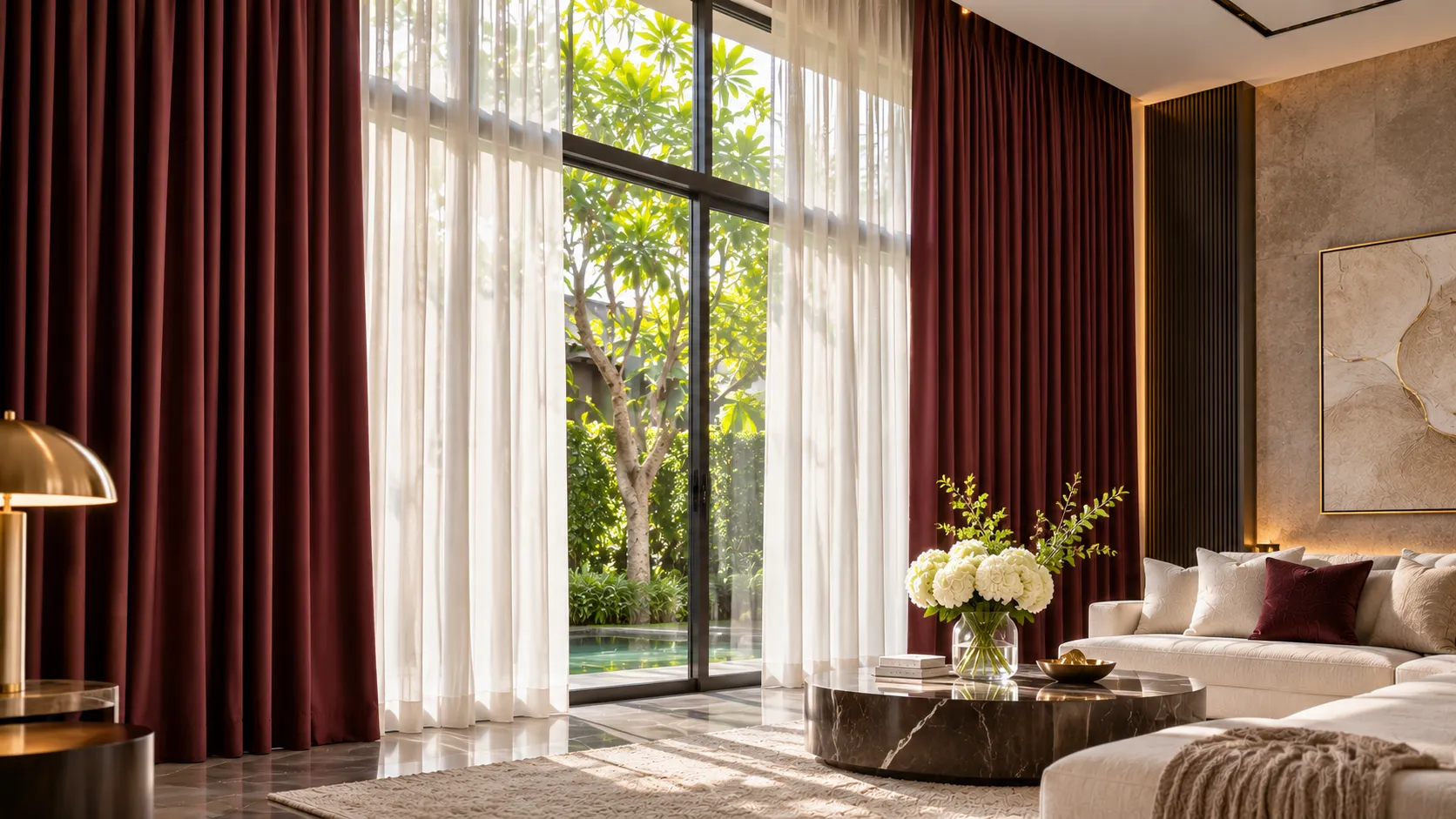
For example, a patterned outer curtain in muted terracotta and olive can be paired with a warm-white sheer. The accent colours may then appear in a cushion or ceramic object. This makes the window feel connected to the room while preserving a clear focal point.
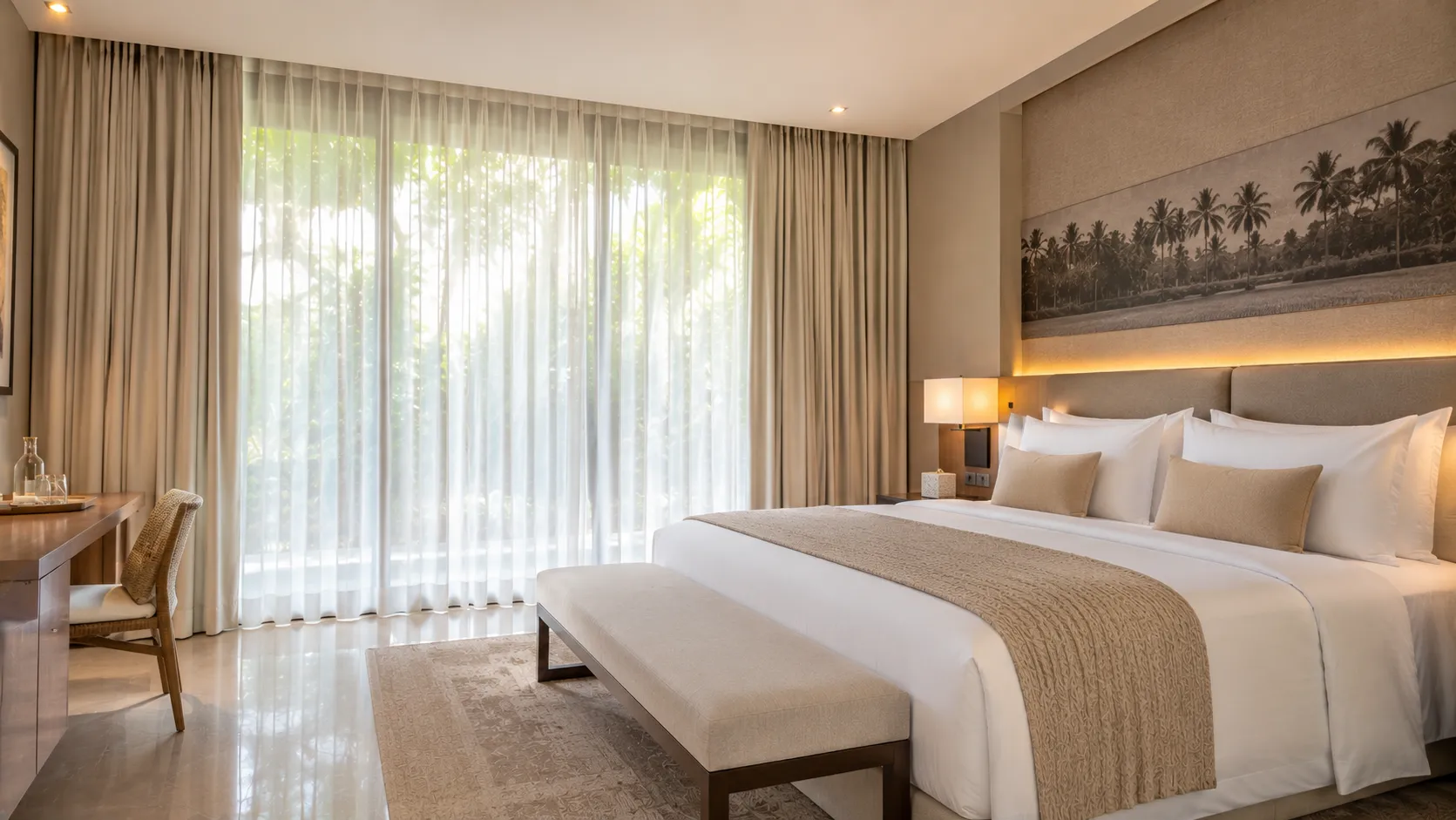
Layering can also be functional. A sheer layer can diffuse daylight and provide daytime screening in some conditions, while a separate dimout or blackout layer can offer stronger light reduction and privacy when closed. The result depends on fabric construction, installation and the gaps around the window; no fabric should be assumed to create complete darkness or privacy in every condition.
5. Highlighting Architectural Frames
Curtains can draw attention to the shape and scale of a window. A full-height installation can visually connect the ceiling and floor, while a wider track can allow the curtains to stack clear of the glass when open. These choices can make a window feel more generous and emphasise architectural lines.
Use height to create a stronger vertical line
Where the room design allows, mounting the track closer to the ceiling and allowing the curtain to finish near the floor can create a continuous vertical composition. The exact position should be planned around ceiling details, pelmets, air-conditioning units, doors, cornices and access for installation. A floor-grazing finish is often practical, while a deliberate puddled finish requires more consideration for cleaning and daily use.
Frame the opening with width
A track that extends beyond the window frame can allow more of the glass to remain visible when the curtains are open. It can also make the window treatment appear more substantial. The extension required depends on the available wall space, curtain stack-back, nearby corners and whether the window is beside a door or another opening.
Respect unusual window shapes
Arched, angled, unusually tall and corner windows need individual planning. A straight track may be suitable for some designs, while others may require a shaped track, a separate blind, a fixed decorative treatment or a combination. Avoid forcing a standard solution onto a distinctive architectural feature without checking operation, access and the desired appearance.
6. Selecting Fabric, Texture and Opacity
The fabric determines how the curtain hangs, how its pattern appears and how it performs in everyday use. Weight, drape, weave, lining and opacity all matter. A crisp fabric may hold a structured shape, while a softer fabric can create relaxed folds. A heavily textured textile may add depth even when its colour is understated.
| Fabric direction | Design character | Practical points |
|---|---|---|
| Linen and linen-look textiles | Natural, relaxed and tactile | Check composition, care instructions, shrinkage guidance and how the fabric responds to humidity. |
| Velvet and heavier decorative fabrics | Rich colour, depth and a more formal statement | Consider weight, suitable track support, dust care and the room’s ventilation. |
| Printed cotton or blended textiles | Clear motifs and a wide range of patterns | Check colourfastness, lining requirements and whether the print repeat affects cutting. |
| Sheer and lightweight fabrics | Soft daylight and an airy visual layer | Privacy varies with lighting and visibility conditions; sheers are not a substitute for night-time privacy. |
| Dimout or blackout fabrics | More controlled light reduction and a quieter backdrop | Confirm the required level of light control and account for light entering around the edges. |
For a patterned curtain, check the reverse side as well as the face. Some fabrics have a noticeably different reverse, which may be visible from outside or when the curtain is folded back. Lining can change the drape, weight and appearance, so review the complete proposed construction rather than selecting the face fabric alone.
In hospitality interiors, consider cleaning frequency, guest use, replacement availability and how the fabric will look after repeated operation. A beautiful fabric is only a successful choice when its maintenance requirements are realistic for the property.
7. Ideas for Different Rooms
Living rooms
Living rooms can accommodate a more expressive design because they often have enough viewing distance for a large-scale motif. Consider the sofa, rug and artwork before selecting a pattern. If the room already contains strong colours or busy surfaces, a textured solid or restrained geometric may create a more balanced result.
Bedrooms
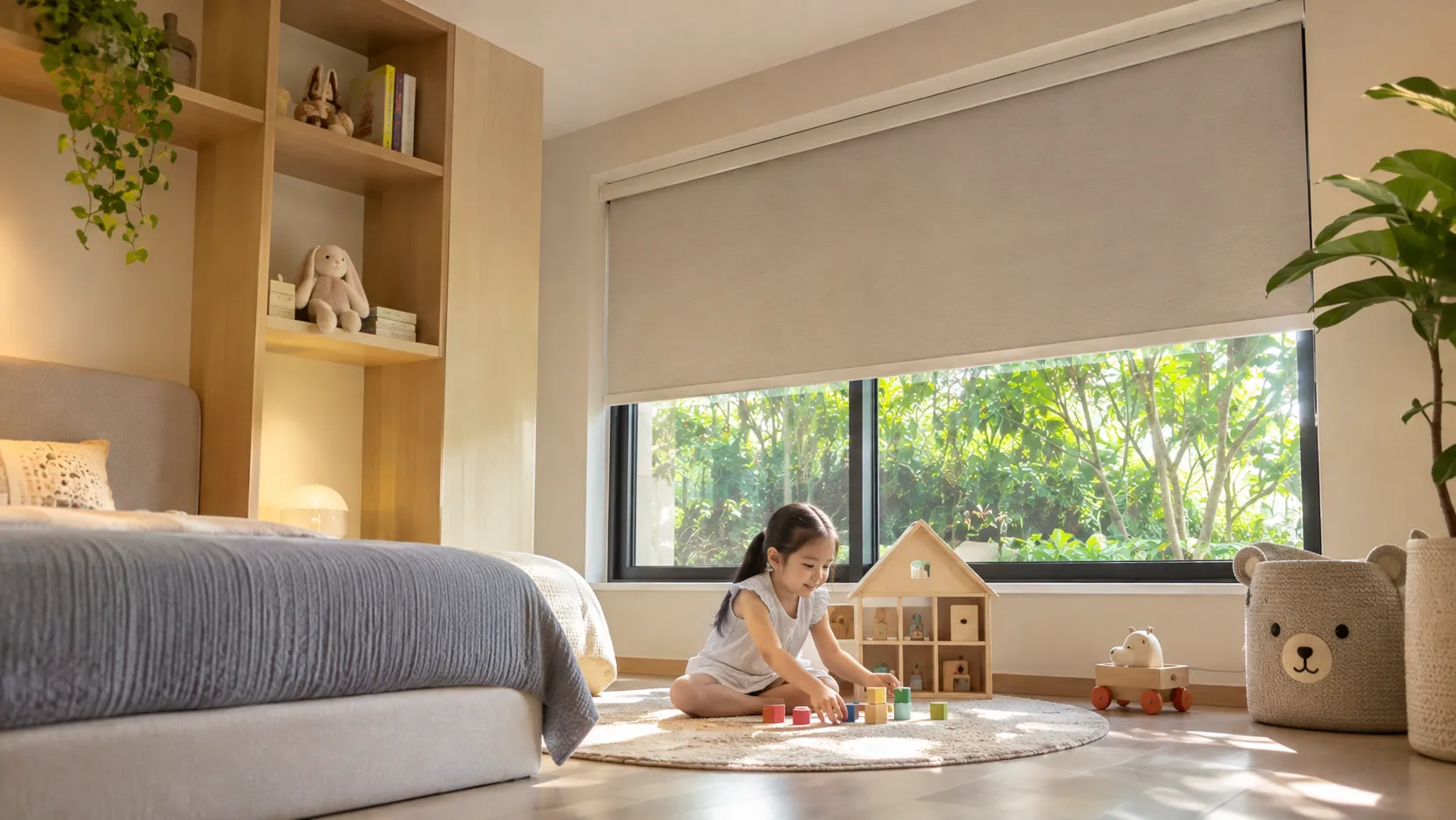
In bedrooms, a statement curtain can add personality without compromising rest. Pair a decorative face fabric with an appropriate lining or a separate light-control layer when needed. Select colours and patterns that feel comfortable in evening lighting, and check that the curtain can be operated easily around bedside furniture.
Dining rooms
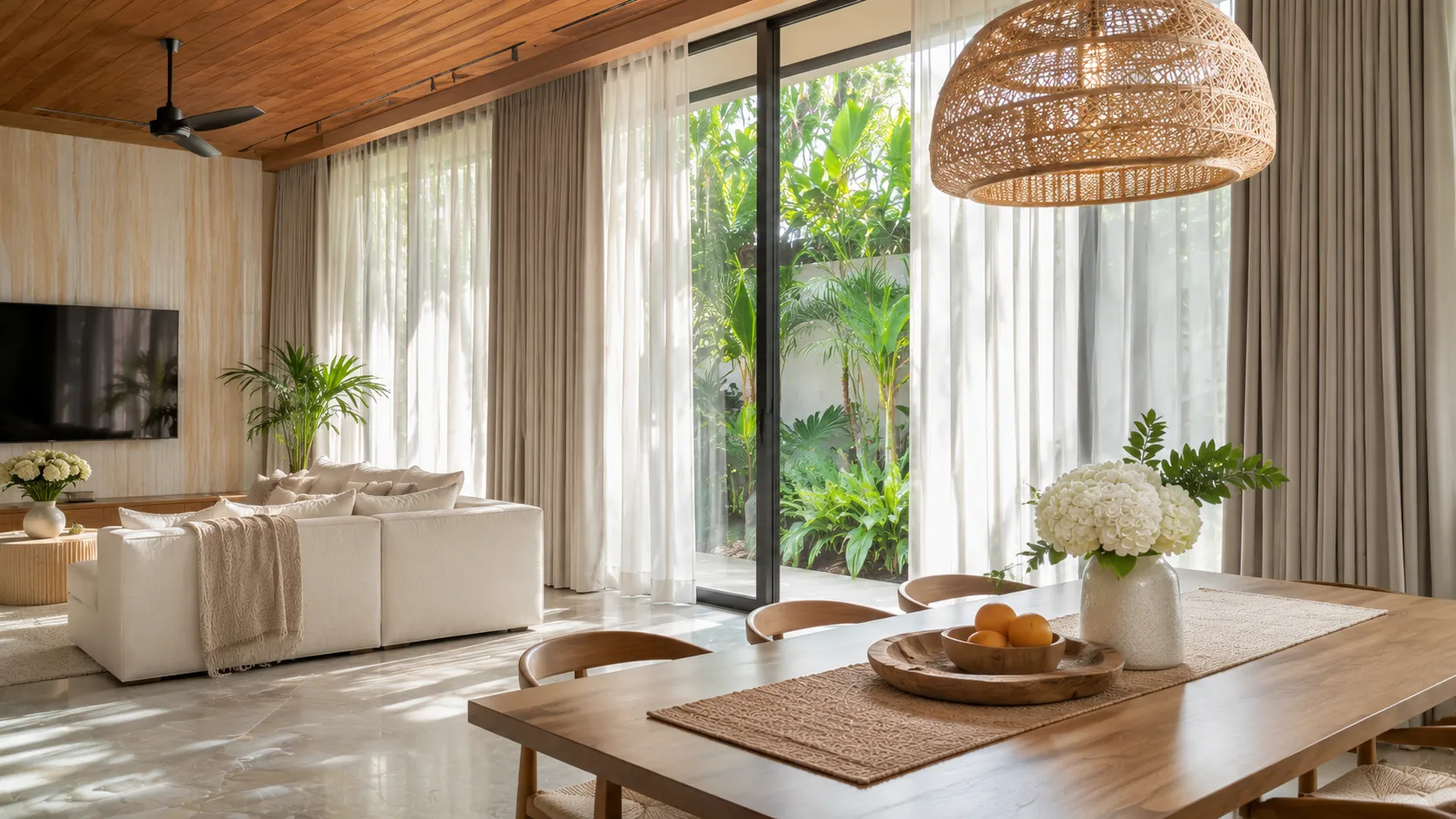
Dining areas can benefit from a pattern that relates to the table, pendant lighting or artwork. Consider how close chairs sit to the curtain and whether fabric could be exposed to food, moisture or frequent contact. A practical hem length and easy access for cleaning can be as important as the visual effect.
Villas and hotel suites
In villas and hotels, curtains contribute to the property’s identity and the guest experience. A distinctive pattern can reinforce a design concept, but repeatability matters across multiple rooms. Plan a coordinated palette with controlled variations so the property feels cohesive without every room looking identical.
8. Designing Statement Curtains for Bali Properties
For Bali villas, resorts and apartments, statement window treatments should respond to strong daylight, humidity, ventilation and the property’s relationship with outdoor spaces. Large openings, garden views and indoor-outdoor layouts can make curtains a prominent part of the interior architecture.
Natural textures, botanical motifs and earthy colours can complement tropical materials such as timber, stone, rattan and woven finishes. However, the right selection depends on the specific room. A window exposed to direct sun may need a different fabric construction or lining from a shaded bedroom opening. Coastal properties may also require careful consideration of hardware finishes and routine maintenance.
- Manage sunlight: Assess the direction and intensity of daylight before choosing colour, opacity and lining. Strong sunlight can affect both comfort and the long-term appearance of some textiles.
- Plan for humidity: Allow suitable ventilation and follow the fabric’s care guidance. No textile should be described as mould-proof without product-specific evidence.
- Choose practical hardware: Select tracks, brackets and components appropriate for the curtain weight and installation environment. In coastal settings, discuss corrosion resistance and maintenance.
- Consider indoor-outdoor views: A sheer layer can soften the transition to a garden or pool area, while a separate layer can provide greater privacy when required.
- Think about operations: For rental villas and hotels, choose systems that guests and housekeeping staff can operate and maintain easily.
Almeers Living works with custom curtains and blinds for Bali properties, including villas, hotels and residential interiors. Explore the Almeers Living product range to compare window treatment directions, or use the design and window treatment articles for further planning ideas.
9. Tracks, Headings and Finishing Details
Hardware and construction determine whether the finished curtain looks intentional. A decorative fabric can lose impact if the track is undersized, the heading is poorly suited to the textile or the folds are inconsistent. Conversely, a simple fabric can look refined when its proportions and finishing are well considered.
Choose a heading that supports the design
- Wave or S-fold: Creates a regular, contemporary wave and works well when a consistent rhythm is desired.
- Pinch pleat: Produces a more tailored, structured appearance and can suit classic or formal interiors.
- Eyelet or ring heading: Makes the hardware part of the visible design and can create a more casual decorative effect.
- Pencil pleat or gathered heading: Offers a softer gathered look, with the final appearance depending on fullness and tape construction.
Not every heading is suitable for every fabric or track. Fabric weight, available stack space, track type, operation and the desired fold shape should be checked together. The curtain’s fullness ratio should be selected for the fabric and heading, rather than assumed to be identical for every project.
Finishing details include hems, returns, side overlaps, lining, pattern alignment and the way the curtain meets the floor. These details may seem small on a specification sheet, but they strongly influence the final visual result.
10. Planning, Measuring and Caring for Statement Curtains
Accurate measurements are essential because statement curtains often occupy a large area and make proportion errors easy to notice. Before ordering, confirm the finished track or pole position, overall width, drop, stack-back space, floor clearance and any obstacles such as handles, cabinetry or air-conditioning units.
For a practical starting point, refer to the Curtain Measuring Guide. If the project includes blinds as well as curtains, review the Shade Measuring Guide. For decorative top treatments, see the Valances and Cornices Measuring Guide. The Curtain Stacking Calculator can also help visualise how much space curtains may occupy when open.
Before confirming an order
- Measure the opening and confirm the proposed track or pole position.
- Check the full fabric sample vertically and in the room’s lighting.
- Confirm the pattern repeat, pattern direction and any matching requirements.
- Agree on the heading style, fullness, lining and finished hem.
- Check track capacity, brackets, access and the available stack-back area.
- Confirm the cleaning instructions, care requirements and realistic maintenance plan.
Care should follow the fabric manufacturer’s instructions. Regular gentle dust removal can help keep curtains presentable, while spot cleaning, washing or professional cleaning should only be carried out when permitted for the specific textile and lining. Avoid assuming that all decorative fabrics can be machine washed or exposed to strong cleaning products.
For custom projects, a site measurement and consultation can help resolve details that are difficult to assess from photographs alone. This is particularly useful for tall windows, curved openings, multiple layers and rooms where the curtain must coordinate with other architectural finishes.
11. Frequently Asked Questions
Can curtains really become the main artwork in a room?
Yes. A patterned, richly coloured or highly textured curtain can act as a large-scale visual feature. Its success depends on proportion, fabric quality, the room’s palette and how much competing decoration is present.
Are bold patterned curtains suitable for small rooms?
They can be. Consider the pattern scale, contrast and viewing distance. A small room may benefit from a controlled motif or a tonal pattern, while a large high-contrast print can work when the rest of the room is kept relatively simple.
Should curtains match cushions and rugs?
They do not need to match exactly. It is usually more effective to repeat one or two colours or textures across the room. This creates a connection while allowing the curtain to remain distinctive.
Can I combine patterned curtains with sheer curtains?
Yes. A patterned outer curtain can be paired with a quieter sheer to soften daylight and add depth. Check the combined colours in natural light and ensure both layers have enough space to operate independently.
Do blackout curtains make a room completely dark?
Not necessarily. Blackout fabric can block light through the fabric itself, but light may still enter around the sides, top, bottom or between panels. A room’s darkness depends on the full installation, not fabric alone.
What patterns work well in Bali villas?
Botanical, organic, geometric and textured designs can all work. Choose based on the villa’s architecture, interior palette, sunlight exposure, maintenance needs and the atmosphere the designer wants to create.
How do I know how much patterned fabric is required?
Fabric consumption depends on the track width, finished drop, fullness, fabric width, pattern repeat, heading style and pattern-matching requirements. A project-specific calculation is more reliable than using a single standard amount.
Make the Window Part of the Design Story
When curtains are treated as part of the architecture rather than a final accessory, they can bring together colour, pattern, texture and proportion in a memorable way. The strongest designs balance visual confidence with everyday function: the pattern feels intentional, the layers have distinct roles, and the hardware supports the fabric properly.
Whether you are styling a private residence, a Bali villa or a boutique hotel, begin with the character of the room and the experience you want the window to create. Then refine the fabric, scale, heading and installation details so the finished treatment feels integrated, expressive and practical.
Discover custom curtains and blinds with Almeers Living, or contact the team to discuss a window treatment concept for your property in Bali.
Design note: Fabric appearance, colour, opacity and performance vary by material, lining, lighting and installation. Confirm specifications and care instructions for the selected product before ordering.