Curtains and Children: Safety First
Window coverings help create privacy, manage daylight and complete the look of a bedroom or living space. In properties used by families, however, their design must also take account of children who may touch, pull, climb or play near curtains and blinds. Cords, chains, poorly secured tracks and unsuitable hardware can introduce avoidable hazards if they are not considered during specification and installation.
For Bali villas, family-friendly hotels and holiday rentals, child-conscious window treatment planning is especially important because a property may be used by guests who are unfamiliar with the room. A safe design should not depend only on a warning label or a guest remembering an instruction. It should reduce foreseeable hazards through suitable product selection, careful installation, clear operating arrangements and regular inspection.
This guide explains practical considerations for cordless curtain systems, fabric and flame-retardant claims, secure hardware and ongoing maintenance. It is intended as general design guidance, not a substitute for local building, fire, product-safety or child-safety requirements. Always verify the applicable rules and the exact product documentation for the property and its location.
1. Why Child-Conscious Window Treatment Design Matters
Children are naturally curious. They may pull a curtain to look outside, hold onto a hanging chain, tug at a fabric panel or use a low sill as a step. A window treatment that appears harmless to an adult can therefore create a risk when its operating components or fixings are accessible to a young child.
Safety should be considered from the earliest design stage, not added after the curtains have been installed. The product type, control method, track position, fixing substrate, furniture layout and window access all influence the final arrangement. The safest practical option is generally one that minimizes accessible loops and dangling cords, keeps hardware securely fixed and avoids creating tempting climbing points.
Where to pay attention
- Operating controls: Check for exposed cords, continuous loops, chains or detachable control components.
- Track and brackets: Ensure the system is appropriate for the curtain weight and securely attached to a suitable structure.
- Furniture placement: Avoid positioning beds, chairs or movable furniture where they provide easy access to a window or control mechanism.
- Window access: Consider opening restrictors, window locks and other appropriate measures where required by the building and local regulations.
- Guest turnover: In accommodation, ensure the safety arrangement remains effective after housekeeping and maintenance activities.
Important safety principle: Do not rely on supervision, warning stickers or instructions alone to control a foreseeable cord or loop hazard. Select an appropriate child-safe operating design and have it installed and checked correctly.
2. Cordless Tracks and Safer Operating Systems
Cordless curtain systems are worth considering for rooms used by children because they remove the need for an exposed pull cord or hanging control chain at the window. Depending on the product, curtains may be operated by hand, a wand, a spring-assisted mechanism or an electric motor. Each design has different operating requirements, so the product should be selected for the window size, curtain weight and intended users.
Manual hand-drawn curtain tracks
A hand-drawn track allows the user to move the curtain by holding the fabric or a designated operating point. When properly specified, it can provide a simple arrangement without a hanging control cord. The track and gliders must be suitable for the curtain’s weight and width, and the fabric should move smoothly without requiring excessive force.
Wand-operated systems
Some curtain tracks use a wand or baton to draw the curtain. This can keep the user’s hand away from the fabric and may offer a convenient alternative to cord operation. Check that the wand is appropriate for the product, securely connected as designed and stored or positioned so it does not become an accessible hazard. Follow the manufacturer’s installation and use instructions.
Motorized curtain tracks
Motorized tracks can remove the need for manual pull cords and may be useful for large windows, high ceilings and hospitality bedrooms. They can be operated through a wall switch, remote control or compatible automation system, depending on the model. Motorization does not automatically make an entire window installation child-safe: accessible controls, electrical components, moving parts and the surrounding window area still need to be considered.
For motorized systems, confirm the motor capacity, track compatibility, power arrangement, control placement and emergency or manual operation method. Keep remotes and control devices in an appropriate location, and ensure electrical work is completed by qualified professionals.
What to confirm before ordering
- Whether the system is genuinely cordless at the point of use.
- Whether any chain, loop, cord or detachable component remains accessible.
- Whether the operating method is suitable for the curtain weight and window dimensions.
- Whether the manufacturer provides child-safety instructions and product documentation.
- Whether the track can be installed securely into the actual ceiling or wall construction.
3. Understanding Cord and Chain Hazards
Dangling cords and continuous-loop chains on window coverings can present a serious strangulation hazard to young children. A loop can become dangerous if a child places their head or body inside it, and a loose cord may be pulled down or become caught around a child. This is why cord management should be treated as a core safety requirement rather than a decorative detail.
Where a corded or chain-operated product is being considered, do not improvise a safety solution. Use only the safety devices, tensioners, cleats or cord guides specified and approved for that exact product, and install them exactly as instructed. A device that is missing, incorrectly positioned, damaged or unsuitable for the mechanism may not provide the intended protection.
Safer design choices
- Prefer an appropriate cordless system where practical.
- Avoid leaving loose cords or chains hanging within a child’s reach.
- Do not tie cords together or create loops as a workaround.
- Keep beds, cots, play areas and climbable furniture away from window-covering controls.
- Inspect safety components after cleaning, repairs or changes to the room layout.
For family accommodation, consider specifying cordless operation as a project requirement from the outset. This makes it easier for designers, suppliers, installers and property managers to check the same safety objective throughout the project.
4. Choosing Fabrics for Family Environments
Fabric selection affects appearance, light control, cleaning and everyday use. In a bedroom or family living space, a suitable textile should be chosen according to the room’s exposure, expected cleaning frequency and the needs of the property. A fabric being described as natural, premium or child-friendly does not by itself prove that it is non-toxic or free from specific chemical substances.
Practical fabric considerations
- Fibre and finish information: Request the fabric composition and details of any coatings, backing, dyes or applied treatments.
- Cleaning requirements: Choose a fabric whose recommended care method is realistic for the property’s housekeeping routine.
- Durability: Consider abrasion, snagging, colour stability and the likelihood of frequent handling.
- Light control: Select sheer, dimout or blackout constructions according to the room’s privacy and daylight requirements.
- Allergy and sensitivity considerations: If a guest or resident has a known sensitivity, obtain product-specific information and seek appropriate professional advice rather than relying on a broad marketing description.
Natural, synthetic and blended textiles
Linen and cotton can provide a relaxed, tactile appearance, while polyester and blended fabrics are available in many constructions that may be suitable for demanding environments. No fibre category is automatically the safest or most durable in every situation. The finished textile, its dyes and treatments, cleaning method and documented product characteristics should all be considered.
For villas and hotels, request fabric samples and technical information before approving a large order. Review the material in the actual room, especially where strong sunlight, humidity or frequent cleaning may affect its performance.
5. Flame-Retardant Fabrics and Chemical Claims
Fire performance can be an important part of window-treatment specification, particularly in hotels, serviced accommodation and larger residential projects. However, flame-retardant, fire-resistant and inherently flame-resistant are not interchangeable claims. Their meaning depends on the product construction, treatment method, test standard and conditions under which the material was assessed.
Understand the product documentation
Some textiles are manufactured using fibres with specific fire-performance characteristics, while others receive a chemical treatment. The performance of a treated textile may be affected by cleaning, wear, ageing or alterations. Ask the supplier for documentation that identifies the exact fabric, treatment, applicable test method, test result and any limitations on cleaning or use.
Do not assume that a fabric is suitable for a hotel or commercial project simply because it is labelled “fire retardant”. Confirm the requirements that apply to the property’s jurisdiction, building classification and intended use. Where necessary, consult the project’s fire-safety consultant, architect or relevant authority.
What does “non-toxic” mean?
“Non-toxic” is a broad marketing term and should not be treated as proof that a textile contains no chemicals or can never cause a reaction. If chemical content is a concern, request specific information such as the supplier’s material declaration, applicable restricted-substance documentation, relevant certification and the scope of that certification. Verify that documents apply to the exact product being purchased, not simply to the supplier or a different fabric in the same collection.
Questions to ask the supplier
- What is the exact fabric composition and product reference?
- Is the flame-performance characteristic inherent to the fibre or achieved through a finish?
- Which test standard and test report apply to this exact textile?
- Does cleaning or laundering affect the stated performance?
- Is there product-level documentation for chemical or restricted-substance claims?
- Does the product meet the project’s applicable local fire and building requirements?
Specification note: Never describe a textile as certified, non-toxic or compliant unless current documentation supports that exact claim. For regulated hospitality projects, obtain approval from the appropriate project professional before ordering or installation.
6. Child-Conscious Hardware and Installation
Even a suitable cordless curtain system can be compromised by poor installation. Tracks, brackets, screws and supporting structures must be selected for the actual curtain weight and the construction they will be fixed into. A loose track can fall, and an incorrectly positioned fitting may create a sharp edge or accessible component.
Secure track and bracket fixing
Before installation, identify whether the track will be mounted to concrete, timber, masonry, plasterboard or another substrate. The correct fixing method depends on that structure and the system manufacturer’s requirements. Do not assume that a standard screw or wall plug is suitable for every ceiling or wall.
Keep hardware and controls appropriately positioned
- Use the correct brackets, fasteners and support spacing for the selected track.
- Check that end stops, gliders and other small components are properly fitted.
- Ensure there are no exposed sharp edges, protruding screws or loose decorative parts.
- Position switches and controls where adults can operate them conveniently without creating unnecessary access risks for young children.
- Keep electrical wiring concealed and protected in accordance with applicable electrical requirements.
- Check that curtains do not obstruct windows, doors, emergency access or required ventilation.
Window and furniture safety
Window coverings are only one part of the room’s safety arrangement. Review window locks, opening restrictors, balcony access and nearby furniture as part of the wider design. Do not place cots, beds, chairs or storage units where they make it easy for a child to climb to a window. Any window-safety device must be suitable for the window type and comply with applicable local requirements, while preserving required emergency egress.
7. Room-by-Room Planning for Bali Villas and Hotels
Different rooms have different operating patterns. A family villa may include children’s bedrooms, shared living spaces and large sliding doors, while a hotel may need a repeatable specification across many guest rooms. The safest and most practical approach is to assess each opening individually while maintaining consistent product standards across the property.
| Area | Window-treatment considerations | Safety and operational checks |
|---|---|---|
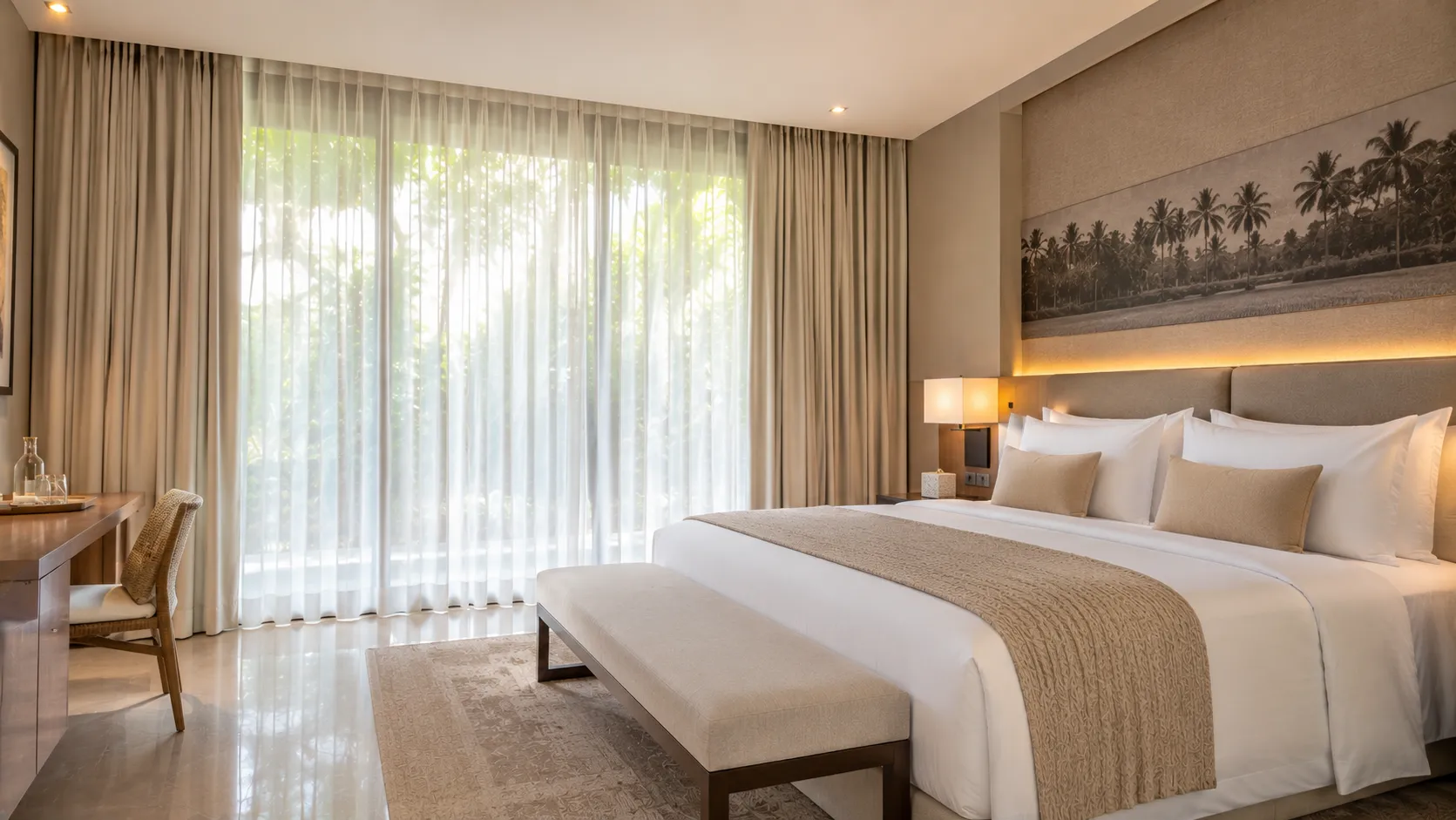
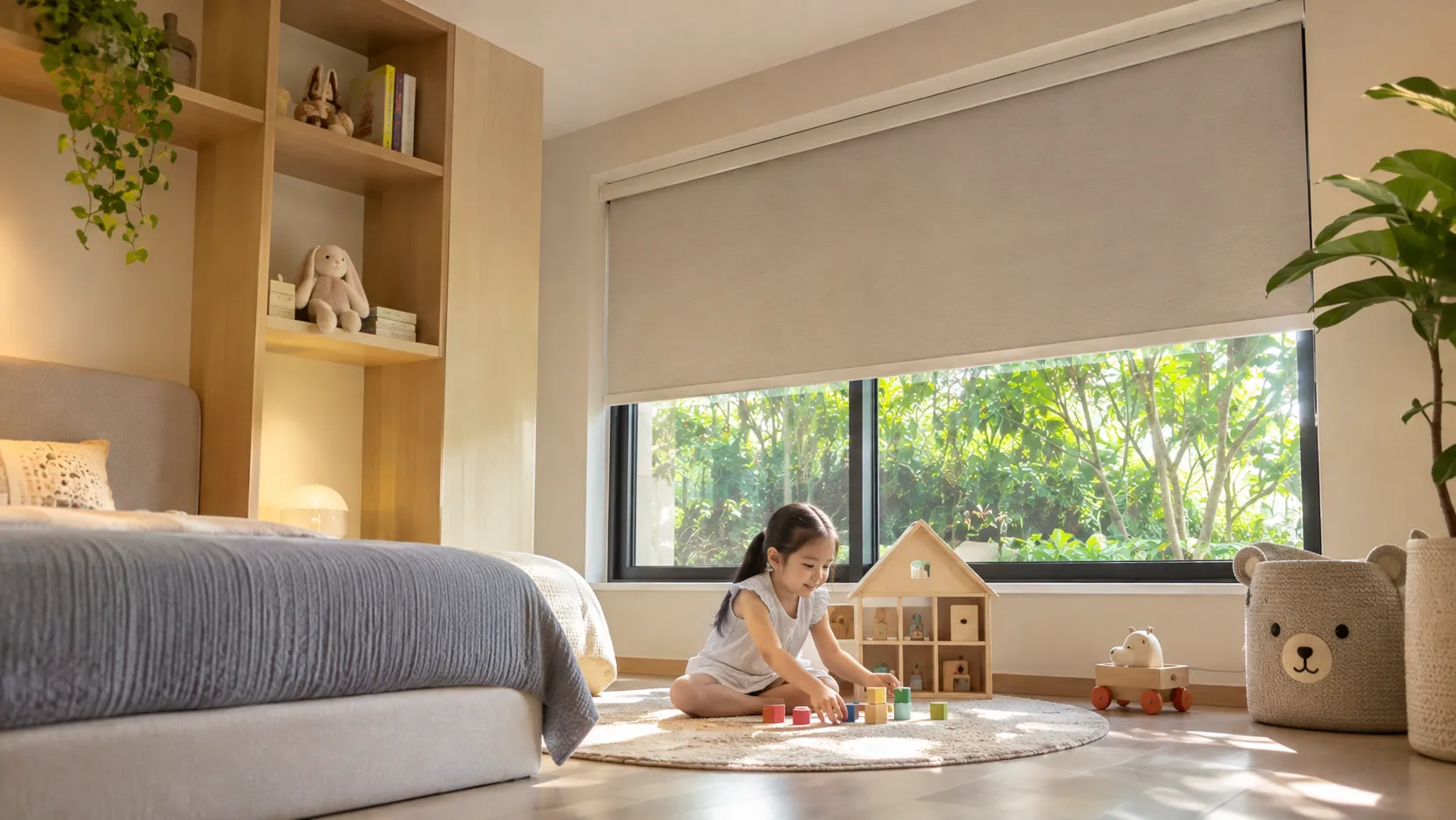
| Children’s bedroom | Consider cordless curtains or an appropriately designed motorized track, with blackout or dimout coverage if needed. | Keep cords and loops inaccessible; keep climbable furniture away from windows; check secure track fixing. |
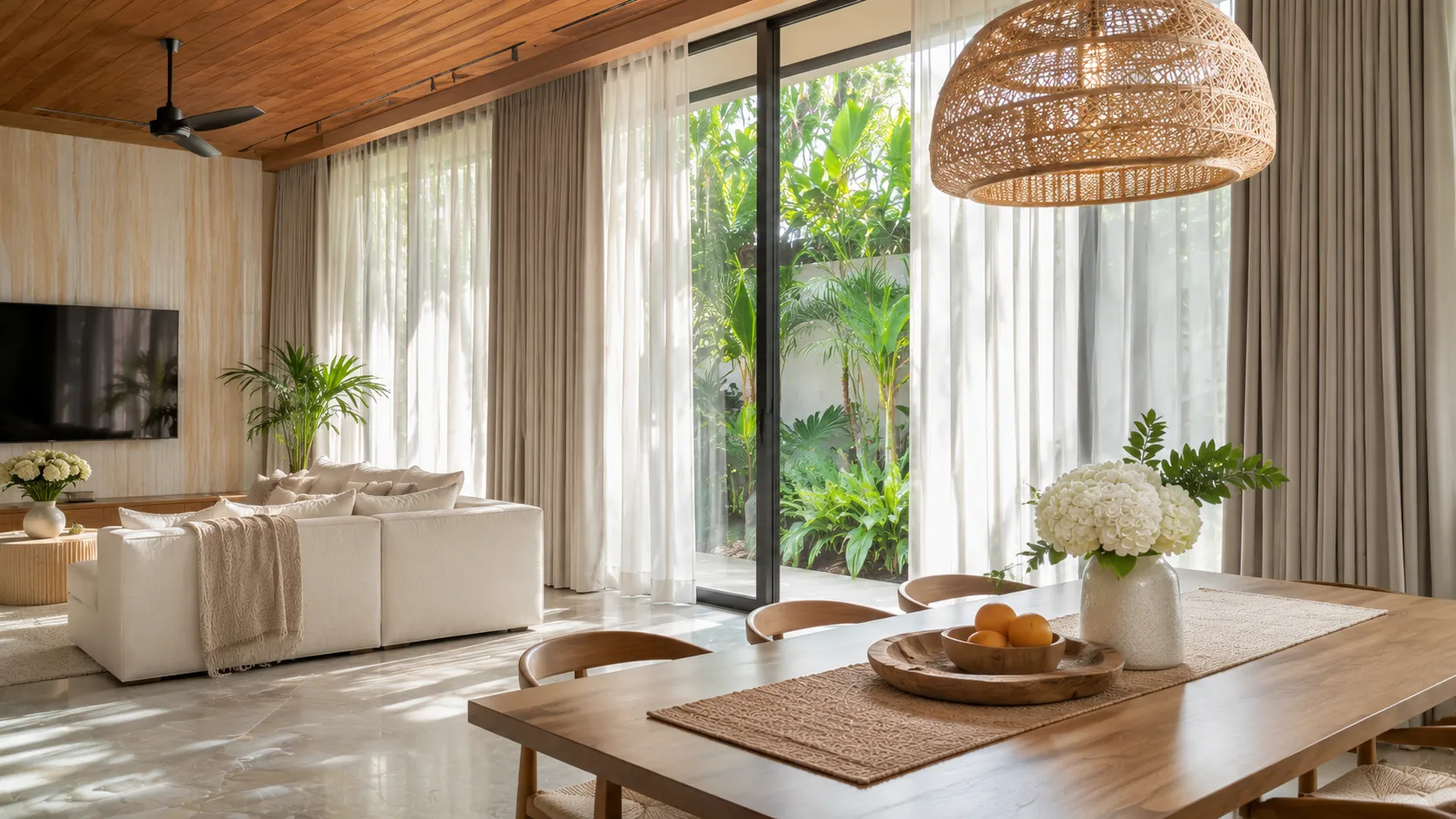
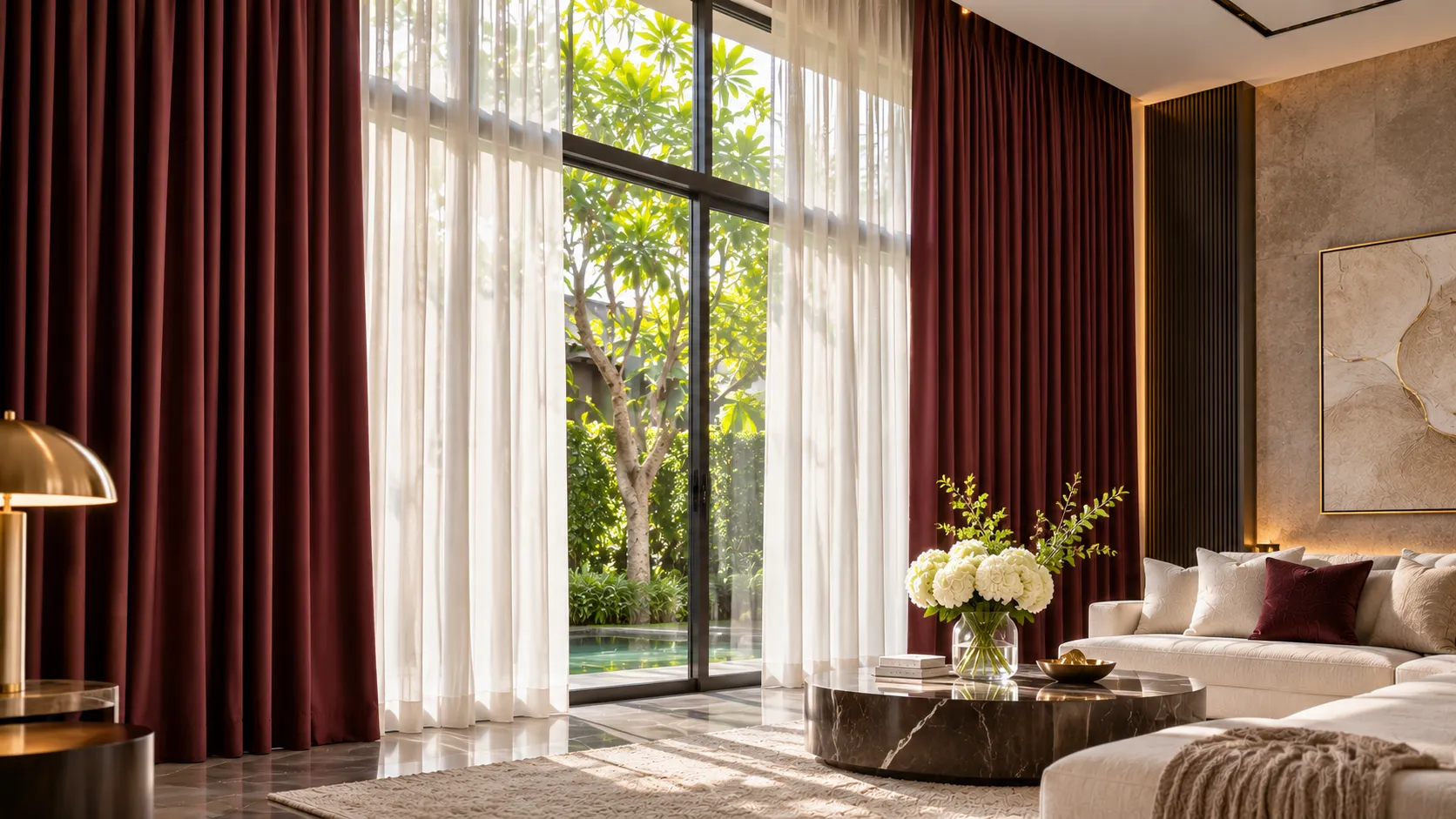
| Family living room | Layer sheers and curtains for flexible daylight and privacy. | Review controls near play areas and ensure panels do not create accessible loops or snagging points. |
| Hotel guest bedroom | Use intuitive controls and durable fabrics suited to housekeeping routines. | Standardize approved components and include safety checks in room inspections. |
| Sliding glass doors | Use a track and panel arrangement that allows convenient access to the opening. | Keep the travel path clear and ensure the curtain does not interfere with door operation or emergency access. |
| High or wide glazing | Consider motorization where manual operation would be difficult. | Verify motor capacity, control location, power arrangements and maintenance access. |
Family-friendly villa design
In a private villa, the owners may know the layout well, but visiting families do not. A simple, cordless operating arrangement and clear room layout can reduce reliance on guest instructions. Provide property staff with a basic maintenance checklist so that loose fittings or damaged components are identified before the next arrival.
Hotel and hospitality specification
For hotels, child-conscious window coverings should be part of the room standard and procurement process. Keep a record of the approved track, fabric, operating system and safety components. If a replacement is needed, use compatible parts and have the installation checked rather than substituting an unverified component.
8. Inspection, Cleaning and Maintenance
Safety is not a one-time installation task. Window coverings are handled, cleaned and sometimes repaired throughout their service life. In a hotel or rental villa, housekeeping and maintenance teams should know which parts must remain in place and how to report damage.
- Check tracks and brackets for movement, looseness or visible damage.
- Inspect operating controls and confirm that no cord, chain or loop has become exposed.
- Check that any manufacturer-supplied safety device remains correctly installed and functional.
- Look for damaged gliders, end stops, wand connections and motor components.
- Clean fabrics only according to the manufacturer’s care instructions.
- After repairs or fabric replacement, re-check the complete system rather than only the repaired part.
- Record inspection findings and arrange prompt repair when a safety-related defect is found.
In Bali’s humid and coastal environments, maintenance should also account for moisture, dust and possible corrosion of exposed hardware. The inspection interval should reflect the product, environment and frequency of use. If a component is damaged or a control becomes unsafe, stop using the affected system until it has been assessed and repaired appropriately.
9. A Practical Child-Safe Window Treatment Checklist
Use this checklist during design review, quotation approval and final handover. It is a planning aid and does not replace any mandatory safety assessment or local compliance check.
- ☐ The operating system has been reviewed for accessible cords, chains and loops.
- ☐ A suitable cordless option has been considered for rooms used by children.
- ☐ Any safety devices required for the selected product are supplied and installed according to manufacturer instructions.
- ☐ Track, brackets and fixings are appropriate for the curtain weight and wall or ceiling substrate.
- ☐ Controls, wands and electrical components are positioned and managed appropriately.
- ☐ Fabric composition, finishes and care instructions have been reviewed.
- ☐ Flame-retardant or chemical-related claims are supported by product-specific documentation where required.
- ☐ Applicable building, fire-safety and product-safety requirements have been checked for the property.
- ☐ Furniture placement does not encourage climbing near windows or controls.
- ☐ The installed system has been tested and included in the property’s maintenance routine.
10. Frequently Asked Questions
Are cordless curtains safer for children?
Cordless systems can reduce risks associated with exposed operating cords and continuous loops. The exact design still needs to be checked for accessible moving parts, detachable components, controls and correct installation. Choose a product intended for the application and follow its safety instructions.
Are motorized curtains automatically child-safe?
No. Motorization can remove the need for a manual pull cord, but the complete installation still needs assessment. Consider control placement, electrical safety, moving parts, track fixing, power arrangements and access to remotes or switches.
What is the safest curtain system for a child’s bedroom?
There is no single system that is best for every room. An appropriately designed cordless track or a suitable motorized system may be a good option. The choice should be based on the window, curtain weight, user needs, product documentation and applicable safety requirements.
Are flame-retardant curtains non-toxic?
Not necessarily. Flame-retardant performance and chemical safety are separate considerations. Ask for product-specific fire-test information and relevant chemical or restricted-substance documentation. Do not assume that a broad “non-toxic” claim proves the absence of all substances of concern.
Do hotels need flame-retardant curtains?
Requirements depend on the building, its classification, jurisdiction and applicable fire-safety regulations. Hotel operators and project teams should confirm the required standard with the relevant authority or qualified fire-safety professional and obtain documentation for the exact textile selected.
Can regular curtains be made child-safe after installation?
Some products may have manufacturer-approved safety accessories or replacement operating components, but an improvised modification is not recommended. Have the existing system assessed and use only compatible components installed according to the manufacturer’s instructions. Replacing a corded system with a suitable cordless option may be more appropriate in some cases.
How often should curtain hardware be checked in a rental villa?
Checks should be included in routine property maintenance and housekeeping inspections, with additional checks after repairs, heavy use or guest reports of a problem. The appropriate interval depends on the system and how frequently it is operated.
Can child-safe curtains still look luxurious?
Yes. Cordless tracks, concealed hardware, tailored headings and high-quality fabrics can create a refined appearance while supporting a safer operating design. Safety requirements should be incorporated into the specification rather than treated as an afterthought.
Conclusion: Design Beautiful Window Treatments with Safety in Mind
Child-conscious window treatment design combines suitable operating systems, carefully selected fabrics, secure hardware and thoughtful room planning. Cordless tracks can reduce exposure to cord and loop hazards, while motorized systems may provide convenient operation for large or high windows. Fabric and flame-retardant claims should always be supported by clear product documentation, and the installation must be appropriate for the building structure and intended use.
For Bali villas and hotels, these decisions should also reflect humidity, coastal exposure, guest turnover and ongoing maintenance. A well-planned window treatment can support the interior design while helping property owners and operators manage foreseeable risks more responsibly.
Almeers Living provides custom curtains and blinds for residential and hospitality projects in Bali, including product selection, on-site measurement and installation planning. Explore the Almeers Living product collection or contact the team to discuss window treatments for a family-friendly villa, hotel or modern residence.