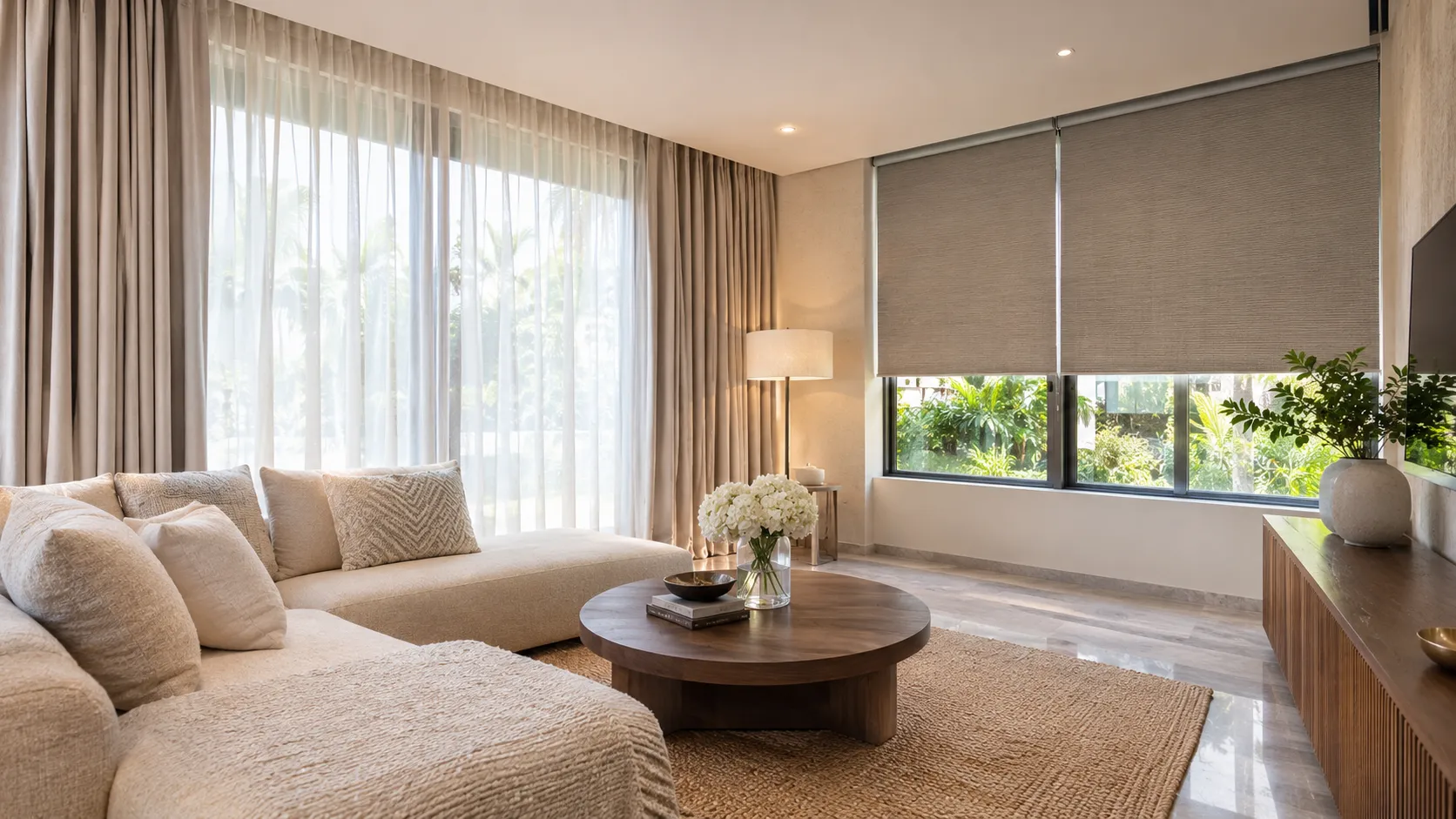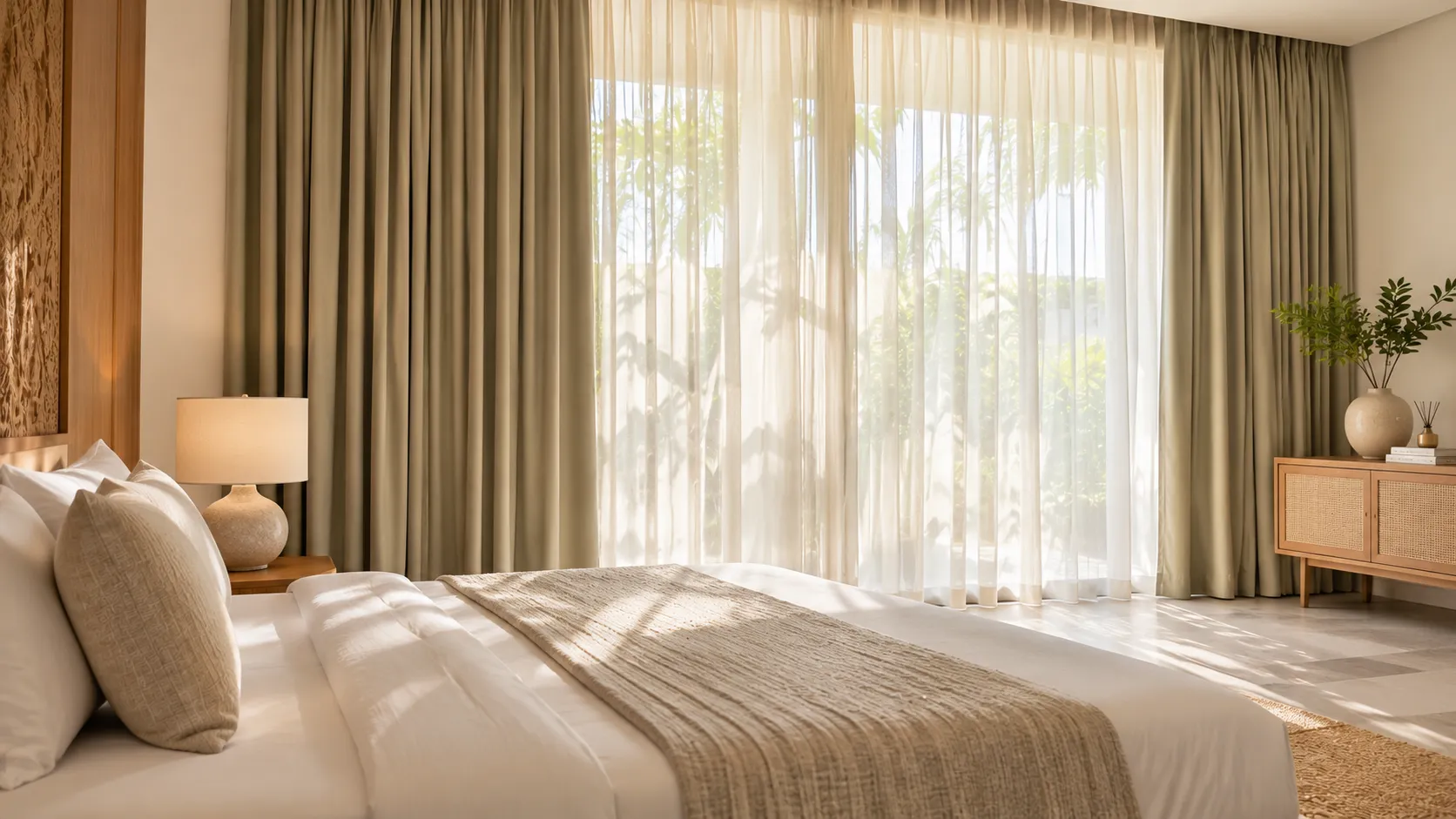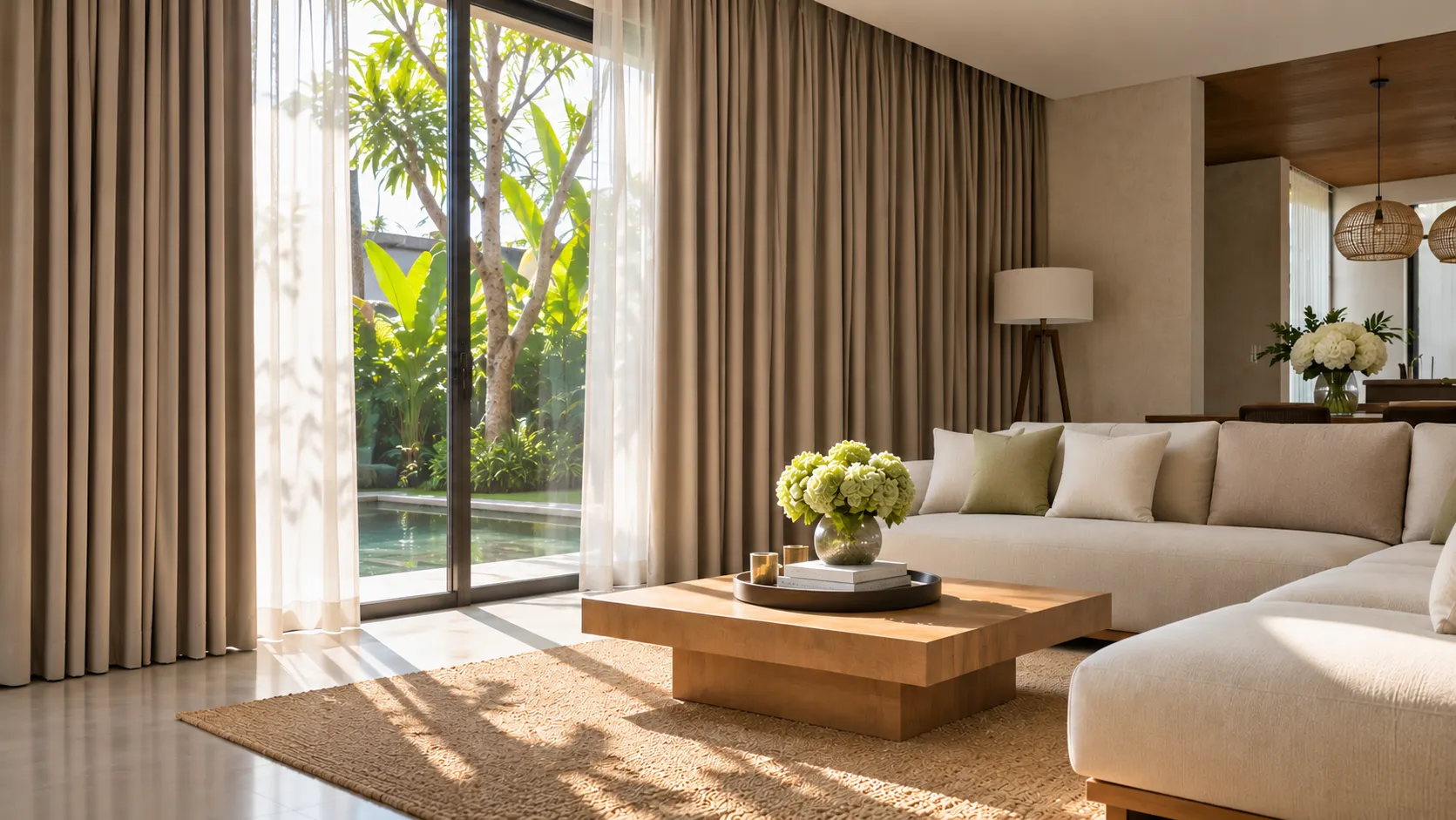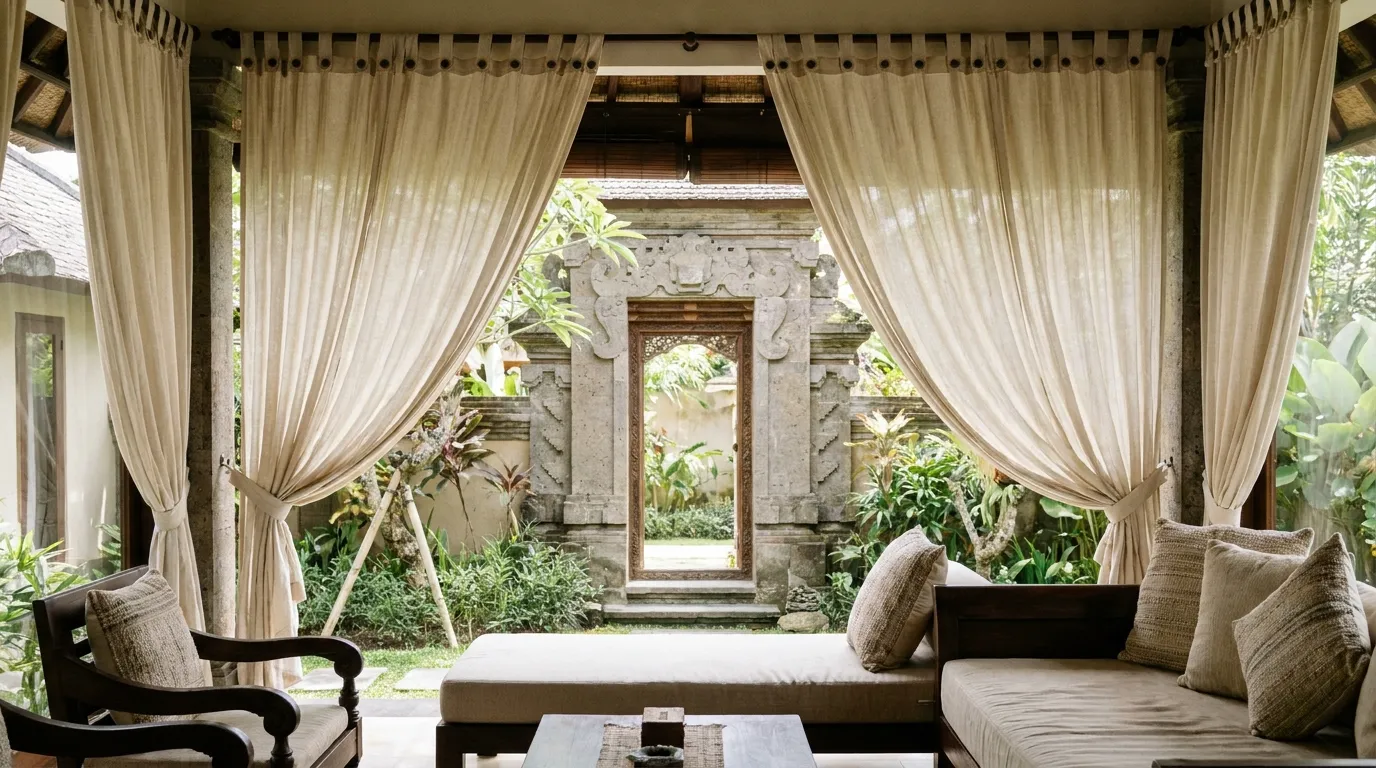
Balinese architecture is often appreciated for its relationship with nature: open-air living areas, timber details, stone finishes, garden views and a relaxed transition between indoor and outdoor spaces. Window treatments should support these qualities rather than compete with them. The right curtains can soften strong sunlight, add privacy where needed and introduce texture while preserving the calm character of the property.
Choosing curtains for a Balinese-style villa is not simply a matter of selecting a natural-looking fabric. The design also needs to respond to airflow, humidity, exposure to sunlight, the location of the opening and the way each room is used. This guide explains how to coordinate curtains with open-air layouts, teak wood accents and organic-fibre-inspired materials, while making practical decisions for homes, villas and hospitality properties in Bali.
In brief: Choose window treatments that respect the architecture first. Use breathable-looking sheers where filtered daylight and views are priorities, consider lined curtains for bedrooms and exposed openings, and coordinate fabric colour and texture with timber, stone and surrounding greenery. For genuinely open or exposed spaces, assess weather, moisture and hardware conditions before specifying a curtain system.
1. Understand the Character of Balinese Architecture
Balinese-inspired properties often combine natural materials, sheltered outdoor areas, carved or patterned details, timber elements and a strong visual connection to gardens or courtyards. In many villas, living and dining spaces are designed to feel open, with large openings that allow daylight and breezes to move through the property.
Curtains should complement this architectural language through proportion, material and restraint. Soft folds can balance hard surfaces such as stone, concrete and timber. Neutral fabrics can connect interior furnishings to the landscape, while carefully selected lining and track systems provide practical light control without making the room feel visually heavy.
Start by identifying the features that should remain visually prominent. If the room already has detailed teak joinery, patterned stone or a strong garden view, a simple curtain fabric may be more successful than a competing statement pattern. If the architecture is minimal, a tactile weave or fuller drape can add warmth.
2. Plan Curtains for Open-Air Living Spaces
Open-air living is a defining feature of many Bali properties, but not every opening is suitable for a conventional indoor curtain. First establish whether the opening is fully protected by a roof and deep overhang, partially exposed to wind-driven rain, or directly open to the elements. This distinction affects fabric choice, track placement, maintenance and expected service life.
Use curtains where they have a clear function
- Covered living pavilions: Curtains may provide flexible screening from low-angle sunlight or neighbouring sightlines when the opening is protected from direct rain.
- Indoor-outdoor transitions: A curtain can soften the visual boundary between a living room and a terrace, provided the track and fabric are appropriate for the exposure.
- Bedrooms facing gardens: Sheers can filter daylight during the day, while a separate dimout or blackout layer can improve darkness and privacy when required.
- Fully exposed openings: Consider whether an exterior-rated screen, shutter or other more suitable solution is preferable to standard interior drapery.
Air movement can cause loose panels to billow, twist or repeatedly contact nearby furniture. Consider panel width, stacking position, tiebacks and the direction of prevailing breezes. Where strong airflow is expected, a heavier fabric or a different window-covering solution may be more practical. Do not assume that a curtain will function as a wind barrier or weather seal.
Protect the transition between inside and outside
Keep fabric clear of wet floors, garden soil and areas where water can splash. Allow enough clearance for doors to operate, and position the stack so panels do not obstruct walkways. For frequently used openings, a smooth-running track and accessible operating method can make everyday use easier.
3. Pair Curtains with Teak Wood Accents
Teak is frequently used in furniture, doors, screens and architectural detailing because of its warm colour and distinctive grain. Curtains can either echo this warmth or create a calm contrast. The best pairing depends on the teak finish, the amount of timber in the room and the surrounding palette.
Coordinate undertones, not just colour names
- Honey or golden teak: Try warm ivory, oatmeal, flax, sand or soft greige to maintain a welcoming atmosphere.
- Deep brown or aged teak: Consider natural beige, warm grey or muted stone to create separation without a harsh contrast.
- Light or washed timber: Off-white, pale taupe and subtle textured neutrals can preserve an airy appearance.
- Strongly patterned timber grain: Use a quieter fabric surface so the wood remains a focal point.
Bring fabric samples into the actual room and view them beside the timber at different times of day. Warm artificial lighting can make a neutral fabric appear more yellow, while strong daylight can reveal cooler undertones. A sample viewed on a screen or under showroom lighting may not look identical in the finished space.
Balance smooth and textured surfaces
If the room includes heavily grained teak, woven furniture, rattan or carved details, a fine linen-look weave can add softness without creating visual clutter. In a room with smooth timber and restrained furniture, a more pronounced slub or woven texture can introduce depth. Aim for a deliberate balance rather than matching every material exactly.
4. Explore Organic and Natural-Look Fibres
Natural materials are popular in tropical interiors because their surface character can create a relaxed, tactile atmosphere. Linen, cotton and selected plant-based fibres offer different appearances and performance characteristics. However, a natural appearance does not automatically mean a fabric is suitable for every Bali location or that it is environmentally certified.
| Material or fabric style | Visual character | Practical considerations |
|---|---|---|
| Pure linen | Distinctive slubs, relaxed drape and an organic surface | Can crease naturally; check care instructions, shrinkage guidance and suitability for humid conditions. |
| Cotton | Soft, familiar and available in many weights and weaves | Performance varies by construction and finish; check cleaning and dimensional stability. |
| Bamboo-look or woven plant-fibre styles | Textural, casual and suited to natural palettes | Confirm the actual fibre composition. Some products described as bamboo-look are synthetic blends. |
| Linen-look polyester or blended fabric | Can reproduce a linen-inspired texture with a more uniform appearance | Often easier to maintain, but composition, breathability and light performance vary by product. |
| Sheer voile | Lightweight, soft and suited to filtered daylight | Usually offers limited privacy at night when interior lights are on. |
For a villa, the right choice is determined by both appearance and use. A decorative natural-fibre curtain in a protected bedroom may be appropriate, while an opening exposed to frequent moisture may need a more durable, easier-care fabric or a different treatment. Always confirm the manufacturer's care guidance and the supplier's recommendations for the intended environment.
Do not confuse texture with performance
A loosely woven fabric may look beautiful but allow more light through than expected. A textured blackout fabric may look substantial while still requiring a separate lining or careful installation to achieve the desired room-darkening effect. Ask for the fabric composition, width, opacity, cleaning method and available lining options before confirming an order.
5. Choose a Balanced Colour Palette
Balinese interiors often draw inspiration from surrounding landscapes: pale sand, warm timber, stone, tropical foliage and natural fibres. A restrained palette helps curtains sit comfortably within this setting. Useful starting points include warm white, ivory, oatmeal, natural beige, taupe, soft grey and muted earthy tones.
Consider the colour of the walls, flooring, ceiling, timber and upholstery together. A warm beige curtain may coordinate well with teak and cream stone, while a cooler grey-beige may work better with concrete finishes and darker timber. If the room already contains strong accent colours, a neutral curtain can create visual continuity.
For a more expressive design, introduce colour through a controlled accent rather than several competing patterns. Muted olive, clay, terracotta or deep charcoal can work as considered accents, depending on the interior scheme. Test samples in daylight and at night before selecting the final colour.
6. Balance Daylight, Privacy and Room Function
Different rooms need different levels of light control. A single fabric specification throughout an entire property may look consistent, but it may not meet the needs of every space.
- Living and dining areas: Sheers or light-filtering curtains can soften daylight while retaining a connection to the garden. Add a second layer only where stronger privacy or light control is needed.
- Bedrooms: Dimout or blackout-lined curtains can reduce incoming light. The final result also depends on track position, side returns, overlap and gaps around the opening.
- Bathrooms: Prioritise privacy and suitability for moisture. Confirm ventilation, cleaning and product recommendations before using fabric near wet areas.
- Media or projector rooms: A blackout system may be appropriate, but installation details are essential because light can enter around the edges.
- Home offices: Consider glare on screens and the direction of sunlight throughout the day.
Layered curtains are useful when a room needs both daytime softness and stronger night-time privacy. A sheer layer and a lined outer curtain can operate independently, allowing occupants to adjust the room as conditions change.
Remember that sheers are not guaranteed to provide privacy after dark. When interior lighting is brighter than the outdoor environment, silhouettes and room details may remain visible from outside. Use an appropriate privacy layer where night-time screening matters.
7. Account for Bali's Tropical Conditions
Bali's tropical environment can involve high humidity, strong sunlight, seasonal rain and, in coastal locations, salt-laden air. These conditions should be considered before selecting fabric, lining, tracks and accessories. A beautiful fabric may not be the best option if it is installed in a location where it is repeatedly exposed to moisture or direct weather.
Sunlight and fading
Direct sunlight can contribute to colour fading and material deterioration over time. For exposed windows, consider lining, suitable fabric construction and the use of blinds or other solar-control solutions where appropriate. Rotate or adjust curtains where possible so that the same section is not constantly exposed, and follow the manufacturer's care advice.
Humidity and ventilation
Good ventilation and routine cleaning help reduce the chance of musty odours and moisture-related problems. Avoid trapping damp fabric against walls or floors. If curtains become wet, allow them to dry thoroughly according to the care instructions. Investigate persistent condensation or water ingress rather than expecting a curtain to solve the underlying issue.
Coastal hardware considerations
For properties near the sea, ask about the material and finish of tracks, brackets, screws and other fittings. Corrosion resistance depends on the actual grade, coating, installation environment and maintenance. Do not rely on a generic description such as “premium” or “rust-proof” without confirming the product specification and suitability for the site.
8. Select Suitable Tracks and Installation Details
The track is part of the finished design. A discreet ceiling-mounted track can create a clean vertical line and help curtains appear integrated with the architecture. A decorative rod may be appropriate where the hardware is intended to be visible, especially when it coordinates with timber or metal accents.
Key installation decisions
- Ceiling or wall mounting: Choose based on the ceiling structure, available fixing points, desired appearance and access for maintenance.
- Track profile: Confirm that the track can support the fabric weight and the required number of layers.
- Stacking space: Allow enough room for open curtains so that panels do not cover too much of the glass or obstruct doors.
- Floor clearance: Select a deliberate drop, taking account of floor level, cleaning routines and any unevenness.
- Operation: Consider hand-drawn, corded or motorised operation according to opening size, accessibility and budget.
- Fixing substrate: Confirm that the ceiling or wall can safely support the track and curtain load, using suitable anchors and installation methods.
For large openings, long spans or heavy lined curtains, professional measurement and installation can help reduce operational problems. Accurate measurements should include the track position, finished drop, stacking direction, overlap and any architectural obstructions.
9. Room-by-Room Recommendations for Bali Properties
| Area | Design direction | Details to check |
|---|---|---|
| Open-plan living room | Light-filtering sheer with optional second layer | Wind movement, garden views, door clearance and stacking space |
| Master bedroom | Textured curtain with dimout or blackout lining | Side gaps, overlap, morning sun and privacy requirements |
| Guest bedroom | Easy-care neutral fabric with suitable lining | Guest comfort, maintenance and consistent appearance |
| Dining pavilion | Simple, restrained treatment where the opening is protected | Exposure to rain, cooking odours and airflow |
| Bathroom or dressing area | Moisture-appropriate privacy solution | Ventilation, splash zones and cleaning instructions |
| Media room | Blackout curtain system or another dedicated light-control treatment | Edge gaps, track returns and light leakage |
These are starting points, not fixed rules. A covered pavilion in one villa may have very different exposure from a similar-looking space in another property. A site assessment is useful when the opening is unusually wide, close to a pool, exposed to coastal weather or integrated with complex timber and stone details.
10. Common Design Mistakes to Avoid
- Choosing by appearance alone: Check composition, opacity, cleaning requirements and environmental suitability as well as colour and texture.
- Using standard indoor fabric in exposed locations: Wind-driven rain and direct sun can shorten the useful life of unsuitable materials.
- Overmatching every natural material: Curtains do not need to be the same shade as teak, rattan or stone. A considered contrast often looks more refined.
- Ignoring the stack: A curtain that covers a large portion of the glass when open can reduce daylight and views.
- Assuming blackout means complete darkness: Light can enter through the sides, top and bottom unless the overall system is designed to minimise gaps.
- Expecting sheers to provide night privacy: Sheers usually filter views rather than fully block them, especially when the room is lit at night.
- Skipping accurate measurement: Incorrect track width or drop can affect appearance, operation and coverage.
- Ignoring maintenance access: Tracks and curtains should be reachable for cleaning and servicing.
11. A Practical Planning Checklist
Before ordering curtains for a Balinese-style property, work through the following points with your designer, supplier or installer:
- Identify whether each opening is indoors, covered outdoors or fully exposed.
- Record the opening width, height, ceiling condition and proposed track position.
- Note the direction and intensity of sunlight at different times of day.
- Decide the required level of daylight, privacy and room darkening.
- Review the timber, stone, flooring and upholstery undertones together.
- Request physical fabric samples and compare them in the actual room.
- Confirm fibre composition, lining options, cleaning instructions and suitability for the location.
- Specify track material, finish, load capacity and appropriate fixings.
- Plan panel stacking, floor clearance, overlap and operating method.
- Agree on production, installation and maintenance expectations before approval.
For measurement preparation, see the Curtain Measuring Guide. If you are comparing how much curtain fabric may sit beyond the window when open, use the Curtain Stacking Calculator. Explore other window-treatment options through the Almeers Living product range.
12. Frequently Asked Questions
What curtain colours work best with Balinese architecture?
Warm white, ivory, oatmeal, natural beige, taupe and soft grey are versatile starting points. The best shade depends on the undertone of the teak, stone, flooring and wall finishes. Always compare physical samples in the property before making a final selection.
Are linen curtains suitable for villas in Bali?
Linen can create a relaxed, natural appearance, but suitability depends on the exact fabric, location, exposure and care requirements. Pure linen may crease and may need more careful maintenance. For demanding areas, compare linen blends or linen-look fabrics and confirm the supplier's recommendations.
Can curtains be installed in open-air living areas?
They can be considered for protected, covered openings where the fabric and hardware are suitable. Fully exposed areas may be affected by rain, wind and direct sunlight. Assess the site before choosing a conventional curtain system.
What type of curtains pair well with teak furniture?
Neutral textured fabrics such as ivory, oatmeal, sand and warm greige often complement teak. Choose a fabric texture that balances the grain and visual weight of the timber rather than competing with it.
Do sheer curtains provide privacy at night?
Usually not enough for full privacy. When the room is illuminated and it is dark outside, people may be able to see silhouettes or details through the sheer. Add a privacy or blackout layer if required.
Do blackout curtains make a room completely dark?
Not necessarily. Blackout fabric can block light through the material, but light may still enter around the top, sides and bottom. Track placement, returns, overlaps and installation accuracy all influence the result.
What should I consider for curtains near the coast?
Consider sunlight, humidity, salt-laden air and maintenance. Ask for the exact track and fitting material or finish, and confirm that it is suitable for the property's exposure. Routine cleaning and inspection are also important.
Should every room use the same curtain fabric?
Not always. A consistent colour palette can connect the property, while fabric opacity, lining and construction can vary according to each room's privacy, light-control and maintenance needs.
Conclusion: Let the Architecture Lead the Design
The most successful curtains for Balinese architecture feel connected to the property rather than added as an afterthought. Natural-looking textures, thoughtful colour choices and considered pairing with teak can bring warmth and softness to a space. At the same time, practical decisions about exposure, airflow, privacy, lining, tracks and installation help the finished treatment work in everyday conditions.
For a cohesive result, begin with the architecture and the way each opening is used. Compare fabric samples beside the actual finishes, confirm the environmental requirements and plan the track and measurements before production. This approach helps create window treatments that respect the relaxed character of Bali while meeting the needs of modern villas, homes and hospitality spaces.
Almeers Living provides customised curtains and blinds in Bali, with fabric consultation, measurement and installation options for residential and hospitality projects. Visit Almeers Living or browse the product range to explore suitable window-treatment solutions.