Curtains for Every Room: A Styling Guide: The Details That Make the Difference — Functional Fabric Opacity Matching, Room-Specific Light Control, and Tailored Drapery Drop Ratios
Curtain Styling Guide · Almeers Living
Curtains for Every Room: A Styling Guide — The Details That Make the Difference
The best curtains are selected for the way a room is used, not simply for how a fabric looks in a sample book. A bedroom may need strong light reduction, a living room may benefit from filtered daylight, and a bathroom or kitchen may require materials that suit moisture and regular cleaning.
This guide explains how to match fabric opacity to room function, plan practical light control, and choose a drapery drop that creates a neat, intentional finish.
1. Start with How the Room Is Used
Before choosing a curtain color or texture, identify the room's main requirements. Consider when the room is occupied, how much daylight it receives, whether privacy is important, and whether the curtains need to reduce glare or help darken the space.
A useful starting point is to assess four factors:
- Daylight: Does the room need soft filtered light, strong light reduction, or the ability to switch between both?
- Privacy: Is the window overlooked by neighboring properties, a street, a pool, or a shared outdoor area?
- Activity: Is the room used for sleeping, relaxing, dining, cooking, working, or watching films?
- Environment: Is the space exposed to humidity, cooking residue, direct sun, coastal air, or frequent handling?
These requirements should guide fabric opacity, lining, heading style, hardware, and the final curtain length. A single specification does not suit every room in a property.
2. Understand Curtain Fabric Opacity
Opacity describes how much light can pass through a fabric and how much visibility it allows. Product descriptions can vary between suppliers, so use the terms below as practical guidance and confirm the actual performance of the selected fabric sample.
Sheer curtains
Sheer fabrics allow substantial daylight to enter while softening the view and reducing direct visual exposure to some degree. They are useful when the priority is a light, airy atmosphere rather than complete privacy or room darkening.
Privacy from sheer curtains depends on the difference in brightness between inside and outside. At night, when interior lights are on and it is darker outdoors, silhouettes and views into the room may become more visible. Sheers should not be treated as a substitute for full privacy covering.
Light-filtering and dimout fabrics
Light-filtering fabrics soften incoming daylight and can reduce glare while retaining some natural brightness. Dimout fabrics generally provide greater light reduction than ordinary light-filtering materials, but the level varies by construction, color, and supplier specification.
These options can be suitable for living rooms, dining areas, and bedrooms where a softer environment is preferred without requiring complete darkness.
Blackout fabrics and blackout lining
Blackout options are designed to block a high proportion of incoming light through the fabric itself or through a suitable lining system. They are often selected for bedrooms, media rooms, and spaces where stronger light control is required.
Even with blackout fabric, light may enter around the sides, top, or bottom of the installation. Track position, overlap, returns, recess depth, and installation accuracy all affect the final result. If near-total darkness is important, discuss the full window arrangement rather than selecting fabric alone.
Opacity is not the same as thermal performance
A fabric that blocks light does not automatically provide a specific level of heat insulation or solar heat reduction. Thermal and UV-related performance depend on fabric construction, color, lining, glazing, orientation, and the overall window system. Ask for documented product specifications when performance claims are important.
3. Room-by-Room Curtain Recommendations
Living room: balance daylight and privacy
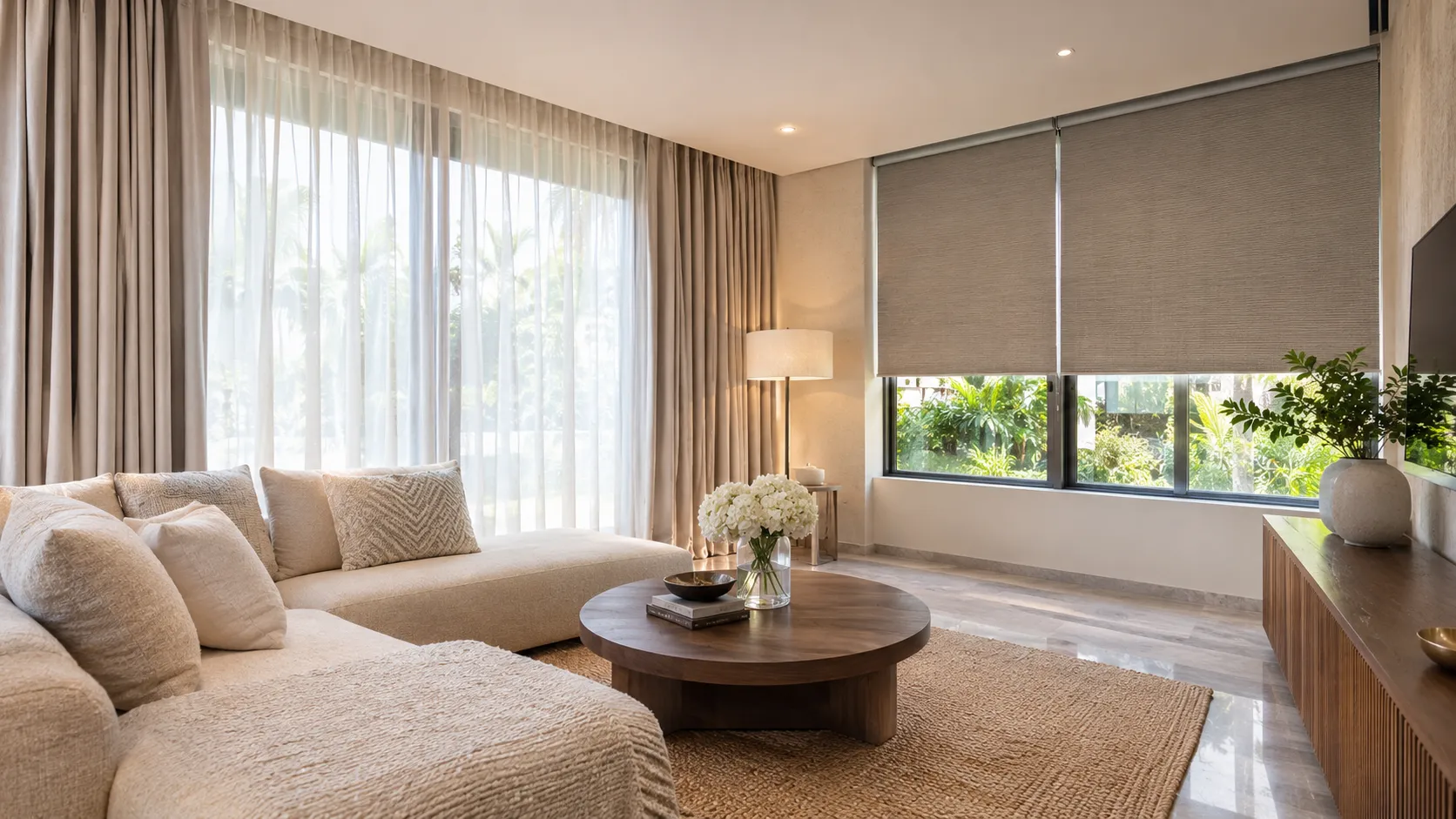
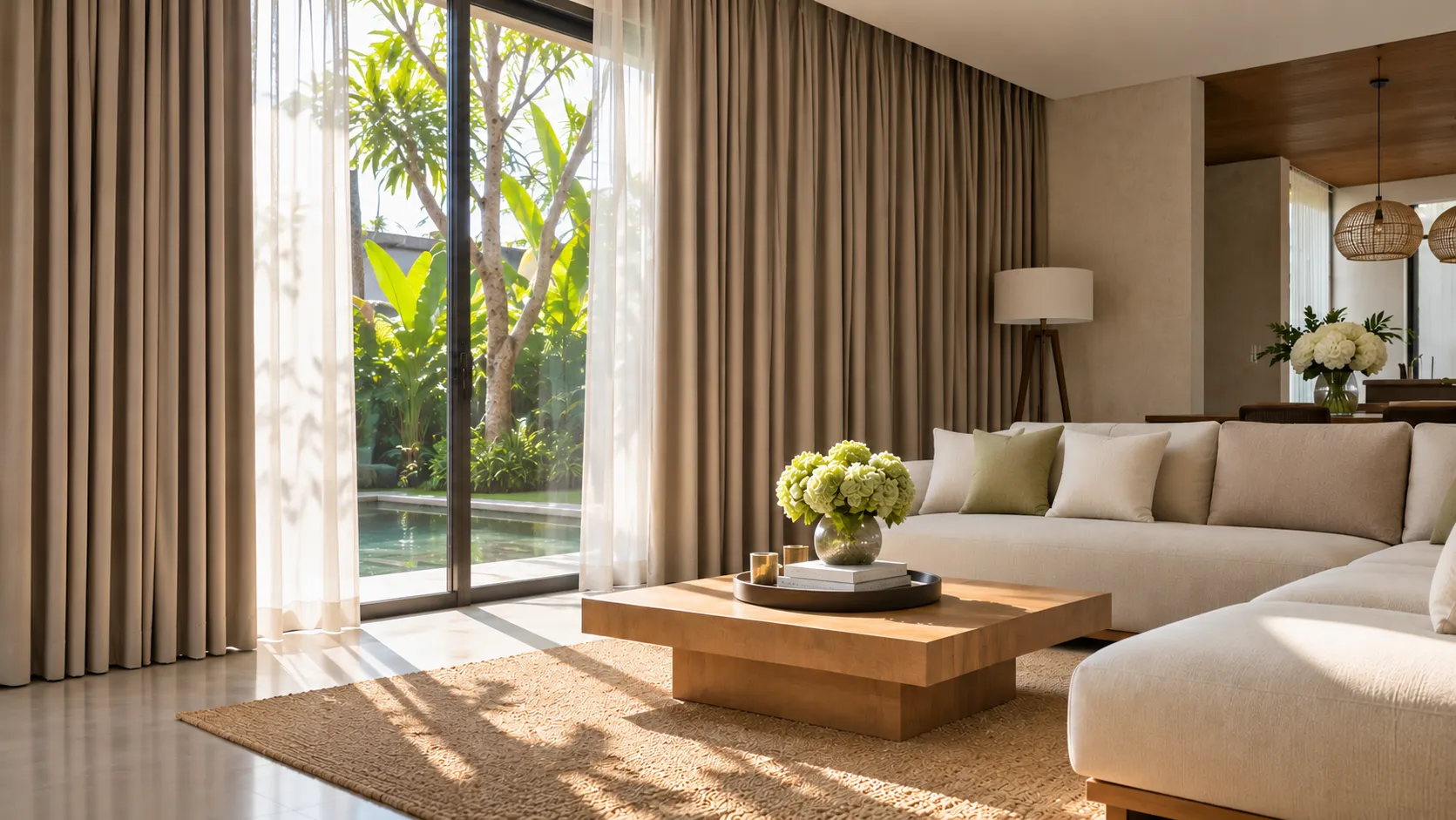
Living rooms often benefit from flexible light control. A sheer layer can soften daylight and create a relaxed atmosphere, while a second dimout or blockout layer provides more privacy and light reduction when needed.
For a bright, open living space, consider linen-look textures, subtle woven fabrics, or a color that complements the sofa and flooring. If the room has large glazing, plan where the curtains will stack when open so they do not cover too much of the glass.
Practical direction: sheer for filtered daylight, or a double-layer system when the room needs both daytime softness and stronger evening coverage.
Bedroom: prioritize comfort and light control
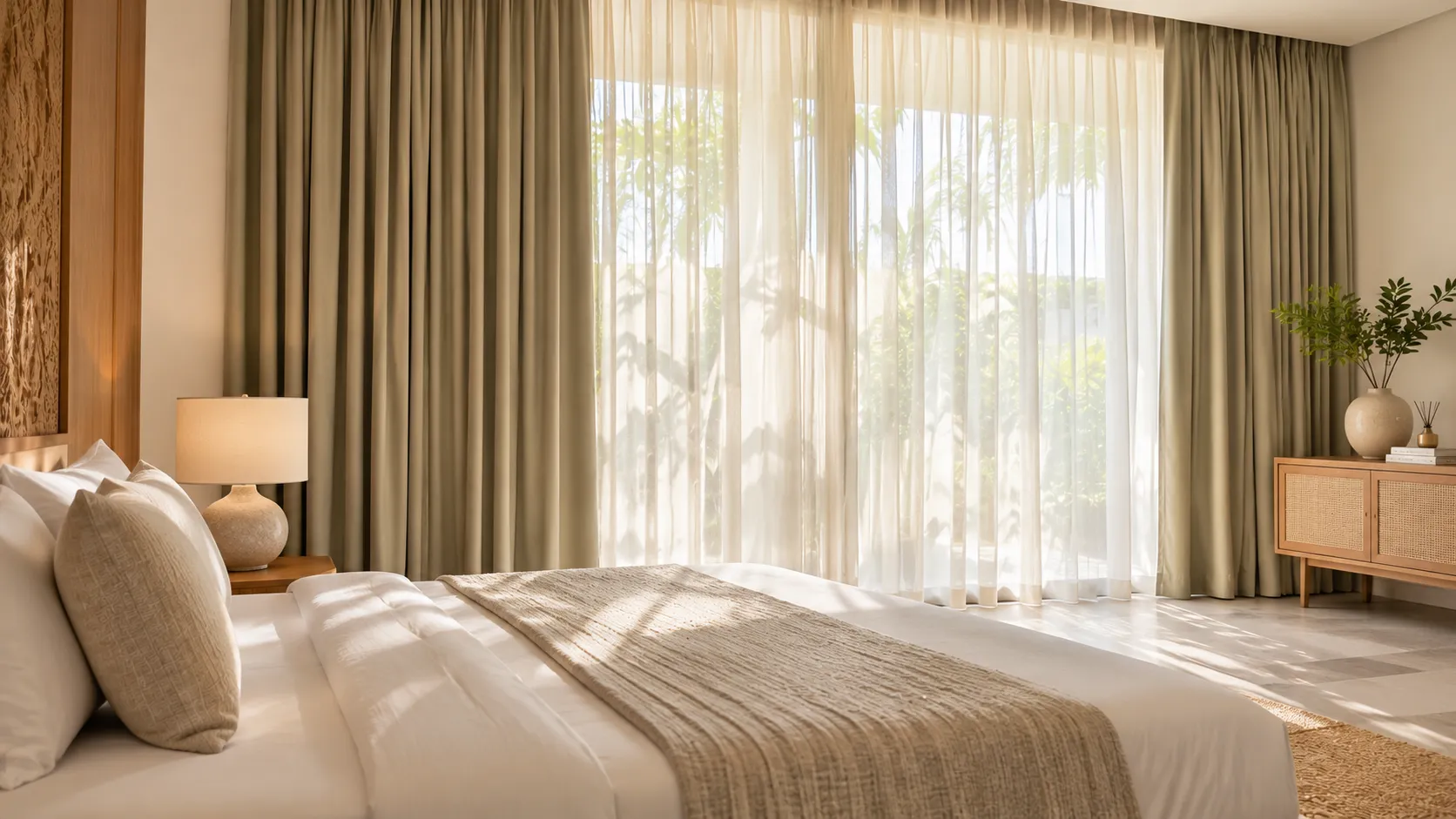
Bedrooms commonly need more privacy and stronger light reduction than social areas. Blackout fabric or a suitable blackout lining can be useful for people who prefer a darker sleeping environment, shift workers, or bedrooms exposed to early morning sunlight.
Choose a fabric that also feels appropriate for the room's style. Soft neutrals can create a calm atmosphere, while deeper tones may add contrast. Check the edges and top of the installation if light leakage is a concern.
Practical direction: dimout for moderate light reduction; blackout for stronger room darkening, with installation details planned to minimize gaps.
Kitchen: consider cleaning and moisture
Kitchen window coverings should suit the location of the window and its distance from cooking areas, sinks, and sources of steam. A simple, easy-to-maintain window treatment may be more practical than a heavy full-length drape near a cooking zone.
Where curtains are appropriate, consider a lighter fabric and a design that does not interfere with counters, appliances, or ventilation. Follow the manufacturer's cleaning instructions and avoid placing fabric where it may contact flames or hot surfaces.
Practical direction: choose a manageable fabric and installation style that suits the kitchen layout and cleaning routine.
Dining room: create atmosphere
Dining areas can accommodate more decorative fabric choices because the main priority is often atmosphere, with privacy and glare control as additional considerations. Textured curtains or a coordinated sheer layer can make the space feel more finished.
For open-plan rooms, use the curtain color to connect the dining area with the living room. Repeating one tone from nearby furniture or accessories can create continuity without making every element identical.
Practical direction: light-filtering or dimout curtains, depending on exposure and privacy needs.
Home office: reduce glare without making the room gloomy
A home office needs enough daylight for a comfortable working environment while controlling glare on monitors and reflective surfaces. The best choice depends on window direction, screen position, and working hours.
Light-filtering or dimout fabrics can help moderate daylight. Where direct sunlight is strong, consider the window orientation and whether a blind, curtain, or layered arrangement gives more useful control.
Practical direction: adjustable light-filtering or dimout coverage, tested at the times the room is used most.
Media room: prioritize controlled darkness
For a projector room or media space, light reduction is usually a primary requirement. Blackout fabric or a lined curtain can help, but the installation should also address side gaps, top gaps, and any light entering through adjacent openings.
Choose a suitable track and enough overlap between panels. If the window shape is unusual, such as an arch or a very wide opening, a made-to-measure solution may be required.
Practical direction: blackout specification with careful attention to coverage, overlap, and installation.
Bathroom: select for the environment
Bathrooms are exposed to moisture and condensation. Before using a fabric curtain, assess ventilation, window position, splash exposure, and the manufacturer's suitability guidance. In many bathrooms, a suitable blind or another moisture-appropriate treatment may be more practical.
Practical direction: prioritize moisture suitability, privacy, ventilation, and ease of maintenance over decorative fullness.
Villa and hospitality properties: balance guest comfort and durability
In villas, serviced apartments, and hospitality properties, each room may have different guest expectations. Bedrooms may need strong light control, living areas may benefit from sheers, and bathrooms or service areas may require materials selected for their environment.
Consider frequent operation, cleaning access, sunlight exposure, hardware durability, and the consistency of the overall interior palette. Standardizing selected fabrics or hardware across rooms can simplify maintenance, while room-specific opacity keeps each space functional.
4. Plan Light Control and Privacy
Good light control is a combination of fabric choice and installation design. The same fabric can perform differently depending on its color, weave, lining, window size, and the way it is fitted.
Think about the direction of sunlight
Observe when direct sunlight reaches the window. East-facing rooms may receive stronger morning sun, while west-facing rooms can experience intense afternoon light. North- and south-facing exposure varies by location and building orientation. Use the actual conditions of the property rather than assuming every window needs the same solution.
Consider daytime and nighttime privacy separately
A sheer may provide a comfortable daytime screen in some conditions, but it generally does not guarantee privacy after dark when the room is illuminated. If a window faces a neighboring building or public area, consider a second layer or a different opacity.
Use layered window treatments for flexibility
A double-track system can allow sheer and heavier curtains to operate independently. This makes it possible to filter daylight during the day and close the heavier layer when privacy or darkness is needed. Confirm that there is enough space for both layers and that the track arrangement suits the window.
Control glare as well as brightness
For television and computer areas, the direction of reflected light may matter as much as total brightness. A light-filtering curtain or adjustable blind can help manage glare while preserving useful daylight. Test the room at the time glare normally occurs.
5. Choose the Right Drapery Drop and Floor Finish
The drapery drop is the finished vertical length of the curtain, measured from the specified heading or track reference point to the bottom edge. The correct drop creates a clean line and determines whether the curtain finishes above the floor, touches it, or rests slightly on it.
Floor clearance: a clean practical finish
A small clearance above the floor can be practical in rooms where floors need frequent cleaning, where there are uneven surfaces, or where the curtains are opened and closed often. The exact clearance should be confirmed after checking the floor level across the full window width.
Floor touch: a tailored contemporary look
A curtain that just meets the floor can create a neat, continuous vertical line. This finish requires accurate measurement because even small differences in floor level can cause one panel to drag while another appears too short.
Light break: a soft, relaxed finish
A slight fabric break at the floor can create a softer appearance. It may suit decorative curtains that are not moved frequently, but it can collect dust and may be less practical in high-traffic areas.
Puddled curtains: a more decorative effect
Extra length that rests on the floor creates a more dramatic, traditional, or luxurious look. It requires more maintenance and may not be ideal where children, pets, cleaning equipment, or frequent operation are considerations.
There is no universal drop ratio
Drop is not reliably determined by one fixed percentage of window height. It is a finished measurement based on the chosen visual effect, the track or pole position, the heading construction, and the actual floor level. Measure each opening individually, especially in properties with multiple windows or uneven floors.
| Finish | Visual effect | Practical consideration |
|---|---|---|
| Floor clearance | Neat and minimal | Useful for frequent cleaning and operation |
| Floor touch | Tailored and continuous | Needs accurate finished-height measurement |
| Light break | Soft and relaxed | May collect more dust at the hem |
| Puddled | Decorative and dramatic | Requires extra fabric and more maintenance |
6. Measurements and Installation Details That Make the Difference
Accurate measuring helps the finished curtains achieve the intended appearance and function. Before production, confirm the following details for every window:
- Track or pole width: measure the intended hardware span, including any returns or extensions required by the design.
- Finished drop: establish the measurement reference point and the desired floor finish.
- Heading system: confirm wave, pinch pleat, eyelet, or another construction before calculating fabric requirements.
- Fabric width and joins: check the usable fabric width, pattern repeat, and direction of the design.
- Fullness: calculate fabric quantity according to the heading, fabric type, and desired fold appearance.
- Stack-back space: allow room for the curtain panels to sit when open, especially on wide windows and doors.
- Obstructions: note handles, air-conditioning units, furniture, cornices, beams, and other elements that may affect operation.
- Mounting surface: check whether the track will be fixed to concrete, timber, plasterboard, or another substrate, and specify suitable supports and fixings.
For a step-by-step starting point, use the Curtain Measuring Guide. If you are planning a blind instead of a curtain, see the Shade Measuring Guide. You can also estimate the space occupied by open curtain panels with the Curtain Stacking Calculator.
7. Common Curtain Selection Mistakes
- Choosing the same opacity for every room: a living room, bedroom, and media room often have different light and privacy requirements.
- Expecting sheers to provide full nighttime privacy: visibility can increase when interior lights are on after dark.
- Assuming blackout fabric guarantees a completely dark room: light can still enter through installation gaps.
- Confusing opacity with thermal performance: light blocking alone does not establish heat or UV performance.
- Using one drop measurement for several windows: ceiling heights and floor levels can vary from opening to opening.
- Ignoring the heading before calculating fabric: different heading systems require different fabric construction and fullness.
- Forgetting stack-back space: open curtains may cover part of the glass if there is not enough room at the sides.
- Not checking fabric samples in the room: natural and artificial lighting can change how color and texture appear.
8. Frequently Asked Questions
Which curtains are best for a living room?
It depends on daylight and privacy needs. Sheers work well when the goal is to soften daylight, while dimout or a double-layer system provides more flexibility when stronger light reduction or privacy is needed.
Should bedroom curtains always be blackout?
Not always. Some people prefer dimout or light-filtering fabrics. Blackout is a useful option when stronger room darkening is desired, but the installation must also address gaps around the window.
Do sheer curtains provide privacy at night?
Not reliably. When interior lights are on and it is darker outside, people may be able to see silhouettes or more of the room. Add a heavier layer if nighttime privacy is important.
What is the difference between dimout and blackout curtains?
Dimout fabrics reduce incoming light but generally allow more light through than blackout options. Blackout fabrics or linings are designed for a higher level of light blocking. Actual results depend on product construction and installation.
Should curtains touch the floor?
They can finish just above the floor, touch it, or rest slightly on it. The best finish depends on the desired style, floor condition, cleaning routine, and how often the curtains will be operated.
How much extra length should I allow for a puddled curtain?
There is no single allowance that suits every fabric and room. The intended puddle should be agreed as a finished measurement, then checked against fabric behavior, floor level, and maintenance requirements.
Can the same curtain fabric be used throughout a property?
Yes, a consistent fabric can create a cohesive interior. However, consider whether different rooms need different linings, opacity levels, or operating systems to meet their individual requirements.
How do I calculate the amount of curtain fabric required?
Fabric quantity depends on track width, heading type, fullness, usable fabric width, pattern repeat, and finished drop. A site measurement and fabric-specific calculation are recommended before production.
The Right Details Create Better Everyday Comfort
Room-by-room curtain planning is about matching appearance with function. Choose opacity according to the way each space is used, plan light control for both day and night, and specify the finished drop to suit the room's style and practical needs. Accurate measurements, suitable hardware, and a considered heading complete the result.
Almeers Living provides custom curtains and window treatment solutions for homes, villas, apartments, and hospitality properties in Bali. Explore our curtain and blinds collections, or visit Almeers Living to discuss fabric options, measurements, and installation requirements.