1. Custom vs. Ready-Made Curtains: What Is the Difference?
Ready-made curtains are manufactured in standard widths, lengths, heading styles, and colour options. They are generally available for purchase without a site-specific production process. This makes them practical for standard-sized windows, temporary accommodation, rental properties, or projects where speed and a controlled budget are the main priorities.
Custom-made curtains are produced to suit the dimensions and requirements of a particular window or room. The process can include on-site measurement, fabric selection, lining choices, heading design, track or rod selection, tailored hemming, and professional installation. The result is designed around the actual opening and the intended appearance rather than relying on standard dimensions.
Neither option is automatically right for every property. A standard ready-made panel may work very well on a straightforward window. A custom solution becomes more valuable when windows are unusually wide or tall, when several openings need a consistent finish, or when light control and architectural details require a more considered approach.
2. Custom vs. Ready-Made Curtains: A Practical Comparison
| Consideration | Custom-made curtains | Ready-made curtains |
|---|---|---|
| Measurements | Can be made to measured track or window dimensions. | Available in standard sizes; may need adjustment or may not fit exactly. |
| Fabric choice | Usually offers a wider choice of fabric, colour, texture, opacity, and lining. | Limited to styles and materials currently stocked. |
| Heading and fullness | Can be specified to suit the chosen track, fabric, and desired fold. | Generally limited to the supplied heading and fullness. |
| Finished length | Can be hemmed to the required floor clearance or intended finish. | May be too long or too short for the actual room. |
| Special windows | Can be planned for wide glazing, high ceilings, sliding doors, and selected unusual openings. | May be difficult to adapt to non-standard dimensions or configurations. |
| Lead time | Requires time for consultation, production, and installation. | Often available immediately if in stock. |
| Budget | Usually a higher initial investment because it is made to specification. | Often a lower upfront price and can suit short-term needs. |
The most important comparison is not simply the price per panel. Consider the complete result: whether the curtains cover the opening properly, whether the fabric suits the room, whether the heading works with the hardware, and whether alterations or replacement may be needed later.
3. Why Precision Site Measurements Matter in Bali
Accurate measurements are essential to the appearance and function of curtains. In many Bali properties, window openings are not identical, ceiling heights vary, and large sliding doors or full-height glazing are common. Even windows that look similar can have different widths, floor levels, ceiling details, or available fixing points.
Measure the installation width, not only the glass
The curtain track or rod often extends beyond the visible glass to improve coverage and allow the curtains to stack at the sides. Measuring only the glass may result in insufficient fabric coverage or curtains that obstruct the opening when drawn. The correct width depends on the installation plan, available wall space, and desired stack-back.
Confirm the finished drop
Measure from the actual track or rod position to the intended bottom edge of the curtain. Floor finishes, uneven floors, ceiling details, and track mounting methods can affect the final drop. A site measurement helps identify these conditions before the fabric is cut and hemmed.
Check obstacles and installation details
Air-conditioning units, cabinetry, window handles, door swings, ceiling recesses, beams, and furniture can influence the curtain design. A site visit can help establish whether a ceiling-mounted, recessed, or wall-mounted track is practical and whether the curtain can move freely.
- Measure every window individually, even when openings appear identical.
- Confirm whether the measurement is for the glass, opening, track, or finished curtain.
- Check ceiling height and floor clearance at more than one point where floors may be uneven.
- Allow for track extensions, overlaps, returns, and space for curtains when open.
- Confirm whether the project requires a single layer or a double layer, such as sheer and blackout.
For a useful starting point, see the Almeers Living Curtain Measuring Guide. For complex windows or a full-property project, professional site measurement is recommended before production.
4. Choosing Fabric for Bali’s Tropical Conditions
Fabric selection should reflect the room’s exposure, ventilation, use, and maintenance needs. Bali’s tropical climate can involve strong sunlight, warm temperatures, and periods of high humidity. These conditions do not affect every fabric in the same way, so consider the actual material, construction, colour, lining, and care instructions.
Sunlight and colour stability
Windows exposed to direct sunlight for long periods can place greater demands on curtain fabrics. Over time, some materials and dyes may fade or change appearance. Lined curtains can add a layer between the room and the window, but lining does not make every face fabric immune to sunlight. Ask about the fabric’s recommended use and care, especially for west-facing windows and large glazed doors.
Humidity, ventilation, and maintenance
In humid environments, curtains benefit from suitable ventilation and regular care. Avoid leaving damp fabric gathered tightly for extended periods. Follow the manufacturer’s cleaning guidance and make sure the room has adequate airflow. Fabric choice should account for occupancy, ventilation, and whether the curtains can be removed for cleaning.
Choose opacity according to the room
- Sheer: diffuses daylight and offers a light, open appearance. It generally does not provide night-time privacy when interior lights are on.
- Dimout: reduces incoming light while allowing some light through the fabric.
- Blackout: is designed to block light through the fabric itself. Light may still enter around the edges if installation coverage is insufficient.
- Decorative or textured fabric: adds warmth and visual character, but should be assessed for drape, cleaning, and room suitability.
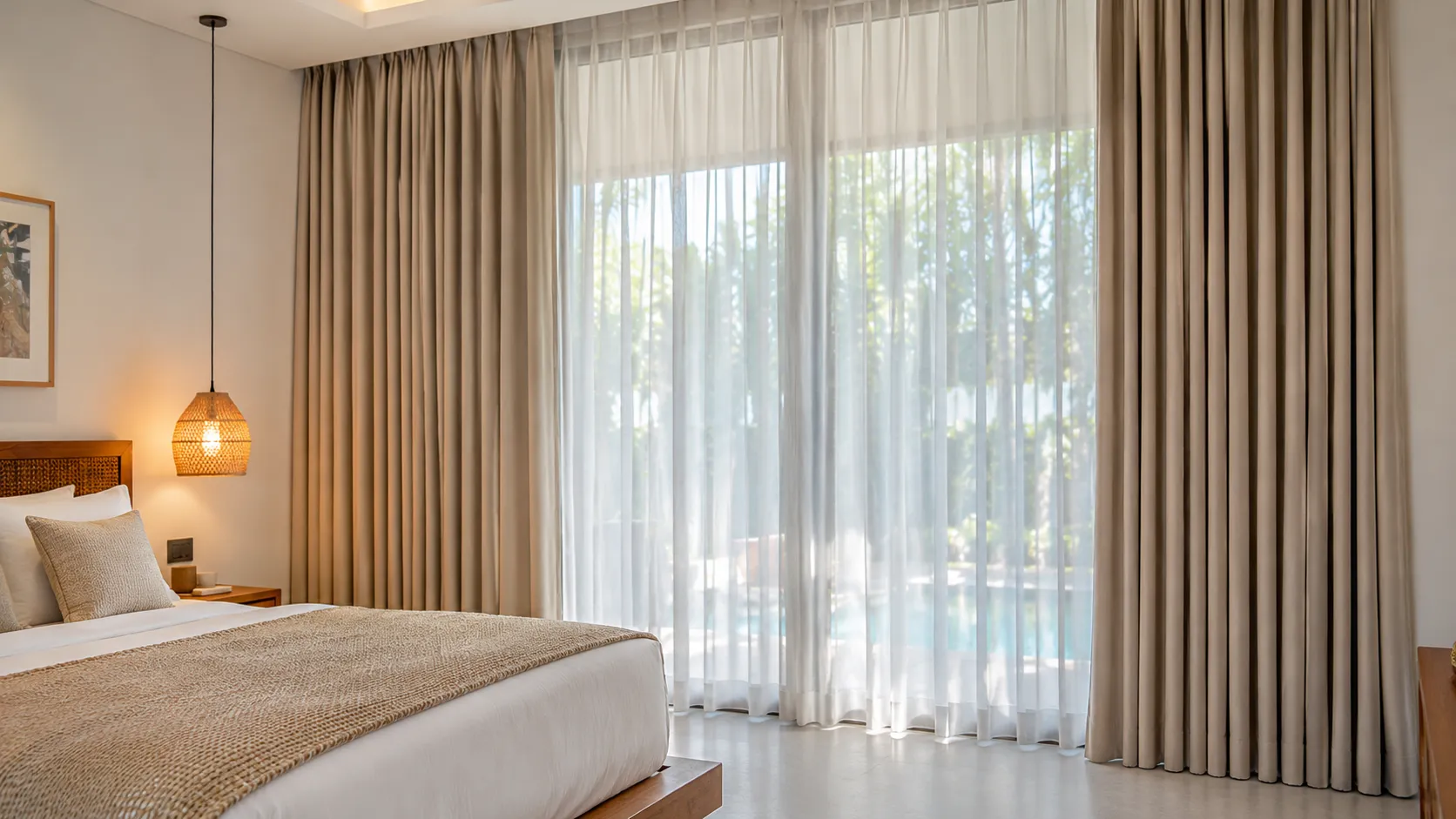
For many villas and homes, a double-layer arrangement combines a sheer curtain with a dimout or blackout curtain. This gives occupants more control over daylight and privacy throughout the day. The best configuration depends on room orientation, view, and use.
Request and compare physical samples
Colours and textures can appear different on a screen than they do in the room. Review samples beside the wall, flooring, and upholstery, ideally in daylight and evening lighting. Check the fabric from a distance as well as close up, because texture and colour depth can change with the viewing angle.
5. The Importance of Tailored Drapery Hemming
The bottom edge of a curtain is a small detail with a major effect on the finished appearance. A carefully measured and sewn hem helps create a consistent line across the window and gives the curtain a more intentional finish. Ready-made curtains may use a standard length that does not match the actual distance between the track and floor.
Choose the right floor finish
- Floor clearance: the curtain finishes slightly above the floor. This is practical for many everyday spaces and can make cleaning easier.
- Floor touch: the curtain just meets the floor for a neat, continuous appearance. This requires accurate measurement and consideration of floor level.
- Light break: a small amount of fabric rests on the floor, creating a softer, relaxed finish.
- Puddle finish: extra fabric rests on the floor for a decorative effect. It may require more frequent care and is not always practical in busy areas.
There is no single correct finish for every room. Consider the property’s cleaning routine, floor surface, whether children or pets use the space, and the overall interior style. For hospitality properties, a floor-clearance or carefully controlled floor-touch finish may be easier to maintain than excess fabric resting on the floor.
Consistent hems across multiple windows
When a room has several windows, the finished bottom line should look consistent wherever floor and ceiling conditions allow. This is particularly important in villas, hotels, and open-plan spaces where several curtain panels can be seen together. Custom production allows the hem to be planned for the measured conditions of each opening.
6. When Custom Curtains Are the Better Choice
Custom curtains are worth considering when the room needs a precise fit, a particular fabric, or a coordinated design. They are especially useful for projects where curtains are an important part of the interior specification rather than a temporary furnishing.
- Large windows and sliding doors: custom widths and track planning can help achieve suitable coverage and stacking space.
- High ceilings: made-to-measure drops can create a continuous full-height appearance.
- Multiple rooms: fabric, colour, heading, and hardware can be coordinated across the property.
- Specific light-control needs: sheer, dimout, blackout, and lining options can be selected for each room.
- Architectural details: recessed tracks, ceiling pockets, corner windows, and selected unusual openings can be planned with the installation.
- Tailored styling: heading, fullness, hem, and track finish can be chosen to support the intended interior design.
Custom curtains are also useful when the client wants to assess fabric samples in the actual property before confirming a final selection. This reduces reliance on screen images and helps align the material with the room’s finishes.
7. When Ready-Made Curtains Make Sense
Ready-made curtains can be a sensible choice when window dimensions match available standard sizes and the product meets the room’s functional needs. They may be appropriate for temporary accommodation, a quick refresh, a secondary room, or a limited budget.
- The window is a common size and available panel dimensions provide adequate coverage.
- The required colour, fabric, opacity, and heading are available in stock.
- The project needs a fast furnishing solution.
- The property is temporary, rented, or likely to change its interior scheme soon.
- The owner is comfortable with standard lengths or straightforward alterations.
Before buying, check the total curtain width, finished drop, heading type, fabric composition, care label, and whether the listed dimensions refer to one panel or a pair. Also confirm whether the product includes a track or rod; many ready-made curtains are sold as fabric panels only.
8. Understanding the Overall Value and Cost
Ready-made curtains often have a lower initial purchase price. However, the complete cost can change if panels need hemming, additional widths are required, hardware must be purchased separately, or the result does not provide the desired coverage. Custom curtains usually involve a higher initial investment because they are specified and produced for the project, and may include measurement and installation depending on the service agreement.
For a fair comparison, request quotations that clearly state what is included. Check whether the price covers fabric, lining, heading, track or rod, brackets, accessories, site measurement, delivery, installation, and alterations. Confirm the number of panels and finished dimensions so quotations are based on comparable specifications.
For villas and hospitality properties, consider durability in the context of actual use. A curtain that fits the window, operates smoothly, and can be maintained according to its care instructions may offer better long-term value than a lower-cost option that requires frequent adjustment or replacement. Longevity cannot be guaranteed by the word “custom” alone; it depends on material quality, construction, exposure, installation, and maintenance.
9. What to Expect from a Custom Curtain Service
A clear process helps clients make decisions before production begins. While each project is different, a typical custom curtain workflow includes these steps:
- Initial consultation: discuss the property, room requirements, preferred style, privacy, and light-control needs.
- Site measurement: assess each opening, ceiling and wall conditions, track position, obstacles, and finished drop.
- Fabric and hardware selection: compare samples, opacity, lining, heading styles, and track options.
- Quotation and confirmation: review dimensions, specifications, pricing, production scope, and installation arrangements.
- Production: curtains are cut, sewn, headed, and hemmed according to confirmed measurements and specifications.
- Installation and final check: fit the track and curtains, check movement and alignment, and review the finished appearance.
Production timelines vary according to fabric availability, project size, selected hardware, and the production schedule. If the property has a fixed opening date or guest arrival, share the deadline early so the supplier can advise whether the requested schedule is realistic.
For a custom consultation in Bali, explore the Almeers Living curtain and blinds collection and contact the team to discuss your window requirements.
10. Frequently Asked Questions
Are custom curtains better than ready-made curtains?
Custom curtains are generally more suitable when windows have non-standard dimensions, when a specific fabric or heading is required, or when a coordinated finish is important. Ready-made curtains can be a good option for standard windows, quick furnishing, and tighter budgets.
Are custom curtains worth the extra cost in Bali?
They can be worth considering for villas and homes with large glazing, high ceilings, multiple window sizes, or specific privacy and light-control requirements. Compare the complete specification and installation scope rather than price alone.
Do custom curtains last longer in tropical climates?
Not automatically. Their lifespan depends on the selected fabric, lining, sunlight exposure, humidity, ventilation, construction quality, and maintenance. Custom production helps match the specification to the property, but it does not make a fabric immune to tropical conditions.
Can ready-made curtains be shortened?
Many ready-made curtains can be altered, depending on their construction and heading. A professional alteration can improve the finished drop, but it cannot solve every issue involving width, fabric fullness, track compatibility, or unusual window shapes.
What is the best curtain length for a minimalist interior?
A floor-clearance or floor-touch finish is common in minimalist spaces because it creates a clean line. The best option depends on floor level, cleaning needs, room use, and the desired visual effect.
Should I choose sheer and blackout curtains together?
A double-layer system is useful when a room needs both soft daytime light and stronger privacy or darkness at other times. A sheer layer alone is usually not sufficient for night-time privacy, while blackout performance also depends on how well the installation covers the window edges.
Can custom curtains be made for recessed tracks?
Yes, provided the track and ceiling recess are planned together. Confirm the track dimensions, pocket clearance, supports, runners, and curtain heading before the ceiling detail and curtain measurements are finalised.
How do I prepare measurements before requesting a quotation?
Start with the curtain measuring guide and record each window separately. For accurate custom production, a site measurement is recommended so track position, finished drop, obstacles, and stack-back can be checked in person.
Final Recommendation: Choose the Curtain Solution That Fits the Property
Ready-made curtains offer convenience, quick availability, and a lower initial price for standard windows. Custom-made curtains provide greater control over dimensions, fabric, heading, track configuration, and finished hemming. For Bali properties with large windows, high ceilings, varied openings, or specific light-control requirements, a made-to-measure approach can help create a more consistent and carefully planned result.
The best decision starts with the window and the way the room is used. Assess the measurements, sunlight exposure, privacy needs, fabric care, and installation details before choosing. A well-specified curtain should look appropriate, operate comfortably, and suit the practical demands of the property.
Almeers Living — Window Treatment Specialist in Bali provides custom curtains and blinds for homes, villas, apartments, and hospitality projects. Explore our products or read more design advice on our blog.