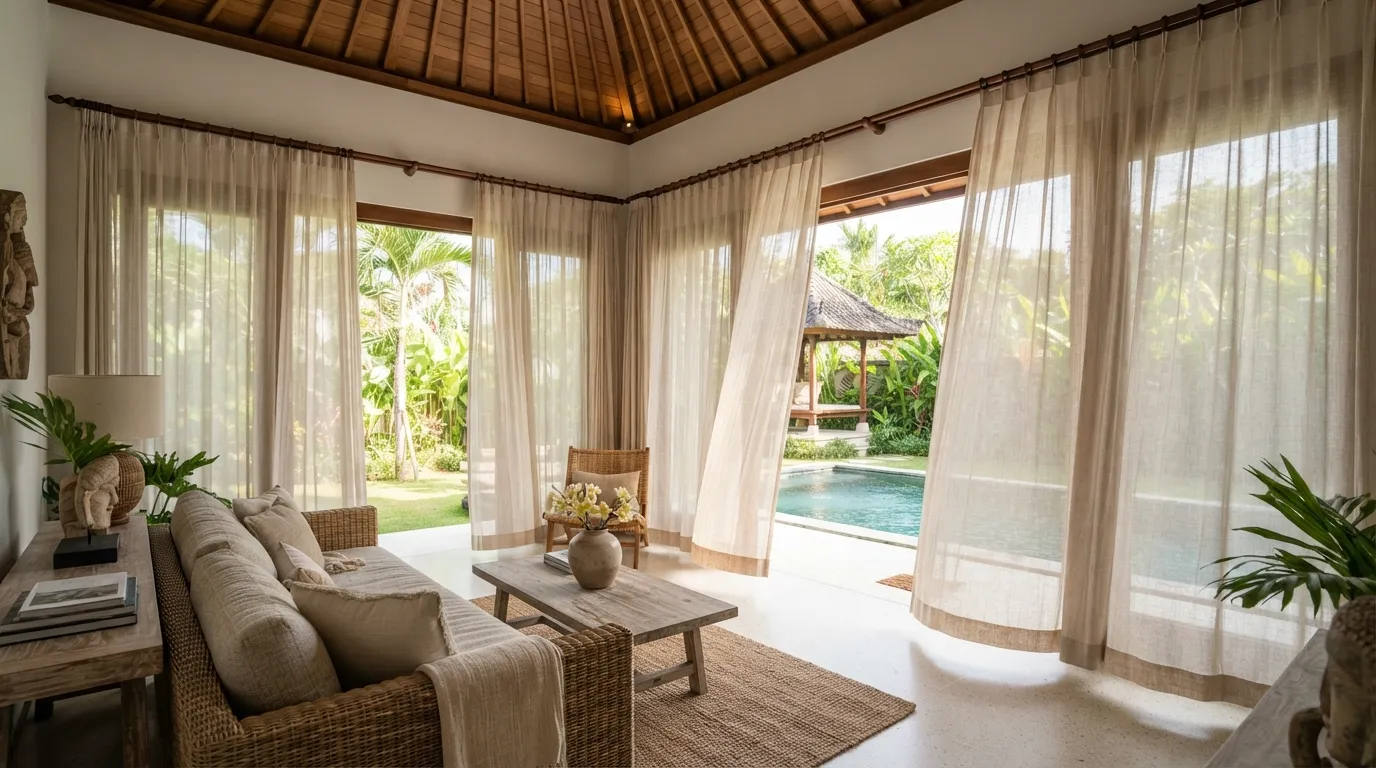
Natural light is one of the defining features of a tropical interior. In Bali, daylight moves across gardens, terraces and large glazed openings, creating changing patterns throughout the day. Sheer curtains help shape that light: they soften direct brightness, reduce visual exposure from outside and add a gentle fabric layer without completely closing off the view.
For villas and hotels, the goal is to balance openness with comfort. A sheer curtain should complement the architecture, respond to the direction of sunlight and provide the level of privacy expected in each room. Fabric choice matters too. Linen and linen-look weaves can create a relaxed, textured appearance, while finer voile-style fabrics offer a lighter and more delicate finish. Their actual performance depends on weave density, fibre content, colour and construction.
This guide explains how to use sheer curtains to enjoy natural light in Bali properties. It covers sunlight diffusion, privacy, airflow considerations, fabric selection, layering with blackout or dimout curtains, room-by-room planning and practical installation details for tropical homes and hospitality spaces.
1. Why Sheer Curtains Work Well in Tropical Interiors
Sheer curtains create a transition between the interior and the outdoors. Rather than leaving a window completely uncovered or blocking it with a heavy curtain, a sheer layer softens the view and introduces a sense of movement. This can be especially effective in Bali properties with garden-facing windows, balconies, courtyards and large sliding doors.
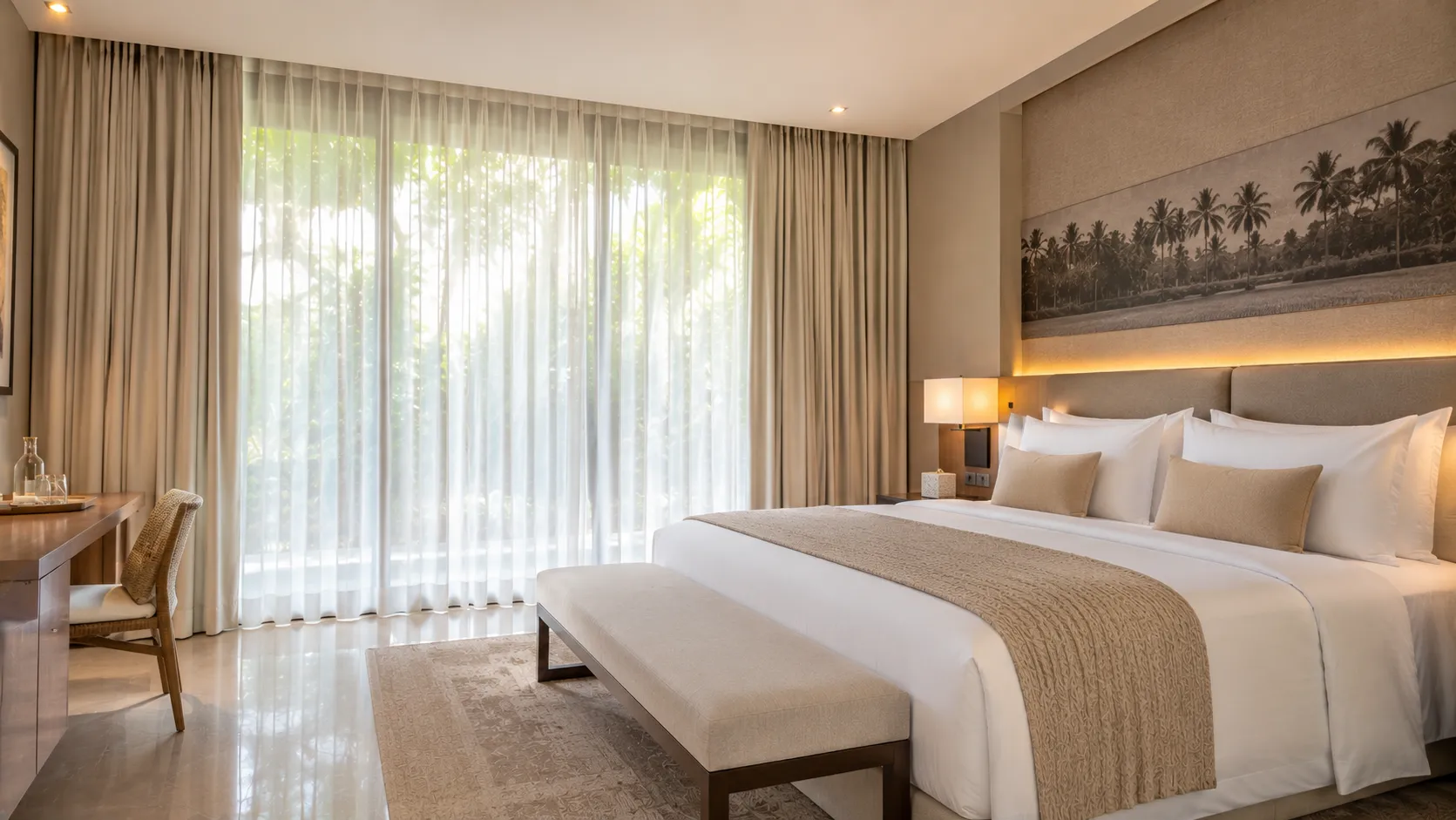
In living spaces, sheers can make daylight feel gentler while preserving a bright atmosphere. In bedrooms, they can provide a light daytime layer when paired with a more opaque curtain for night-time privacy. In hotel and villa interiors, their soft folds can also add visual continuity across large windows.
- Softened daylight: a sheer fabric can diffuse direct light and reduce the sharpness of bright window areas.
- Visual connection: depending on its density and the lighting conditions, a sheer can preserve a partial view of the garden or outdoor setting.
- Gentle privacy: sheers can reduce direct visibility while still allowing daylight into the room, although they do not provide complete privacy in every condition.
- Layering flexibility: a sheer can operate independently from a heavier curtain or blind.
- Decorative softness: flowing fabric can balance stone, timber, concrete and other firm architectural finishes.
2. Understanding Sunlight Filtering and Diffusion
Sunlight filtering describes how a fabric moderates the light passing through a window. Diffusion occurs when the fabric scatters or softens incoming light, reducing the appearance of a hard beam and creating a more even visual effect. The amount of diffusion depends on the weave, yarn, fabric density, colour and the angle and strength of the sunlight.
A very open sheer may preserve more of the outdoor view but provide less screening. A denser weave may soften the view more strongly and offer greater daytime privacy from some angles, but it can also reduce the amount of visible detail outside. It is important to assess the actual sample rather than relying on the product name alone.
Direct sunlight and glare
Windows receiving strong direct sunlight may still feel bright with a sheer curtain. A sheer can soften the light, but it should not be treated as a guaranteed heat-control or glare-elimination solution. Consider the window orientation, glazing, external shading and the room's use. For screen areas or rooms with intense afternoon exposure, a blind or additional curtain layer may be needed.
Changing light throughout the day
The appearance of a sheer changes as daylight moves. A fabric that looks almost transparent in bright daytime conditions may appear more opaque when the room is darker than the outdoors. At night, when interior lights are on, people outside may be able to see into the room. Plan privacy using the full day-and-night lighting situation, not daytime appearance alone.
3. Choosing Sheer and Linen-Look Fabrics
Sheer fabrics are available in different constructions, textures and fibre compositions. The right choice depends on the desired appearance, the property's maintenance routine and the conditions around the window. "Linen look" describes a visual character; it does not necessarily mean that a fabric is made from 100% linen. Check the product specification for the actual fibre content.
Fine voile-style sheers
Fine voile-style fabrics create a light, delicate appearance and can suit minimalist bedrooms, living rooms and contemporary hotel interiors. Their relatively light visual character can help preserve an open feeling. Check the weave and care instructions, particularly for wide panels that will be handled frequently.
Linen and linen-blend sheers
Linen and linen-blend fabrics can introduce natural texture and an understated, relaxed look. Slubs and variations in the yarn create visual interest, making them suitable for interiors with timber, stone and woven materials. Natural-fibre content can affect care, dimensional stability and the way the fabric hangs, so follow the supplier's guidance.
Linen-look and textured sheers
Linen-look alternatives can offer a similar textured appearance with different composition and care characteristics. They may be worth comparing where a project needs a particular look alongside practical maintenance considerations. Evaluate the sample for drape, transparency, colour and surface texture.
Open and denser weaves
An open weave generally allows more visibility and light through, while a denser construction can create a more screened appearance. Neither is automatically better. The best choice depends on the window's exposure, the distance to neighbours, the desired outdoor view and whether a second layer is planned.
4. Creating Soft Privacy Without Closing the Room
Sheer curtains can provide a degree of visual screening during the day, but their privacy performance is not absolute. Visibility depends on the difference between indoor and outdoor light levels, the fabric's openness, the viewing angle and the distance between the window and nearby spaces.
For a villa bedroom facing a garden, a sheer may be enough for a soft daytime boundary if the outdoor area is private. For a ground-floor apartment facing a walkway or neighbouring property, a denser sheer or an additional blind may be more appropriate. Bathrooms and other sensitive spaces generally need a more reliable privacy solution than a sheer alone.
- Review sightlines from paths, neighbouring windows, balconies and shared outdoor areas.
- Check the fabric from both inside and outside in daylight.
- Repeat the check after dark with the room lights switched on.
- Use a second layer or another suitable treatment where privacy must be maintained at night.
- Consider how the curtain will sit when open so that the window can still be used comfortably.
5. Sheers, Breeze and Ventilation
Sheer curtains are visually light, but they are not ventilation systems. Air movement through a fabric depends on its construction and the strength and direction of the breeze. A dense sheer may move less air than a very open weave, and any curtain can shift or billow when windows and doors are open.
In Bali homes designed for indoor-outdoor living, consider how the curtain interacts with the opening. Make sure the fabric does not become trapped in sliding-door tracks, catch on handles or obstruct circulation. For exposed openings, discuss ways to secure or manage the panels when the property is ventilated.
Do not assume that a sheer will provide the same airflow as an uncovered opening. If natural ventilation is a priority, the window or door configuration, insect screening, furniture placement and curtain stack all need to be considered together.
6. Layering Sheers with Blackout and Dimout Curtains
Layering is a practical way to create different light and privacy settings in one room. The sheer can remain closed during the day to soften the view, while the outer curtain can be drawn when stronger privacy or room darkening is needed. Separate tracks allow each layer to operate independently.
Sheer with blackout curtain
This combination is often useful in bedrooms, guest suites and media rooms. The sheer supports a soft daytime atmosphere, while the blackout layer is selected for stronger light blocking. Complete darkness still depends on the installation, because light may enter through gaps around the curtain edges.
Sheer with dimout curtain
A dimout layer may suit rooms where softer light reduction is sufficient. It can be a suitable choice for some living spaces and guest areas, but it should not be described as equivalent to blackout. Confirm the supplier's product information and assess the required level of darkness.
Coordinating the two fabrics
For a calm palette, pair warm white or ivory sheers with oatmeal, sand, beige or taupe curtains. A textured linen-look sheer can also complement a plain outer curtain. The fabrics do not need to match exactly; they should share compatible undertones and work with the room's finishes.
7. Colours, Textures and Interior Coordination
Sheer curtain colours influence how a window relates to the rest of the interior. Warm white and ivory can soften daylight and work with natural timber, cream walls and warm stone. Soft grey and stone tones may suit contemporary spaces with concrete, dark frames and cooler finishes. Sand and oatmeal can add warmth without creating a strong contrast.
Texture is equally important. A smooth, fine sheer creates a more delicate appearance, while a linen-look weave adds surface variation and a relaxed character. When choosing a textured fabric, check it at the intended hanging height and in the room's natural light. A small swatch may not show how the texture reads across a full-width curtain.
| Sheer colour or texture | Interior character | Useful coordination ideas |
|---|---|---|
| Warm white or ivory | Soft, bright and understated | Pairs naturally with cream walls, warm timber and light stone |
| Oatmeal or sand | Relaxed and earthy | Complements rattan, woven details and natural flooring |
| Soft grey or stone | Quiet and contemporary | Works with concrete, grey stone and dark window frames |
| Linen-look slub texture | Organic and tactile | Adds depth to minimalist interiors without a bold pattern |
| Fine, smooth voile | Light and delicate | Supports a clean appearance in bedrooms and modern living spaces |
8. Sheer Curtain Ideas for Each Room
Villa living rooms
Large living areas often benefit from full-height sheers that frame garden views and soften the transition between inside and outside. Consider the stack direction carefully so the fabric does not cover too much glazing when open. If the room receives strong afternoon sun, assess whether a second layer or a suitable blind is required.
Bedrooms and guest suites
Use sheers as a daytime layer and pair them with blackout or dimout curtains according to the guest's needs. Choose a colour that complements the bedding, headboard and wall finishes. The system should be easy to operate and provide adequate coverage when closed.
Dining areas
A sheer can create a softer atmosphere around a dining space while retaining daylight. Consider how close the curtain is to doors, furniture and areas where food is served. Select a fabric that can be maintained according to the property's cleaning routine.
Bathrooms
Use caution when specifying sheers in bathrooms. A sheer alone may not provide sufficient privacy, particularly at night, and fabric close to showers or persistent moisture may need additional care. Confirm suitability and consider a more private secondary treatment where required.
Hotel lounges and reception spaces
In hospitality areas, sheers can soften expansive glazing and create a consistent visual language across multiple windows. Confirm that the fabric, track and operating method are suitable for the expected frequency of use and the property's maintenance arrangements.
9. Measurements, Tracks and Installation
Even a simple sheer curtain depends on accurate measurements and a suitable track. Measure the actual installation width and height, confirm whether the track is ceiling-mounted or wall-mounted, and identify any pelmets, cornices, beams or other obstructions. For full-height curtains, small measurement errors can become noticeable across a long drop.
Track selection
Choose a track that is compatible with the curtain heading and suitable for the span and finished fabric weight. A single track is often sufficient for one sheer layer, while a double track can support a sheer and an outer curtain. Confirm bracket positions and fixing suitability for the ceiling or wall construction.
Fullness and finished appearance
The amount of fabric relative to the track width determines the fullness and visual density of the folds. The appropriate ratio depends on the fabric, heading system and desired appearance. Very open sheers may need a different fullness from heavier textured fabrics to achieve a balanced result.
Stacking and access
Plan where the sheer will sit when open. On sliding doors, ensure the stack does not obstruct handles or access. For wide openings, consider whether the curtain should open from the centre or stack to one side. The best arrangement depends on the door configuration and available wall space.
Before confirming the project, review the curtain measuring guide, the shade measuring guide and the valances and cornices measuring guide. The curtain stacking calculator can help estimate how much space the curtain may occupy when drawn open.
10. Care and Maintenance in Bali
Sheer curtains can collect dust and airborne particles, particularly in properties with open doors, gardens or nearby construction. Their care requirements depend on the fibre content, weave, finishing and supplier instructions. Delicate fabrics may need gentler handling than more robust synthetic or blended constructions.
- Follow the manufacturer's cleaning instructions and do not assume every sheer is machine washable.
- Allow fabric to dry fully after cleaning before rehanging it.
- Keep curtains from resting against persistently damp walls or window surfaces.
- Check tracks and gliders periodically so the panels continue to move smoothly.
- Use care when opening and closing wide panels to avoid pulling or snagging the fabric.
- For hospitality properties, include curtain inspection and cleaning in the regular maintenance schedule.
In coastal locations, also consider the exposure of the track and fixings to salt-laden air. Ask the supplier or installer to recommend hardware suitable for the property's conditions and confirm the relevant maintenance guidance.
11. Common Mistakes to Avoid
- Expecting complete privacy from a sheer: visibility changes with indoor and outdoor lighting, especially after dark.
- Assuming all sheers allow the same light: weave density, colour and fibre construction affect transparency and diffusion.
- Calling a sheer an airflow solution: fabric may move with a breeze, but it does not replace proper ventilation design.
- Ignoring strong sun exposure: a sheer can soften light but may not provide enough glare or heat control on its own.
- Choosing only from a photograph: evaluate physical samples in the room and under different lighting conditions.
- Forgetting the night-time view: interior lighting can make a room visible from outside through a sheer.
- Not planning the stack: an incorrectly positioned track can obstruct doors or reduce the clear view.
- Overlooking care requirements: confirm cleaning instructions before specifying delicate or natural-fibre fabrics for busy properties.
12. Frequently Asked Questions
Are sheer curtains suitable for Bali villas?
Yes. Sheers can soften daylight and create a relaxed connection with outdoor views in many Bali villas. The fabric should be selected according to sunlight exposure, privacy needs, ventilation, maintenance and the room's function.
Do sheer curtains provide privacy during the day?
They can provide some daytime screening, depending on the fabric density, viewing angle and difference in light levels. They do not guarantee privacy in every situation, and they usually provide less privacy at night when interior lights are on.
Do linen sheer curtains allow air to pass through?
Air movement depends on the fabric's weave and construction. Some open weaves allow more air movement than denser fabrics, but a curtain should not be treated as a substitute for ventilation through a properly designed window or door opening.
What is the best colour for sheer curtains in Bali?
Warm white, ivory, oatmeal and soft neutral tones are versatile choices for tropical interiors. The best colour depends on the wall finish, flooring, timber, window frames and the tone of the main curtain layer.
Should sheer curtains be paired with blackout curtains?
They are often paired in bedrooms and guest suites where daytime light filtering and stronger night-time darkness are both required. Separate tracks allow each layer to be operated independently.
Can sheer curtains block heat?
Sheers can diffuse some direct light, but their ability to reduce heat depends on the fabric and the complete window system. For significant solar exposure, assess glazing, external shading, blinds and lined curtains as part of the solution.
Are sheer curtains suitable for hotel rooms?
They can be suitable for hotel rooms when the fabric, track and cleaning requirements match the property's operational needs. Guest bedrooms often benefit from a second layer for privacy and room darkening.
How do I choose the right sheer fabric?
Compare physical samples for transparency, texture, colour and drape. Confirm fibre composition, width, care instructions and availability, then assess the sample at the actual window in different lighting conditions.
Conclusion: Let Bali's Natural Light Shape the Interior
Sheer curtains offer a graceful way to soften daylight and bring texture to tropical interiors. In Bali villas and hotels, the right sheer can frame a garden view, create a gentle daytime privacy layer and complement natural materials without making the room feel closed. The result depends on choosing a fabric with suitable transparency, texture and care requirements.
For the best outcome, consider the complete window: sunlight direction, night-time privacy, ventilation, track position, curtain stack and the possible need for a second layer. Test fabric samples in the property and confirm measurements before production. A carefully planned sheer curtain can then support both the visual character and everyday use of the space.
Explore the Almeers Living product range for custom curtains and blinds, or visit the Almeers Living blog for more window treatment guidance. Almeers Living supports custom window treatment planning in Bali, with solutions considered around each property's measurements, interior direction and functional requirements.