Window treatments are becoming more than decorative finishing touches. In modern villas and hotels, curtains and blinds can contribute to privacy, guest comfort, daylight management, energy-conscious operation and the overall experience of a room. As property owners in Bali look for more considered ways to manage tropical sunlight and create comfortable interiors, three developments deserve attention: smart motorized systems, textiles made with recycled or lower-impact materials, and advanced solutions designed to reduce unwanted solar heat.
These technologies are not one-size-fits-all upgrades. A motorized curtain may be valuable in a tall villa living room but unnecessary for a small guest bedroom. A recycled textile may be an excellent choice when its composition and durability match the project, but the word “sustainable” alone does not guarantee a lower environmental impact. Thermal performance also depends on the entire window assembly, including glass, shading, installation gaps and how the room is used.
Key takeaway: The future of window treatments in Bali is likely to be a thoughtful combination of automation, responsible material selection and effective solar control. The best solution starts with the building, its orientation, exposure, operating needs and maintenance plan—not with technology alone.
1. Why Window Treatments Are Evolving
Large glazed openings, open-plan layouts and strong connections to outdoor spaces are common features in Bali properties. They create attractive views and bring natural light indoors, but they can also introduce heat, glare and privacy challenges. A window treatment helps manage these conditions while contributing to the visual character of the interior.
At the same time, guest expectations are changing. Convenient controls, quiet operation, comfortable sleeping conditions and interiors that reflect responsible material choices can all influence how a property is experienced. For owners and operators, the aim is to balance comfort and design with reliability, ease of maintenance and sensible operating costs.
Three trends are particularly relevant:
- Automation: Curtains and blinds can be operated using wall switches, remotes, apps or compatible smart-home systems.
- Material innovation: Recycled-content yarns and improved textile manufacturing are expanding the range of fabric options available to designers.
- Solar and thermal management: Specialised fabrics, reflective backings, layered treatments and external shading can help reduce solar heat entering a space.
These developments work best when specified together. For example, a motorized solar screen may reduce glare during the day, while a decorative curtain adds softness and privacy at night.
2. Smart Automated Motorization: Convenience Meets Design
Motorized curtains and blinds use an electric drive system to move the window covering along a track or roller mechanism. Depending on the product, the system may be operated by a remote control, wall switch, mobile application or a compatible home-automation platform.
Where motorization makes the biggest difference
- High or hard-to-reach windows: Automation makes it easier to operate treatments without reaching for a long cord or manually pulling a heavy curtain.
- Wide sliding doors: A motor can help move long or substantial curtain panels more consistently.
- Bedrooms and suites: Scheduled opening and closing can support a guest's preferred daily routine.
- Large villas: Multiple window treatments may be grouped into zones for more convenient control.
- Hospitality spaces: Staff may be able to operate selected treatments efficiently, depending on the control design and property procedures.
Choose the motor to match the treatment
Not every motor is suitable for every curtain. The correct specification depends on the curtain's weight, track length, fabric construction, number of panels, opening direction and expected frequency of use. Ask the supplier to confirm the motor's rated capacity and compatibility with the proposed track and curtain configuration.
Quiet operation can be important in bedrooms and premium hospitality settings. However, actual noise levels vary by motor, track, installation quality and load. Where quietness is a priority, request a demonstration or technical specification for the exact system being proposed.
Power and installation planning
Motorized systems may use mains power or rechargeable/battery-powered options, depending on the product. Mains-powered installations require electrical planning and suitable access to the power supply. Battery-powered options can simplify some installations but introduce charging or battery replacement requirements. Confirm the power method, wiring route, access for servicing and any backup operation before construction or renovation work is finalised.
3. Controls, Sensors and Smart-Home Integration
Smart controls can make a window treatment more convenient, but the control experience should remain simple for residents, guests and property staff. A reliable setup is often more valuable than a complicated system with features that are rarely used.
Common control options
| Control method | Potential benefit | Planning consideration |
|---|---|---|
| Remote control | Simple local operation without a phone | Keep remotes labelled, accessible and easy to replace. |
| Wall switch | Familiar control in a fixed location | Agree switch positions and wiring before installation. |
| Mobile application | Convenient operation and, on some systems, scheduling | Check network requirements, account management and handover procedures. |
| Smart-home integration | Can coordinate treatments with lighting or other building systems | Confirm protocol compatibility, hub requirements and installer support. |
| Sunlight or temperature sensor | May trigger automatic responses based on measured conditions | Sensor placement, thresholds and manual override need careful configuration. |
For a Bali villa, a practical automation scene might close selected blinds during periods of strong afternoon sun and reopen them later. In a hotel, a simple guest-facing control may be preferable to a complex interface. Any automated schedule should allow manual override and should be tested under real operating conditions.
Do not assume that all motors connect directly to every smart-home platform. Confirm the communication protocol, required gateway or hub, app support, internet dependency and compatibility with the property's existing system. Ask who will provide technical support after handover.
4. Sustainable and Recycled Textiles: Better Choices Through Verification
Textile innovation is creating more options for projects that want to consider recycled content and material sourcing. Some fabrics use recycled polyester yarns, including yarn made from post-consumer plastic. Other products may combine recycled and virgin fibres or use manufacturing processes intended to reduce selected environmental impacts.
For designers and property owners, the important step is to look beyond broad marketing descriptions. A fabric described as eco-friendly or sustainable should be evaluated through its actual composition, verified claims, durability, care requirements and the manufacturer's available documentation.
Questions to ask about recycled-content fabrics
- What percentage of the textile is recycled content?
- Is the recycled material post-consumer, post-industrial or a combination?
- Is there documentation or a recognised certification supporting the claim?
- How does the fabric perform under the expected sunlight and usage conditions?
- What are the cleaning instructions and expected maintenance needs?
- Can the supplier provide consistent availability for replacement panels or future phases?
Durability is part of responsible specification
A textile that needs frequent replacement may not be the best long-term choice, even if it contains recycled fibres. For hotels and villas, consider abrasion, colour stability, cleaning frequency, sunlight exposure and the availability of replacement material. A suitable fabric should meet the project's operational requirements as well as its design goals.
Natural fibres and recycled synthetics can serve different purposes
Linen and cotton can provide a natural tactile appearance, while recycled polyester blends may offer other practical characteristics depending on construction. Neither category is automatically superior in every application. Compare the complete product specification and choose according to the opening, exposure, performance requirements and care plan.
5. Next-Generation Thermal Heat Barriers and Solar Control
In a tropical climate, managing solar heat and glare can be as important as selecting a decorative fabric. Window treatments can form part of a broader solar-control strategy by reducing direct sunlight, filtering glare and limiting some heat transfer through the glazed opening. The result depends on the fabric, colour, backing, openness, installation and the window itself.
Solar screen and reflective fabrics
Solar screen fabrics are designed to manage incoming sunlight while often preserving some outward visibility. Their performance is influenced by openness factor, colour and construction. A tighter weave generally changes the amount of light and view passing through, but the correct balance depends on the room's orientation and the desired outlook.
Some specialist fabrics use reflective or metallised layers intended to reflect a portion of solar radiation. These products may be considered for windows with strong sun exposure, but performance claims should be supported by product-specific test data. Ask for relevant figures such as solar reflectance, solar transmittance or total solar energy rejection where available, and clarify the test method.
Thermal-lined curtains
Thermal or specialised curtain linings can add another layer between the room and the window. Depending on the lining construction and installation, they may help reduce heat transfer and improve comfort. The result is not identical across all products, and a lining does not replace appropriate glazing, ventilation or external shading where those measures are needed.
External shading can be especially effective
Where practical, overhangs, verandas, exterior screens and vegetation can intercept sunlight before it reaches the glass. External shading can be an important part of the overall design because it addresses solar exposure earlier in the heat-gain process. Interior curtains and blinds can then provide additional glare, privacy and comfort control.
For properties with extensive glazing, consider a combined strategy: architectural shading, suitable glass, solar-control blinds and decorative curtains. A qualified building or energy professional can help assess the overall envelope where thermal performance is a major project objective.
6. Layering for Tropical Comfort and Flexible Interiors
Layering combines two or more window treatments to serve different purposes. It is a flexible approach for Bali properties because the needs of a room can change throughout the day. A sheer layer can soften daylight, while a second curtain or blind provides stronger privacy or light control.
| Layer combination | Typical use | Key point |
|---|---|---|
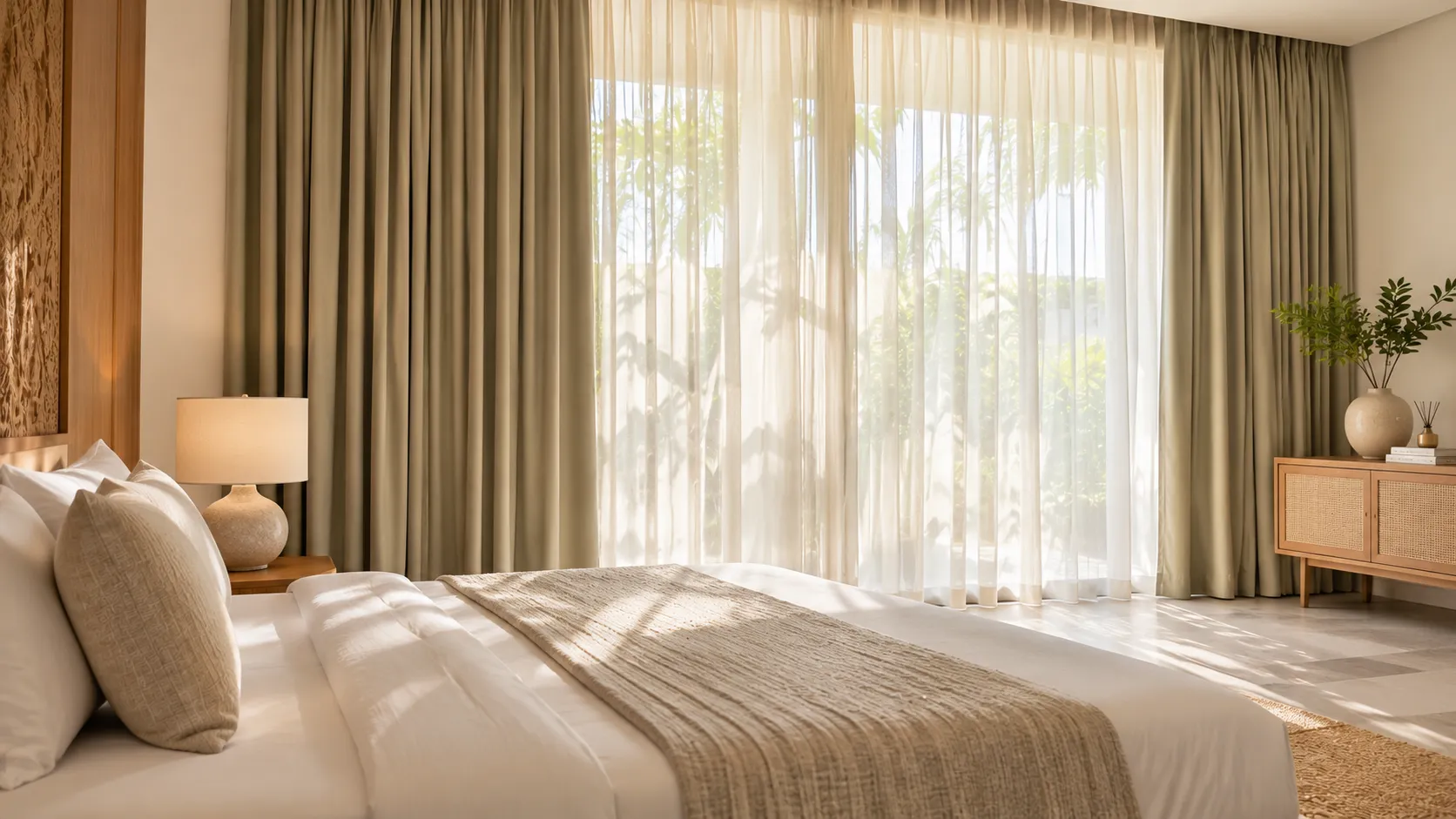
| Sheer + blackout curtain | Bedrooms and suites | Plan overlap and edge coverage to minimise unwanted light gaps. |
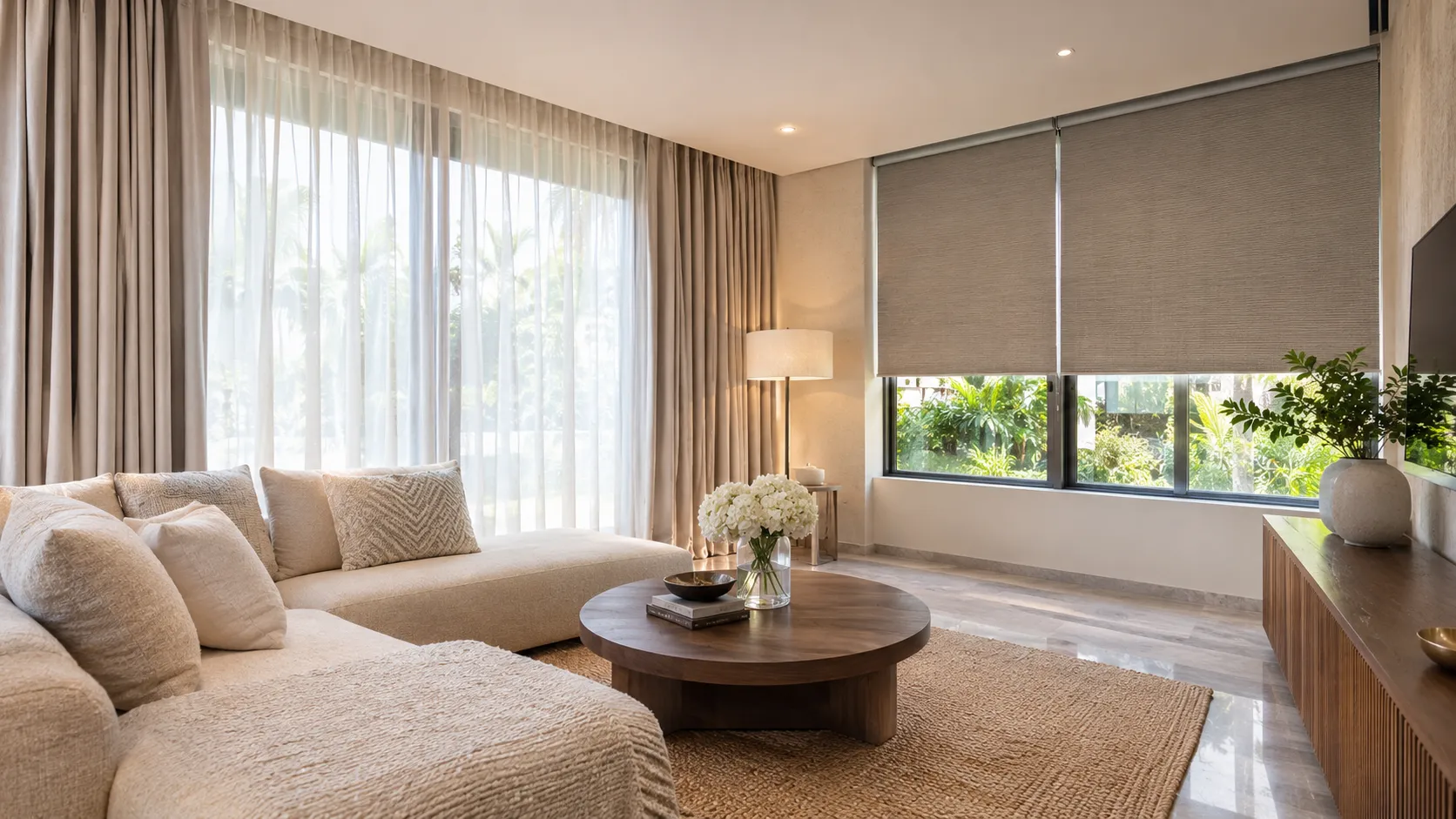
| Solar screen blind + decorative curtain | Living rooms with strong daylight | Coordinate blind openness and curtain stack with the view and furniture. |
| Sheer + dimout curtain | Guest rooms and multipurpose spaces | Dimout reduces light but is not necessarily total blackout. |
| Motorized blind + manual decorative drapery | Spaces where automated solar control and soft styling are both desired | Make sure the two systems can operate without interference. |
Layering should be planned before the track and ceiling details are completed. Double-layer systems need sufficient track space, appropriate brackets and a practical stacking arrangement. For large openings, calculate where each layer will sit when fully open so that the treatment does not unnecessarily cover the glass or obstruct access.
Explore the Almeers Living Stacking Calculator to understand curtain stacking space, and review the Curtain Measuring Guide before preparing measurements.
7. What Bali Villas and Hotels Should Prioritise
Private villas and hotels may use similar products, but their operating requirements can differ. A private owner may prioritise personal control, aesthetics and integration with a home-automation system. A hotel or managed villa may place greater emphasis on repeatable operation, staff training, replacement parts and ease of maintenance.
For private villas
- Prioritise convenient operation for large or high windows.
- Consider automated schedules for selected sun-exposed areas, while retaining manual control.
- Coordinate fabric texture and colour with timber, stone, furniture and landscape views.
- Choose systems that can be serviced without excessive disruption to the property.
For hotels and hospitality projects
- Use simple, intuitive controls that guests can understand quickly.
- Specify robust components appropriate for the expected frequency of operation.
- Standardise fabric and hardware selections where practical to simplify replacement and maintenance.
- Provide staff with clear operating instructions and a process for reporting faults.
- Consider cleaning schedules, spare parts and supplier support as part of the initial specification.
In both settings, assess each window individually. A west-facing bedroom, a shaded courtyard suite and a poolside lounge may require different levels of solar control and different material specifications.
8. How to Select the Right Future-Ready Window Treatment
A future-ready specification is not necessarily the most expensive or technologically advanced option. It is a system that addresses the property's real requirements and can be maintained over time.
Step 1: Assess the opening and its exposure
Record the opening dimensions, orientation, glass type where known, shading conditions, surrounding surfaces and exposure to rain or wind. Note whether the opening is used frequently and whether it is accessible for manual operation.
Step 2: Define the performance goal
Decide whether the main priority is glare reduction, daytime privacy, night-time privacy, room darkening, convenience, thermal comfort or visual softness. A clear priority helps narrow the options and prevents unnecessary features.
Step 3: Compare fabric and technical specifications
Review fabric composition, opacity, openness factor where relevant, colour, backing, cleaning method and available performance data. Request physical samples and assess them in the actual room at different times of day.
Step 4: Confirm motor and control compatibility
For automated systems, check motor capacity, track compatibility, power requirements, control options, integration protocol, warranty and service arrangements. Confirm that the system has a practical manual or emergency operating method where applicable.
Step 5: Plan installation and handover
Confirm fixing points, wiring, track position, stacking space, access panels and the installation sequence. For hospitality projects, include a short handover covering daily operation, cleaning and how to report a fault.
9. Maintenance and Long-Term Operation
Maintenance should be considered before a product is selected, especially in villas and hotels where treatments may be operated frequently. Dust, humidity, salt in coastal air and repeated use can affect both fabric and mechanical components. Follow the manufacturer's instructions rather than applying a single cleaning method to every textile or motorised system.
- Fabric care: Confirm whether the fabric can be vacuumed gently, spot-cleaned, professionally cleaned or washed. Do not assume all fabrics are washable.
- Track care: Keep tracks free of dust and debris, and use only maintenance products recommended by the supplier.
- Motor checks: Observe unusual noise, inconsistent movement or interruptions and arrange inspection when needed.
- Electrical safety: Have electrical work and repairs handled by appropriately qualified personnel.
- Coastal environments: Inspect exposed fittings periodically and follow the supplier's cleaning and maintenance guidance.
- Replacement planning: Keep fabric references, product codes, motor details and installation information for future servicing.
For hotels, a simple asset register can record each treatment's location, fabric code, track type, motor model, installation date and service history. This makes it easier to identify components and maintain consistency when repairs or replacements are required.
10. Common Mistakes to Avoid
- Automating every window without a use case: Start with openings where motorization solves a genuine access or convenience problem.
- Assuming all smart motors are compatible: Confirm the exact protocol, hub, power and control requirements.
- Choosing recycled fabric based only on a label: Request composition details and evidence for environmental claims.
- Expecting curtains alone to solve overheating: Assess glass, external shading, ventilation and solar exposure as part of the complete building strategy.
- Confusing dimout with blackout: Check the actual opacity and understand that installation gaps can still allow light through.
- Ignoring maintenance access: Motors, tracks and controls need to remain accessible for servicing.
- Leaving electrical planning too late: Power points, wiring routes and control positions are easier to coordinate before ceilings and finishes are complete.
- Overcomplicating guest controls: A clear, reliable control interface is usually better than a confusing set of options.
11. Project Planning Checklist for Bali Properties
- Map each window and record its dimensions, orientation and exposure.
- Identify the primary objective for each room: glare control, privacy, darkness, comfort or convenience.
- Decide which openings genuinely benefit from motorized operation.
- Confirm the motor, track, power supply and control-system compatibility.
- Request fabric composition and supporting documentation for recycled-content or performance claims.
- Compare solar-screen, thermal-lining and layered-treatment options against the actual site conditions.
- Review samples in daylight and under the property's night-time lighting.
- Coordinate tracks, wiring, ceiling details and stacking space with the construction or interior team.
- Confirm cleaning instructions, warranty coverage, spare-part availability and service contacts.
- Arrange testing and user handover after installation.
For more preparation, visit the Curtain Measuring Guide, browse the Shade Measuring Guide, and explore available curtains and blinds from Almeers Living.
12. Frequently Asked Questions
Are motorized curtains worth installing in a Bali villa?
They can be worthwhile for large, high or frequently used openings, and where convenient control is a priority. The value depends on the number of windows, curtain weight, access, power availability and the owner's preferred control method.
Can motorized curtains be connected to a smart-home system?
Some systems can integrate with smart-home platforms, but compatibility varies by motor and controller. Confirm the communication protocol, gateway requirements, app support and installation arrangements before purchasing.
Do recycled textiles work for hotel curtains?
They may be suitable when their composition, durability, cleaning requirements and performance match the hotel's operating conditions. Request product documentation and test or sample information rather than relying on a general sustainability label.
What are thermal curtains or thermal heat barriers?
These terms can refer to curtains or linings designed to help reduce heat transfer, or to solar-control fabrics that manage incoming sunlight. Performance varies by construction and installation, so review product-specific test data where available.
Can curtains reduce heat in a Bali property?
Suitable blinds, solar screens, reflective fabrics and lined curtains can help manage sunlight and may improve comfort. Results depend on window orientation, glazing, shading, fabric specification and installation. External shading can also be an important part of the solution.
Are solar screen blinds better than curtains?
Neither is universally better. Solar screens can be useful for glare and daylight management while retaining some view, whereas curtains offer a softer appearance and flexible privacy or room-darkening options. A layered combination may suit some spaces.
What should hotels consider before installing automated blinds?
Hotels should consider guest-friendly controls, reliability, motor capacity, staff procedures, service access, spare parts and maintenance planning. A standardised system across similar rooms can simplify operation and future replacement.
Do motorized curtains still work during a power or network outage?
It depends on the motor and control design. Some products provide manual override or battery options, while others may require power to operate. Confirm the exact backup behaviour with the supplier rather than assuming it is included.
Conclusion: A Smarter, More Considered Approach to Window Treatments
The future of window treatments for Bali villas and hotels is not defined by automation or new materials alone. It is about combining useful technology, well-documented material choices and effective solar management in a way that suits the architecture and daily operation of each property.
Motorized curtains can make large openings easier to manage. Recycled-content textiles can support more informed material selection when claims are verified and performance is appropriate. Solar screens and thermal-oriented linings can contribute to comfort when specified as part of a broader approach to glazing and shading.
Start with the needs of each room, compare real product specifications and plan installation early. This creates a window-treatment system that is attractive, practical and easier to maintain over the long term.
Almeers Living provides customised curtains and blinds in Bali, with consultation, measurement and installation options for residential and hospitality projects. Visit Almeers Living or browse the product range to explore window-treatment solutions for your property.