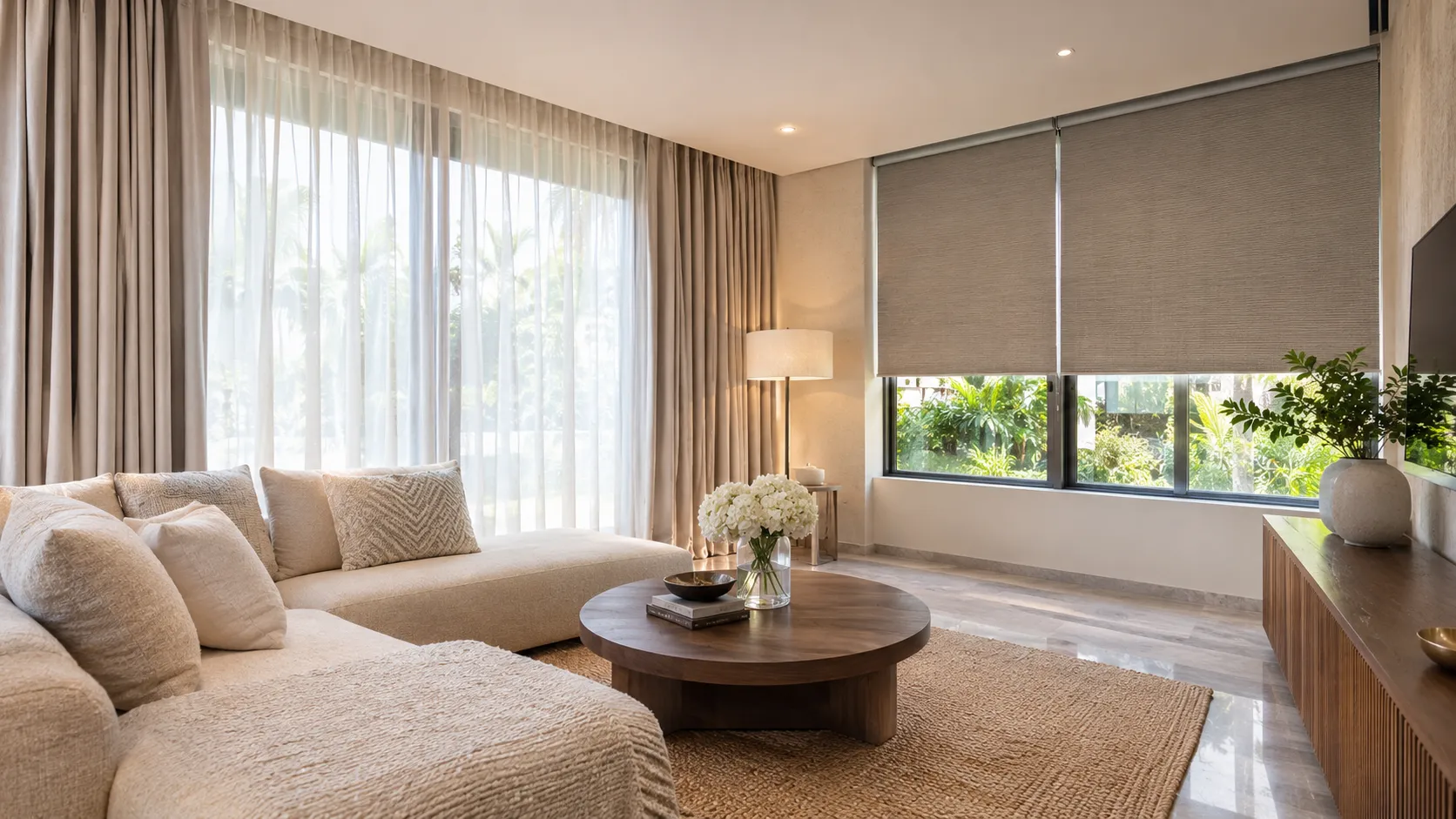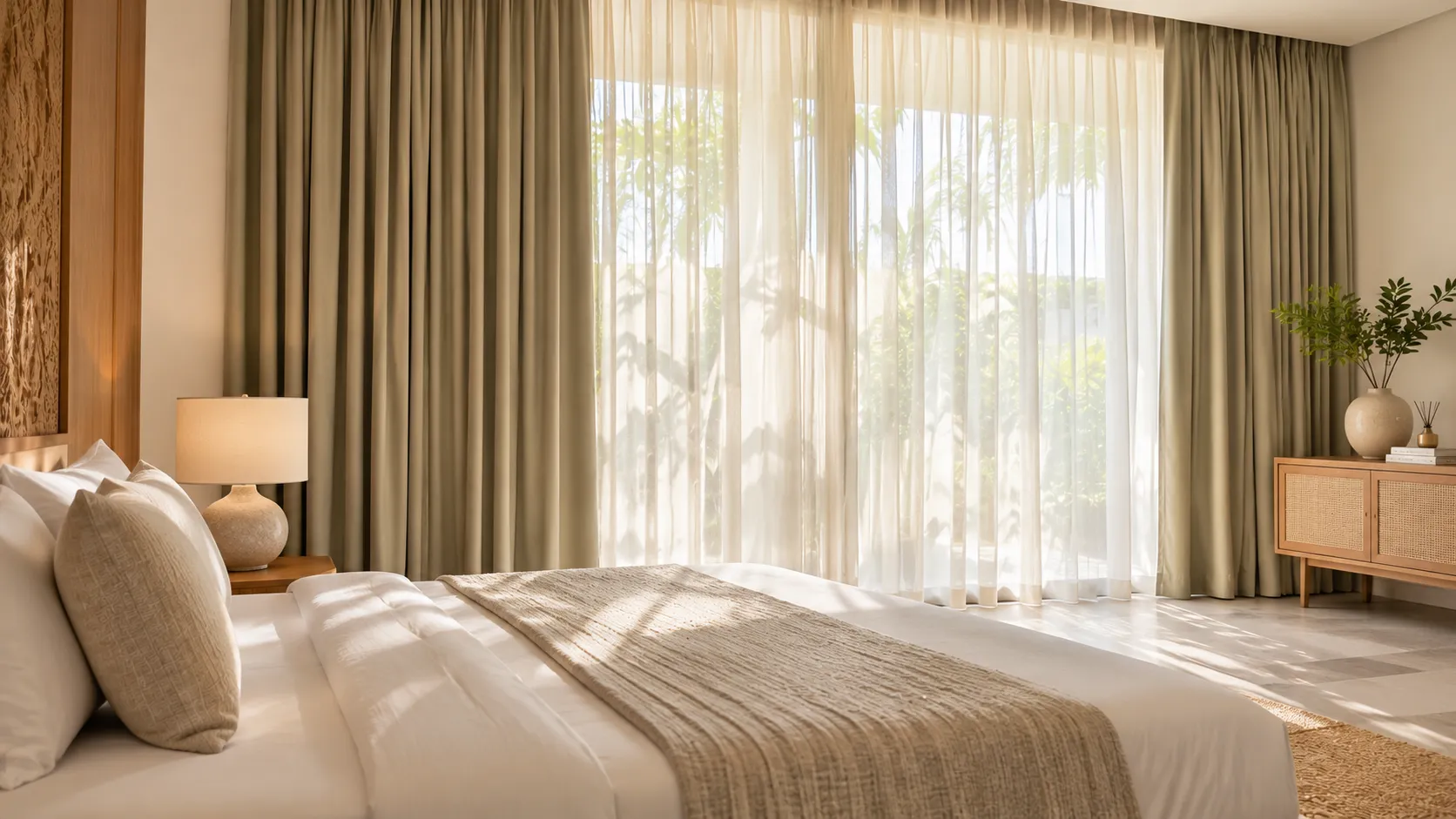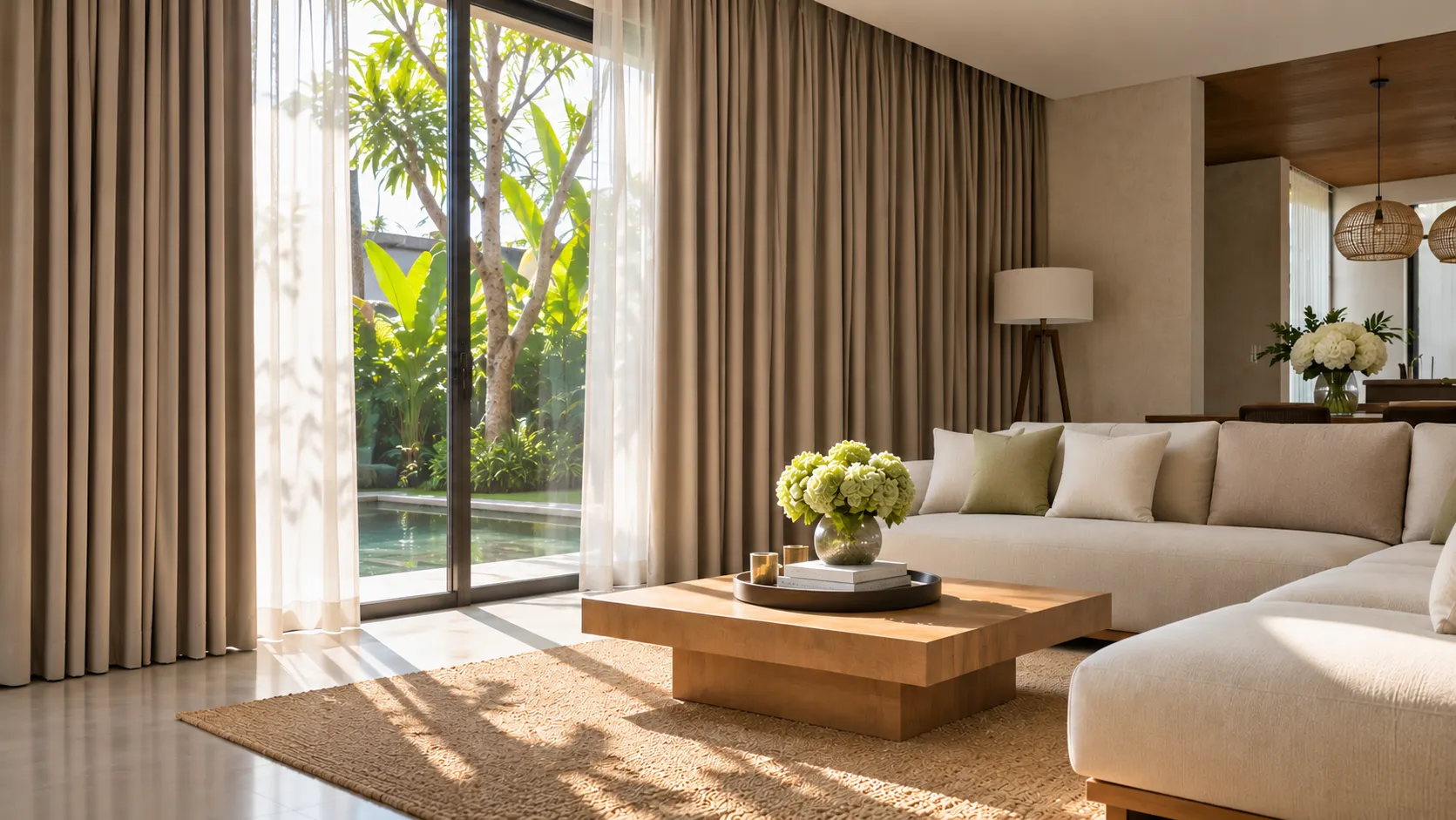
Bali's villas and hotels often combine natural materials, generous glazing and a strong connection between indoor and outdoor spaces. Window treatments need to complement this character while also performing practical tasks such as managing daylight, providing privacy and supporting comfortable room use. Ready-made products may suit standard openings, but bespoke tailoring becomes valuable when windows have unusual dimensions, high ceilings, layered finishes or a specific design direction.
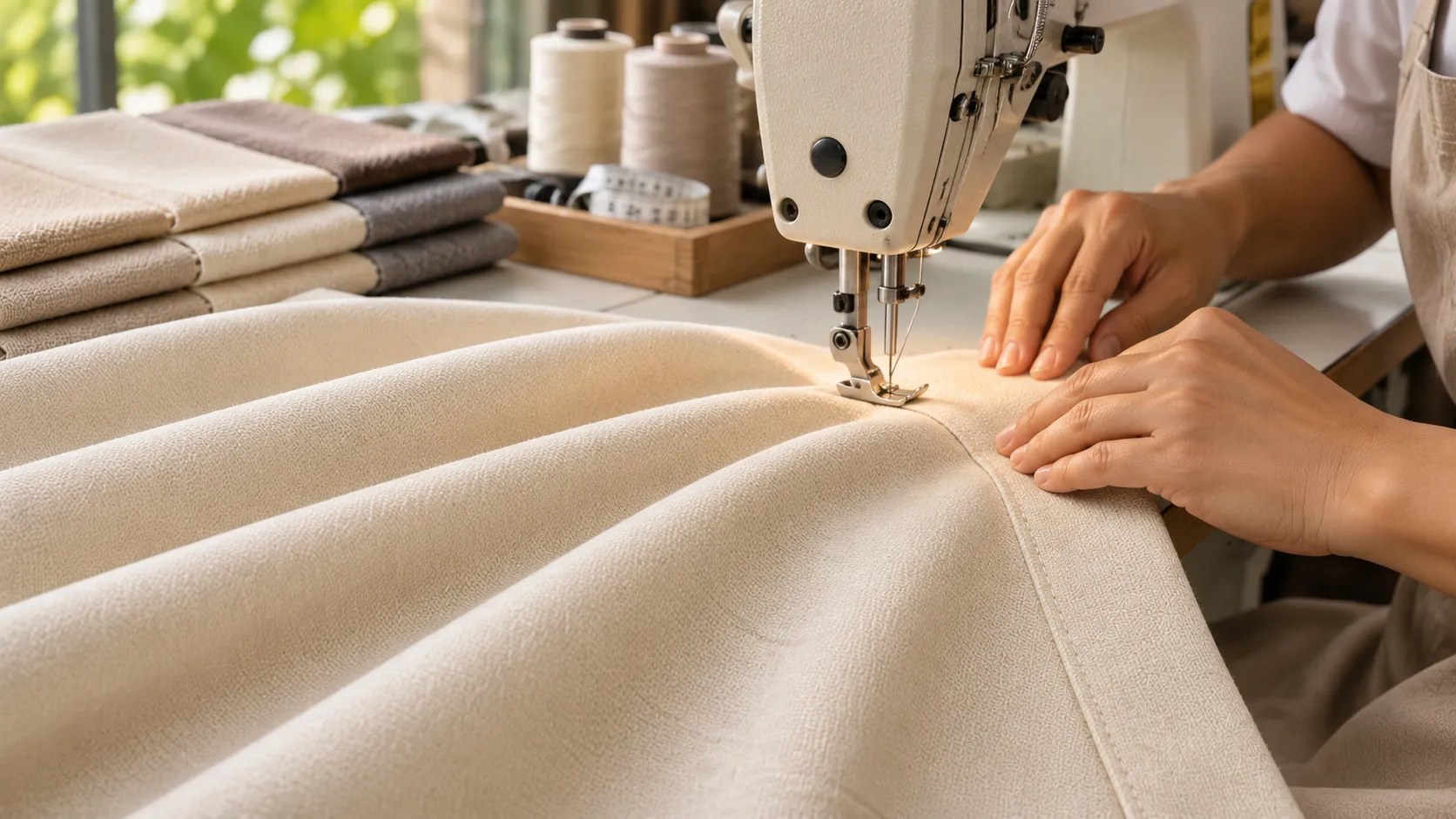
Handcrafted does not simply mean that a product is made by hand. It describes an approach in which measurements, fabric preparation, cutting, sewing, heading construction and final inspection receive careful attention. The result should be a curtain that fits its opening, hangs as intended and is finished consistently across the property. This guide explains what to look for when planning handcrafted window treatments for villas, boutique hotels and premium hospitality projects in Bali.
1. What Handcrafted Window Treatments Mean
Handcrafted window treatments are made or finished with attention to the individual requirements of a window and the overall interior scheme. Rather than relying only on standard sizes, a bespoke process considers the actual width and height, track position, fabric characteristics, desired fullness, heading style and finished hem. These decisions help determine how the curtain will look and function once installed.
Custom production is particularly useful when a property includes full-height glazing, wide sliding doors, arched or angled openings, unusually high ceilings or several rooms with different dimensions. It also allows the designer or property owner to coordinate curtain colours, textures, linings and hardware with other interior finishes.
Handcrafted work still benefits from clear specifications and repeatable quality checks. For a multi-room project, each opening should be measured and documented individually, while the chosen fabric, heading and finishing standards should remain consistent where the design calls for it.
2. The Value of Local Artisan Craftsmanship
Working with a local production and installation team can make communication and project coordination more practical for properties in Bali. Site measurements, fabric discussions, sample reviews and installation planning can be arranged with an understanding of local building conditions and project schedules. Local production may also make it easier to clarify details before work begins and address adjustments that arise during the process.
Attention to the individual opening
Not every window in a property is identical. Ceiling levels, wall returns, floor finishes and track positions can vary from room to room. A careful maker records these differences rather than assuming that one measurement or panel specification will work everywhere.
Craftsmanship is visible in the finish
Look for straight and even hems, clean seams, balanced panels, consistent pleat spacing and a heading that works with the selected track. These details are especially noticeable on long curtains and large glazed openings, where even small inconsistencies can become visually prominent.
Communication throughout production
Good project coordination involves confirming fabric codes, colours, lining, measurements, opening direction, track details and installation expectations before production. A clear approval process reduces the risk of misunderstandings and helps the finished treatment match the agreed specification.
3. Selecting Fabrics for Bali Properties
Fabric is both a decorative surface and a functional material. It influences how a curtain falls, how much light enters a room, how much privacy it provides and how it responds to cleaning and regular use. In Bali, fabric selection should also account for sunlight exposure, humidity, coastal conditions and the property's maintenance routine.
Natural and linen-look textures
Linen and linen-blend fabrics are valued for their relaxed texture and natural character. Linen-look alternatives can offer a similar visual direction with different fibre compositions and care requirements. These materials can work well in villas and hotels where the interior palette uses timber, stone, textured plaster and neutral tones. Confirm the actual fibre content rather than assuming that a linen appearance means the fabric is made from natural linen.
Sheer fabrics for filtered daylight
Sheers soften the appearance of incoming daylight and maintain a light visual connection to the outdoors. They are commonly used in living areas, dining rooms and bedrooms where daytime brightness is welcome. Their privacy is limited at night when interior lighting is on, so a second layer may be needed where privacy is important.
Dimout and blackout options
Dimout fabrics reduce visible light and can provide greater privacy than a sheer. Blackout fabrics or linings are used when stronger room-darkening is required, such as in bedrooms or media rooms. Blackout fabric does not guarantee complete darkness if light can enter around the sides, top or bottom of the installation.
Consider use and maintenance
Public areas, guest rooms and private residences have different cleaning and durability requirements. Before selecting a fabric, review its care instructions, suitability for sunlight exposure, colour stability information where available and the practicalities of removing or cleaning the finished curtain. The most suitable choice is the one that balances appearance with the way the property is operated.
| Fabric direction | Visual character | Planning considerations |
|---|---|---|
| Natural linen | Relaxed, tactile and understated | Check fibre content, care instructions, shrinkage guidance and sunlight exposure. |
| Linen-look woven | Textured appearance with a range of colour and construction options | Compare composition, drape and maintenance between fabric collections. |
| Sheer voile or textured sheer | Light, soft and suitable for filtering daylight | Provides limited night privacy and may need a second layer. |
| Dimout | More substantial appearance with reduced light transmission | Light control varies by textile construction and installation gaps. |
| Blackout fabric or lining | Designed for strong room-darkening | Specify coverage and edge details if reducing light leakage is important. |
| Decorative heavyweight fabric | Fuller folds and a more substantial drape | Check panel weight, track capacity, stack space and cleaning requirements. |
4. Why Custom Fabric Hemming Matters
The hem is one of the most visible finishing details on a full-length curtain. It determines how the panel meets the floor and contributes to the way the fabric hangs. A carefully finished hem helps create a clean, balanced appearance, particularly when curtains extend from a high ceiling to the floor.
Choose the intended floor finish
A floor-grazing hem creates a tailored look and is often practical for hotels and frequently used living spaces. A slight break at the floor can produce a softer appearance, while a puddled finish creates a more decorative effect. The choice should reflect the interior style, floor condition, cleaning routine and risk of moisture or dust.
Allow for the fabric's behaviour
Different fabrics respond differently to gravity, humidity, lining and use. Some may relax or settle after hanging, while others may require specific handling or care during production. The maker should consider the textile's characteristics and the agreed finished drop when preparing the hem. Where the fabric requires special treatment, follow the supplier's recommendations.
Maintain consistency across multiple panels
For a pair of curtains or a series of windows in one room, matching hem lengths and balanced panel proportions are essential. On a hotel project, consistency across repeated room types also matters. Each opening should still be checked individually because floors and ceiling heights can vary between spaces.
Account for lining and layered curtains
When a curtain includes a lining or a separate sheer layer, the finished lengths and floor clearances should be coordinated. The face fabric and lining should hang appropriately without one layer dragging or appearing uneven. This is especially important when two layers are visible together.
5. High-End Resort Tailoring and Finishing
Resort-quality tailoring is about creating a refined appearance that can also withstand regular operation. Guest rooms may have curtains opened and closed every day, while public areas may feature large panels that need to move smoothly and remain visually consistent. Good workmanship considers both the presentation and the practical demands of hospitality use.
Accurate cutting and seam alignment
Fabric should be cut according to the approved dimensions and the direction of the pattern or weave. Where panels are joined, seam placement should be considered so that it does not distract from the overall appearance. Patterned textiles may require additional planning to align repeats across panels.
Balanced fullness and pleat formation
Fullness is the amount of fabric used in relation to the finished track width. It affects how rich or minimal the folds appear and how much space the curtain occupies when open. The suitable fullness depends on the heading, fabric weight and desired design. Consistent pleat spacing helps create an orderly finish.
Clean side hems and returns
Side hems should be neat and consistent, with the panel edges hanging cleanly. Where the installation calls for returns to the wall, the curtain should be made and fitted to suit the track or pole system. These details can improve the finished appearance and help the panels sit as intended.
Finishing for frequent use
For hospitality properties, consider reinforced points where appropriate, suitable hooks and carriers, and a track system that matches the panel weight and operating frequency. Any additional reinforcement should be specified according to the fabric and construction rather than applied indiscriminately.
6. Choosing a Heading and Track System
The heading determines how the curtain attaches to its track and how the folds are formed. It affects the overall style, fabric requirement, stack-back and operation. The track or pole should be selected at the same time as the heading so that the two systems work together.
| Heading style | Appearance | Suitable design direction |
|---|---|---|
| Pinch pleat | Structured, tailored folds | Classic, formal, transitional and luxury bedroom interiors. |
| Double or triple pleat | Defined folds with a more substantial look | Formal spaces and projects seeking a detailed drapery finish. |
| Wave fold / S-fold | Continuous, regular wave-like folds | Contemporary villas, modern hotels and wide glazed openings. |
| Pencil pleat | Gathered, flexible heading | Versatile residential and decorative applications. |
| Eyelet | Soft folds on a visible pole | Casual contemporary interiors where the pole is part of the design. |
Concealed ceiling tracks create a minimal appearance and allow the fabric to become the main visual feature. Decorative poles can introduce a more traditional or ornamental detail. In either case, confirm the track's load capacity, bracket spacing, fixing method and compatibility with the chosen heading.
For wide or tall curtains, the stack-back should be planned before the fabric is cut. The open panels need sufficient space so they do not cover too much glass or obstruct doors and furniture. Almeers Living's Curtain Stacking Calculator can help visualise the space required for gathered panels.
7. Planning Treatments Across a Villa or Hotel
A cohesive property does not necessarily need identical curtains in every room. It needs a consistent design language that responds to each space's function. A guest bedroom may require blackout lining, a lounge may benefit from a sheer layer, and a dining area may need a treatment that frames the view without obstructing access to a terrace.
Guest bedrooms and suites
Prioritise privacy, comfortable light control and ease of operation. A sheer and blackout combination offers flexibility for guests who prefer different levels of daylight. Select hardware that moves smoothly and is simple to understand.
Living and lounge areas
Use texture and proportion to complement the architecture. Large windows can benefit from full-height panels, while a sheer layer can soften daylight without making the space feel closed. Ensure open curtains do not interfere with sliding doors or outdoor circulation.
Dining and shared spaces
Consider the relationship between curtains, lighting, furniture and the room's focal points. Fabric should complement the interior palette and be practical to maintain. In restaurants or shared dining areas, consider how close the fabric sits to tables, walkways and food-service zones.
Villa-wide consistency
Use a documented schedule for fabric codes, lining types, heading styles, track finishes and room measurements. This makes it easier to coordinate production and maintain a consistent specification while still tailoring each curtain to its individual opening.
8. From Consultation to Installation
A clear workflow helps turn a design idea into a finished window treatment. For custom projects in Bali, the process generally includes understanding the property, measuring openings, reviewing fabric options, confirming specifications, producing the curtains and arranging installation.
- Initial consultation: Discuss the property's style, room functions, privacy needs, light control and project schedule.
- Site measurement: Record each opening, ceiling height, track position, floor clearance and any architectural constraints.
- Fabric selection: Review samples in the actual room where possible, considering daylight, wall colour, flooring and furnishings.
- Specification approval: Confirm fabric codes, lining, heading, fullness, finished dimensions, hardware and installation scope.
- Custom production: Prepare, cut, sew and finish each panel according to the approved measurements and construction details.
- Installation: Fit tracks or poles, hang panels and check operation, alignment and finished drop.
- Final review: Confirm that the installed treatment matches the agreed specification and explain basic care and operation.
Accurate measurements are particularly important for full-height and multi-layer installations. Refer to the Curtain Measuring Guide before preparing dimensions. For blind and shade projects, see the Shade Measuring Guide.
9. Quality Checks and Maintenance
Handcrafted curtains should be inspected before and after installation. A consistent quality checklist helps identify issues while they are still straightforward to address and supports a professional handover to the property owner or operator.
Before installation
- Check fabric colour, code and quantity against the approved specification.
- Inspect seams, side hems, bottom hems and lining attachment.
- Confirm panel dimensions and heading construction.
- Review pattern alignment where the fabric has a repeat.
- Check hooks, carriers, tracks, poles and installation accessories.
After installation
- Confirm that panels hang evenly and the hems have the intended floor clearance.
- Check that pleats are distributed consistently across the track.
- Open and close each curtain to confirm smooth operation.
- Ensure the panels do not obstruct doors, handles or required access paths.
- Review the finished appearance in daylight and under the room's usual lighting.
Ongoing care
Follow the fabric and hardware manufacturer's care instructions. Regularly remove dust using an appropriate method, address marks promptly according to the textile guidance and avoid using unsuitable cleaning products. In humid environments, allow fabrics to dry thoroughly after cleaning and avoid leaving damp curtains compressed against walls or floors. Track systems should be checked periodically for smooth movement and secure fixings.
10. Common Mistakes to Avoid
- Using one measurement for several windows: Openings can differ in height, width and track position even within the same room or building.
- Selecting fabric only from a small screen image: Colour and texture can look different under natural and artificial lighting. Review physical samples where possible.
- Ignoring fabric behaviour: Weight, weave and lining influence how the curtain hangs and how the hem should be finished.
- Choosing a heading before checking the track: Heading and track compatibility should be confirmed together.
- Underestimating panel weight: Heavy fabrics and linings need appropriate tracks, brackets and structural support.
- Overlooking stack-back: Curtains may cover glass or block access if the open position is not considered.
- Assuming handcrafted means automatically perfect: Clear specifications, inspection and final installation checks are still necessary.
- Neglecting maintenance: Even well-made curtains need appropriate cleaning and hardware care to retain their appearance.
11. Frequently Asked Questions
What are handcrafted window treatments?
They are custom or individually finished curtains and window coverings made with attention to measurements, fabric preparation, sewing, hemming, heading construction and installation requirements. The exact level of handwork varies by maker and should be confirmed as part of the project specification.
Why choose custom curtains for a Bali villa?
Custom curtains can be made to suit individual window dimensions, high ceilings, wide doors, specific fabric preferences and the property's interior design. They also allow the owner or designer to specify heading styles, lining, finished drop and hardware.
Why is custom hemming important?
The hem determines how the curtain meets the floor and contributes to its overall proportions. Accurate hemming helps create an even, tailored finish, particularly across full-height panels and multiple windows.
Which fabric is best for luxury hotel curtains?
There is no single best fabric for every hotel. The selection should consider the room's design, desired light control, privacy, fabric drape, cleaning requirements, sunlight exposure and operating conditions. Samples and product specifications should be reviewed before approval.
Are linen-look curtains the same as natural linen?
No. Linen-look describes an appearance and may refer to fabrics made from different fibres. Natural linen has its own fibre characteristics and care requirements. Always check the fabric composition and supplier guidance.
Can handcrafted curtains be made for very tall windows?
Yes, subject to suitable fabric, track design, structural support, installation access and practical operating requirements. Very tall or wide installations should be measured and specified carefully, and may benefit from motorised operation.
How do I maintain custom curtains in Bali's climate?
Follow the textile's care instructions, remove dust appropriately, avoid leaving fabric damp or compressed and inspect tracks and hardware periodically. Properties near the coast should also follow the recommended care guidance for metal finishes and fittings.
What should be confirmed before custom curtain production begins?
Confirm the fabric code and colour, measurements, finished drop, heading style, fullness, lining, track or pole, hardware finish, installation scope and project schedule. Written approval helps ensure that production follows the intended specification.
Conclusion: Craftsmanship in Every Detail
The beauty of handcrafted window treatments lies in the details that bring design and function together. Accurate measurements create the right proportions, custom hemming gives each panel a considered finish, and skilled tailoring helps pleats and seams look consistent. When these elements are combined with suitable fabrics and well-specified hardware, curtains can become an integral part of a villa or hotel's interior identity.
For properties in Bali, bespoke window treatments should reflect the architecture, the way each room is used and the practical demands of the local environment. Almeers Living helps villa owners, hotel operators, designers and property professionals explore custom curtains and blinds with attention to fabric, measurements, finishing and installation requirements.