How to Measure Windows for Custom Curtains: Complete Guide
Measuring a window correctly is the first step toward ordering custom curtains, blinds, Roman shades, or other window treatments. A measurement that is only a few centimeters off can affect the fit, hardware position, light control, and final appearance.
This guide focuses on measuring the window and its surrounding conditions. It is designed for homeowners, villa owners, designers, contractors, and property managers who want to prepare accurate window information before requesting a custom quotation.
If you already know your window dimensions and want to calculate the finished curtain width, drop, stack-back, and fullness, continue with our expert guide to measuring curtains.
1. What You Need Before Measuring
- Steel tape measure
- Pen or pencil
- Paper or a digital note for recording dimensions
- Step stool or suitable ladder for high windows
- Phone or camera for reference photos
A steel tape measure is preferable to a soft fabric tape because it is easier to keep straight across wider openings. For tall or difficult-to-access windows, use appropriate safety precautions rather than stretching from an unstable position.
2. Identify the Window Type
Before taking measurements, identify what you are measuring:
- Standard window
- Sliding glass door
- Floor-to-ceiling glass
- Multiple windows joined together
- Window with a deep recess
- Window with handles or other protruding hardware
The window type affects the amount of surrounding space that should be checked before selecting a custom treatment.
3. Measure the Window Width
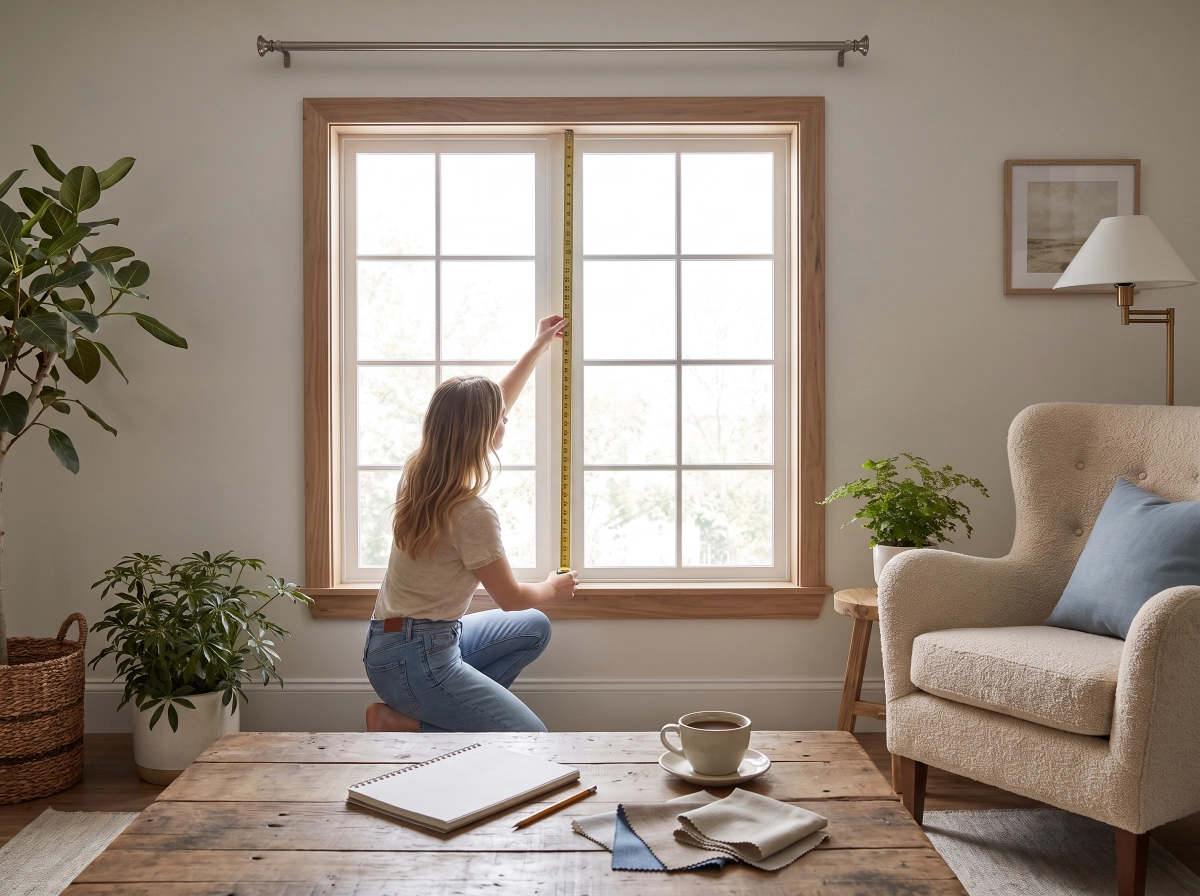
Measure the opening from left to right. Do not assume that the top, middle, and bottom of the window are exactly the same.
Take three width measurements:
- Top of the opening
- Middle of the opening
- Bottom of the opening
Record all three measurements. If they differ, the largest measurement is useful when assessing the available opening, but the final installation decision should consider whether the wall or frame is out of square.
4. Measure the Window Height
Measure the opening vertically at more than one point.
- Left side
- Center
- Right side
Record the measurements rather than relying on a single reading. Uneven floors, ceilings, frames, or construction tolerances can create differences across the opening.
If the final treatment will be a floor-length curtain, remember that the finished curtain drop is normally measured from the planned curtain hardware position rather than simply from the top of the window frame.
5. Measure the Window Recess
For inside-mounted blinds or shades, recess depth is important. Measure from the front edge of the recess toward the back of the window area and record the usable depth.
Also check whether the window frame, handles, locks, screens, or other components reduce the available depth.
6. Check for Obstructions
Measurements should not be taken in isolation. Look around the complete window area for anything that could interfere with the treatment.
- Window handles
- Door handles
- Air-conditioning units
- Electrical outlets and switches
- Columns or wall returns
- Furniture
- Existing curtain tracks or blinds
- Ceiling features and bulkheads
Take photos of these areas and record any restrictions. A technically correct window measurement can still produce an unsuitable installation if the surrounding space is ignored.
7. Check Whether the Window Is Square
Windows and walls are not always perfectly square, particularly in larger properties or buildings with construction variations.
Comparing the top, middle, and bottom widths and the left, center, and right heights can reveal differences. For unusual openings, a professional site measurement is safer than relying on a single dimension.
8. Measure Multiple Windows Separately
If a room contains several windows that appear identical, measure each opening separately and label the measurements clearly.
For example:
- Bedroom Window 01
- Bedroom Window 02
- Living Room Window 01
- Living Room Sliding Door
Do not assume that two windows with the same visual appearance have exactly the same dimensions.
9. Measure Sliding Glass Doors
For sliding doors, measure the complete opening and note which direction the panels move. Also check the available wall space beside the opening for the curtain or blind when it is open.
For large villa openings, note the floor level, ceiling level, door handles, wall returns, and any furniture close to the opening. These details can influence the hardware and final treatment.
10. Measuring for Roller Blinds and Roman Shades
If the window will receive a roller blind or Roman shade, the measurement process is different from simply measuring for a pair of curtains.
Record:
- Opening width
- Opening height
- Recess depth
- Handle position
- Frame position
- Any obstruction inside the recess
Also decide whether the intended installation is inside the recess or outside the recess. The mounting decision should be made before the final production dimensions are confirmed.
11. Measuring for Curtains: What Changes?
Window measurements provide the starting information, but they are not automatically the final curtain dimensions.
For curtains, you still need to determine:
- Track or pole position
- Track or pole width
- Stack-back area
- Finished curtain drop
- Fullness
- Heading or pleat style
- Number of panels
For the detailed curtain calculation process, see our How to Measure for Curtains: An Expert Guide.
12. How to Record Your Measurements
Create a simple measurement record for every opening. Include the room name, opening number, width measurements, height measurements, recess depth where relevant, and notes about obstructions.
Photos are also useful. Take at least one straight-on photo and additional photos showing the surrounding wall, ceiling, floor, handles, and other possible obstructions.
13. Common Window Measurement Mistakes
- Measuring only once.
- Measuring only the visible glass.
- Failing to check the top, middle, and bottom width.
- Failing to check the left, center, and right height.
- Ignoring recess depth for inside-mounted treatments.
- Forgetting handles and other protrusions.
- Not checking the wall space beside sliding doors.
- Assuming every window in the same room is identical.
- Confusing window dimensions with final curtain dimensions.
14. When Professional Window Measurement Is Better
Professional measurement is particularly useful for large villas, floor-to-ceiling glazing, multiple connected windows, sliding doors, layered treatments, unusual recesses, and projects involving several different window treatment types.
A professional site survey can connect the physical window dimensions with the intended product, mounting method, hardware, light-control requirements, and installation conditions.
15. Professional Window Measurement in Bali
Almeers Living provides custom curtains, blinds, and window treatments for residential and hospitality properties across Bali. Our team can assess your window openings, discuss the appropriate treatment, and verify the installation conditions before production.
If you have measured your windows but are unsure whether the dimensions are suitable for custom production, contact Almeers Living for a professional consultation.
Frequently Asked Questions
Should I measure the glass or the whole window frame?
Record the actual opening and frame dimensions relevant to the intended installation. For inside-mounted treatments, the usable recess and internal obstructions are especially important. For curtains, the final hardware position must also be considered.
Why should I measure a window three times?
Taking measurements at multiple points helps identify differences caused by construction tolerances or openings that are not perfectly square. It gives a better picture of the actual installation condition.
Do I need to measure recess depth?
Yes, when considering an inside-mounted blind or shade. Recess depth can determine whether the selected product and its hardware can fit correctly inside the opening.
Are window measurements the same as curtain measurements?
No. Window measurements describe the opening. Curtain measurements also require decisions about the track or pole, stack-back, finished drop, fullness, heading style, and installation position.
Window Measurement Checklist
- Window type identified
- Top, middle, and bottom width recorded
- Left, center, and right height recorded
- Recess depth checked where relevant
- Handles and obstructions recorded
- Wall space beside sliding doors checked
- Each window labeled separately
- Photos taken
- Mounting method considered
- Final product requirements discussed before production
Accurate window information gives your window treatment project a stronger starting point. When the property has complex openings or premium custom treatments, a professional site survey can help verify the measurements before fabrication.