Luxury Hotel Curtains: What to Look For: What Works Best in Bali — High-Density Hospitality Fabrics, Flame-Retardant Linings, and Heavy Drapery Pleating
Designing world-class boutique hotels, five-star luxury resorts, and high-end hospitality estates across Bali—from the vibrant coastal tourism corridors of Canggu, Seminyak, and Umalas to the serene rainforest sanctuaries of Ubud and dramatic clifftop retreats in Uluwatu—demands an uncompromising commitment to commercial durability, guest comfort, and architectural sophistication. In hospitality interior design, guest room window treatments are among the most critical functional investments in the property. Framing sweeping floor-to-ceiling glass sliding doors that connect interior suites directly with private plunge pools, tropical gardens, and ocean horizons, luxury hotel curtains establish the immediate visual impression, acoustic serenity, and sleep quality of every guest room. However, outfitting commercial hospitality properties in tropical island environments introduces severe operational and environmental challenges. Hotel draperies endure intensive daily guest handling, continuous luggage friction, sunlight exposure, intense UV radiation, high atmospheric humidity, and rigorous fire safety compliance codes. Property owners, hotel developers, and hospitality architects frequently search for authoritative guidance on luxury hotel curtains: what to look for: what works best in Bali (mastering high-density hospitality fabrics, flame-retardant linings, and heavy drapery pleating) to ensure long-term operational resilience, guest satisfaction, and timeless aesthetic prestige.
Executing an immaculate hospitality drapery scheme in high-temperature, high-humidity island microclimates requires a sophisticated architectural engineering approach: evaluating commercial Martindale abrasion ratings, specifying NFPA 701 and BS 5867 flame-retardant safety linings, engineering concealed ceiling recessed pelmet pockets, applying non-toxic anti-mold protection, and integrating smart automated solar scheduling. In this comprehensive editorial masterclass, we explore the core design principles, commercial material standards, and practical installation metrics required to curate five-star luxury hotel window treatments in Bali.
1. The Rigorous Demands of Hospitality Window Treatments in Tropical Resorts
Before specifying fabrics or hardware tracks for a hotel or luxury villa resort, property investors must understand the unique physical and operational stressors commercial draperies undergo:
- High-Frequency Guest Handling: Unlike residential curtains operated by homeowners, hotel guest room drapes are pulled multiple times daily by changing guests who operate controls with varying degrees of force, frequently grabbing face fabrics directly rather than draw wands.
- Strict International Fire Safety Compliance: Commercial hospitality buildings across Bali must adhere to stringent fire safety regulations. All public area and guest room draperies require certified flame-retardant treatments to prevent rapid flame propagation in emergency scenarios.
- Equatorial Climate Wear and Tear: Unshaded glass sliding doors allow intense ultraviolet radiation to flood guest rooms, degrading cheap synthetic fibers and fading budget dyes within months, while high coastal humidity fosters fungal mold growth.
2. Pillar 1: High-Density Hospitality Fabrics & Martindale Durability
Choosing the correct textile composition is the single most critical decision in hospitality design. Specifying residential-grade silk, unblended cotton, or delicate lightweight fabrics leads to rapid fraying, staining, and high operational replacement costs:
- Solution-Dyed Poly-Linen Composites: While 100% natural raw linen offers an organic look, pure linen absorbs moisture constantly in humid coastal air, causing vertical drops to stretch and shrink unpredictably. Specifying high-tenacity solution-dyed polyester-linen blends retains the organic slubbed texture while offering dimensional stability, high crease recovery, and long-term tensile strength against sun exposure. Explore technical hospitality fabric options starting at Rp 60.000/m on our products page.
- Commercial Abrasion Resistance (> 40,000 Rubs): Specify heavy-duty drapery and upholstery textiles tested to withstand over 40,000 double-rubs on the Martindale scale, ensuring fabrics resist pilling, surface wear, and seam tearing under heavy commercial use.
- Hydrophobic Stain-Shield Coatings: Nanotechnology fabric finishes create an invisible barrier across textile fibers, causing liquid spills, beverage drops, and sunscreen smudges to bead up on the surface for easy housekeeping wipe-cleaning rather than absorbing into yarn cores.
3. Pillar 2: Flame-Retardant Linings and International Safety Standards
Hospitality architecture requires strict adherence to fire safety regulations to safeguard guests and comply with international building codes:
- Inherently Flame-Retardant (IFR) Fibers: Specify textiles woven from inherently flame-retardant synthetic polymers (such as Trevira CS polyester) where flame-retardant chemical properties are embedded permanently inside the molecular structure of the yarn, ensuring properties survive multiple commercial launderings without diminishing.
- Compliance with NFPA 701 and BS 5867 Standards: High-end hotel draperies supplied by Almeers Living meet or exceed major international commercial fire testing standards, including NFPA 701 (Standard Methods of Fire Tests for Flame Propagation of Textiles and Films) and BS 5867 (Fabrics for Curtains, Drapes and Window Blinds).
- Multi-Pass Coated Thermal Blackout Linings: Integrating flame-retardant multi-pass acrylic blackout linings blocks 100% of morning sun light, insulates guest rooms against radiant equatorial heat, and dampens external resort noise for optimal sleep quality (starting at Rp 60.000/m to Rp 110.000/m on our products page).
4. Pillar 3: Heavy Drapery Pleating & S-Fold Wave Mechanics
How fabric hangs across wide guest room sliding door spans dictates whether a hotel suite feels ordinary or luxurious. Traditional pinch pleats or rod pockets look dated in modern resort architecture:
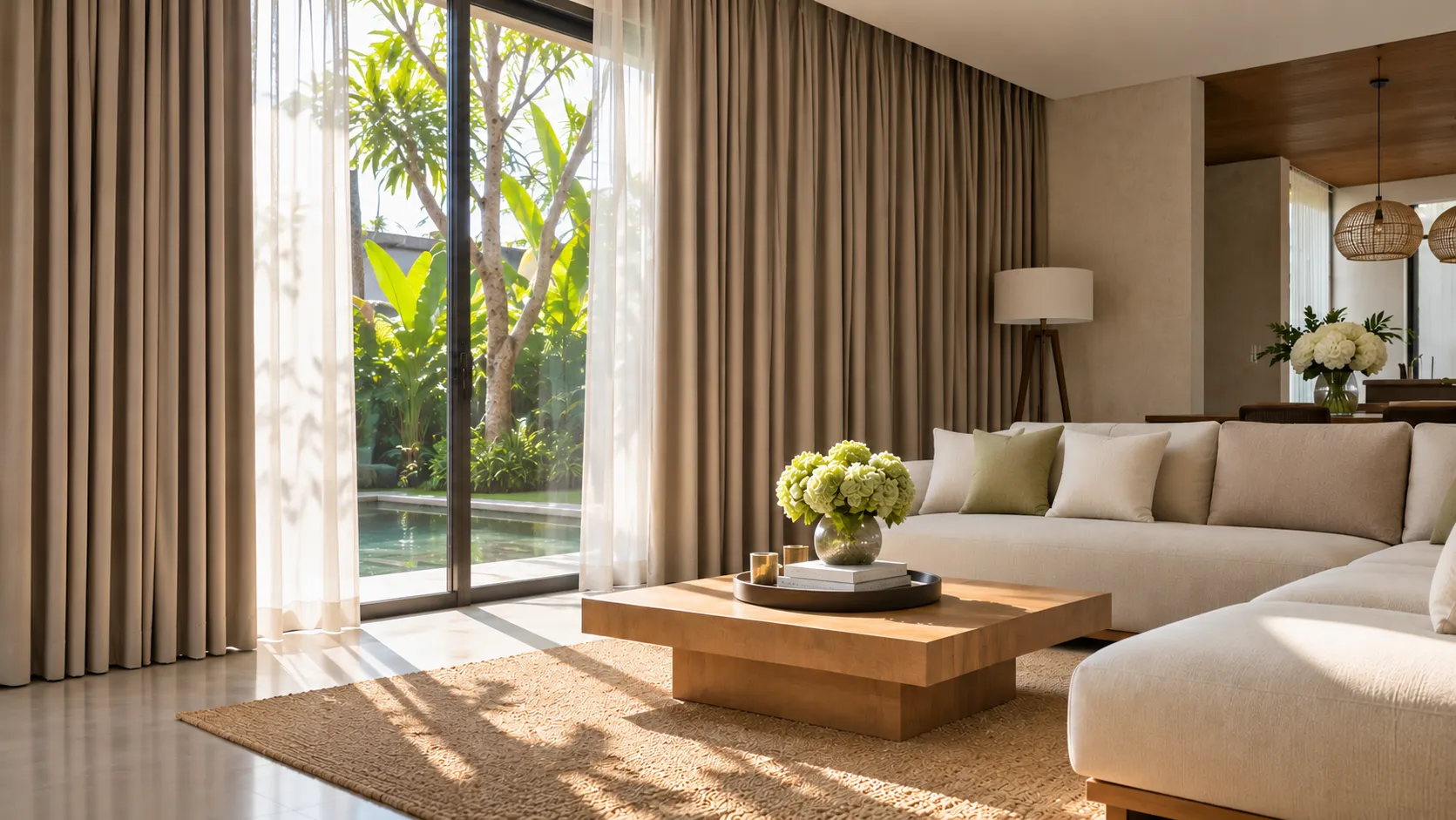
- The S-Fold (Ripplefold) Wave Pleat Standard: Suspended from continuous runner tapes, S-fold systems shape organic and synthetic fabrics into uniform, continuous vertical S-curves from top to bottom. S-fold waves fold neatly together without crushing, maintaining crisp architectural symmetry whether drapes are drawn open or closed.
- The 2.2x High-Fullness Multiplier: True hospitality luxury requires generous fabric volume. Always specify 2.2 times the track width in flat fabric volume to create deep, lush vertical folds that frame views impeccably. Calculate exact fabric volume requirements using our digital stacking calculator.
- Continuous Bottom Lead Weight Tapes: Commercial luxury draperies incorporate continuous lead weight tapes encased inside bottom hems. This downward gravitational tension keeps vertical S-waves straight, taut, and elegant against coastal breeze currents.
5. Spatial Details: Ceiling Recessed Pelmet Pockets & Floor Clearances
Executing a resort-grade drapery installation that meets five-star hotel standards requires precise architectural detailing:
- Concealed Ceiling Recessed Pelmet Pockets: Mount heavy-duty aluminum tracks flush inside built-in ceiling recessed pelmet pockets measuring **20 cm to 25 cm wide** and **12 cm to 15 cm deep** for commercial dual-track systems. Recessing hardware hides tracks completely, allowing light-diffusing sheer and blackout cascades to emerge seamlessly out of the ceiling line. Spatial tolerances can be cross-referenced on our valances and cornices measuring guide.
- The 1 cm Floor Hover Clearance Rule: Verify vertical drop distances accurately from track runner eyelets down to finished floor surfaces. Calibrate adjustable ratchet hooks so bottom hems hover precisely **1 cm above finished floor level**. This prevents bottom hems from dragging across floor tracks, collecting dust, or absorbing moisture during daily housekeeping floor mopping. Review drop measurement rules on our curtain measuring guide and dedicated shade measuring guide.
6. Tropical Climate Resilience: Advanced Anti-Mold Protection
In humid coastal environments like Bali, relative atmospheric humidity routinely exceeds 85%. Guest rooms featuring expansive glass sliding doors experience continuous temperature contrasts between indoor guest air conditioning and outdoor humidity, creating condensation microclimates near glass panes where fungal mold spores thrive.
To preserve pristine textile hygiene, bright fabric luminosity, and indoor air quality, commercial draperies supplied by Almeers Living incorporate advanced **Anti-Mold** (anti-jamur) technology. This specialized hydrophobic antimicrobial finish repels moisture droplets and prevents fungal spore germination, keeping your hotel draperies clean, fresh, and allergen-free season after season.
7. Smart Motorization for Five-Star Hospitality Efficiency
In high-end luxury hotels and resorts, manually drawing heavy multi-layer floor-to-ceiling draperies across wide 5-meter to 8-meter sliding door spans places physical strain on staff and guests. Upgrading guest room window treatments to a motorized track system powered by whisper-quiet DC actuators defines modern resort luxury.
Motorized tracks glide drapes smoothly along the ceiling line at the press of a bedside button or wall keypad. Systems integrate seamlessly with centralized hotel room management systems (RMS) and smart platforms like Apple HomeKit, Google Assistant, Amazon Alexa, and Control4. Program automated solar schedules to close blackout layers during unoccupied peak heat hours (11:00 AM – 3:00 PM), maintaining cool indoor temperatures passively and reducing hotel air-conditioning energy consumption substantially.
8. Elevate Your Hospitality Project with Almeers Living
Designing luxury hotel curtains in Bali requires an expert synthesis of commercial fabric durability, flame-retardant safety compliance, heavy S-fold pleating, anti-mold protection, and smart motorization. Partnering with an experienced local specialist guarantees precise laser site surveys, master commercial fabrication, and long-term operational durability. As a recognized premier window treatment specialist in Bali, Almeers Living offers complete turnkey execution—from complimentary on-site laser surveys and commercial fabric sampling to professional motorized installation across the island.
Transform your boutique hotel, resort villas, or hospitality development into a five-star, sun-regulated sanctuary today. Browse our full range of commercial drapery fabrics, dual-track hardware, and automated window solutions on our products page to schedule your personalized on-site consultation with Bali’s trusted window experts.