Motorized Curtains for Large & High Windows: A Practical Specification Guide
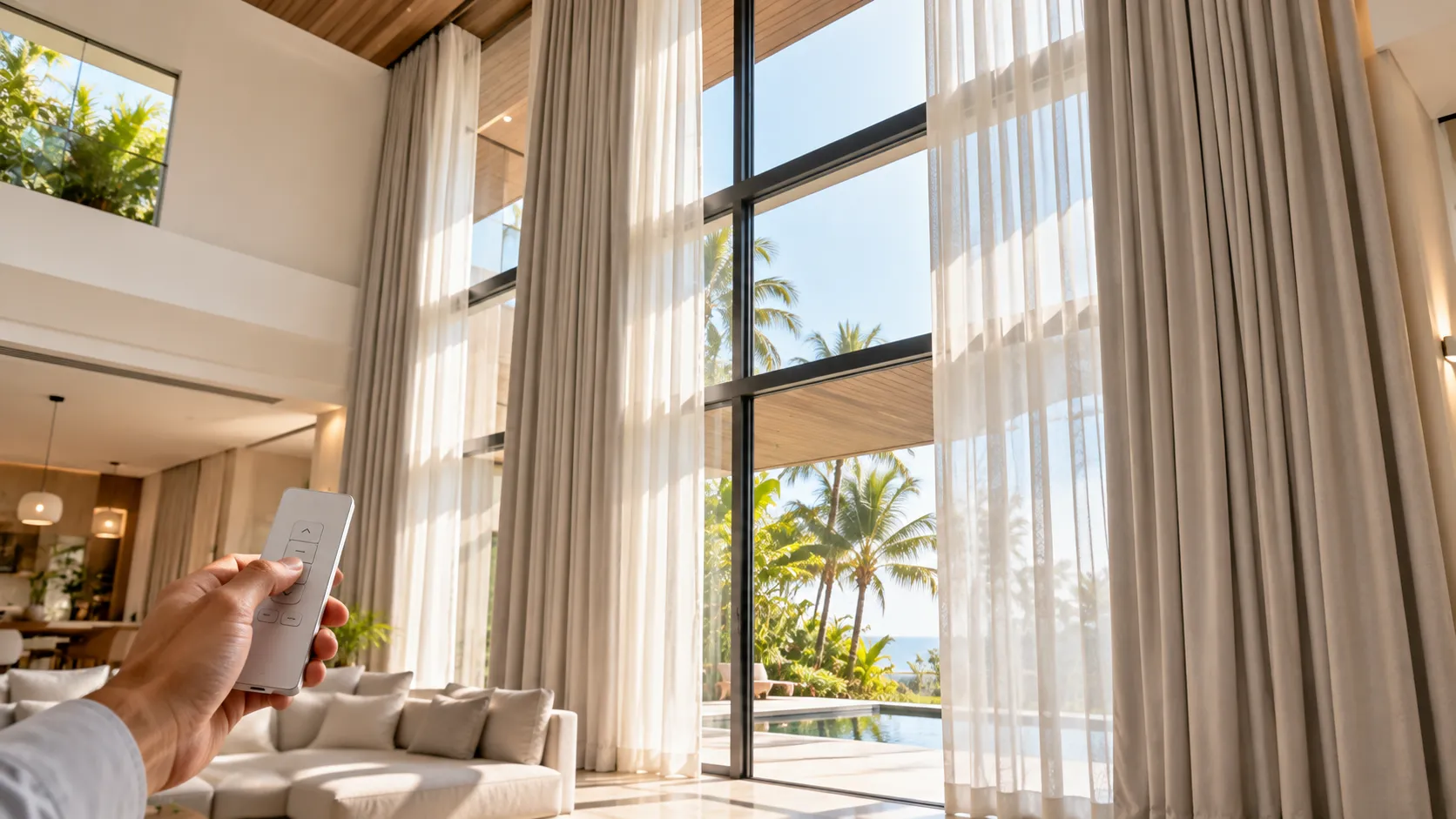
Motorized curtains are most useful when curtain size, height, frequency of use or accessibility makes manual operation inconvenient. For large villa glazing and high windows, the motor is only one part of the system. Track capacity, fabric weight, stack-back, power planning, controls and installation all need to work together.
When Should You Consider Motorization?
| Window condition | Why motorization can be useful |
|---|---|
| Very wide opening | Reduces effort required to move large panels |
| High window | Improves daily access without ladders |
| Multiple rooms | Allows a consistent operating routine |
| Layered curtains | Can separate daylight and privacy control |
| Hard-to-reach glazing | Makes regular adjustment practical |
Start With the Curtain, Not the Motor
Motor selection should follow the curtain specification. First establish opening width, finished height, fabric type, lining, fullness, panel arrangement and expected daily operation. These factors affect the load and track configuration.
A heavy blackout curtain and a lightweight sheer do not place the same demands on a motorized system. The fabric should therefore be specified before final hardware capacity is confirmed.
Track Configuration Matters
Motorized curtains can use centre-opening or one-way configurations. The correct arrangement depends on architecture, available stack-back and the location of doors, furniture and other treatments.
For a large sliding door, stack-back should be planned so the open curtain does not unnecessarily block the usable doorway or the best part of the view.
Power and Control Planning
Electrical planning should be considered before installation. Confirm where the motor will be located, how the power connection will be accessed and whether the project requires a dedicated control, remote, wall switch or smart-home integration.
For new villas, these requirements are easier to coordinate during construction or interior fit-out than after finishes are complete.
Motorized Does Not Always Mean Smart-Home Integration
A motorized curtain can operate through a dedicated control system without being connected to a broader smart-home platform. Integration is an additional layer that may be useful when the property already uses compatible automation.
Before specifying integration, confirm the actual control requirement. A simple remote may be enough for one room, while a multi-room property may benefit from coordinated scenes or schedules.
Room-by-Room Applications
| Room | Typical reason | Planning point |
|---|---|---|
| Master bedroom | Easy privacy and morning light control | Quiet operation and blackout coverage |
| Living room | Large glazing and daily adjustment | Track capacity and stack-back |
| High-ceiling villa | Accessibility | Motor and service access |
| Media room | Repeatable light control | Blackout coverage and side gaps |
| Hospitality space | Consistent operation | Simple user controls |
Installation Checklist
- Confirm opening dimensions.
- Confirm curtain weight and fullness.
- Choose opening direction.
- Plan stack-back.
- Confirm mounting surface and track position.
- Plan power access.
- Confirm control method.
- Check service access.
- Test complete curtain movement after installation.
Common Mistakes
- Choosing a motor before specifying the curtain.
- Ignoring stack-back on wide openings.
- Leaving electrical planning until after finishes are complete.
- Assuming every motorized system has the same load capacity.
- Adding smart-home integration without defining the actual user requirement.
Motorized Curtains in a Bali Villa
For Bali villas, large glazed openings, high ceilings and indoor-outdoor layouts can make motorization particularly practical. The system should still be specified around the actual architecture, fabric and installation condition.
For related planning, see our motorized blinds and smart homes guide and our motorized curtain guide.
Final Takeaway
The strongest motorized-curtain specification starts with the opening and curtain, then selects the appropriate track, motor, power arrangement and control method. This approach reduces installation surprises and makes the finished system easier to use.