Venetian vs Roman vs Vertical Blinds by Room: How to Choose
Venetian, Roman and vertical blinds are designed around different window conditions and visual goals. The right choice depends on the opening, desired light control, privacy, material or fabric preference, available space and how the blind will be operated.
Quick Comparison
| Blind type | Character | Useful for | Key planning point |
|---|---|---|---|
| Venetian | Horizontal slats | Adjustable light and privacy | Slat material, width and cleaning |
| Roman | Soft fabric folds | Bedrooms and refined living spaces | Fabric weight and stack height |
| Vertical | Vertical vanes | Wide windows and sliding doors | Opening direction and stack-back |
Venetian Blinds
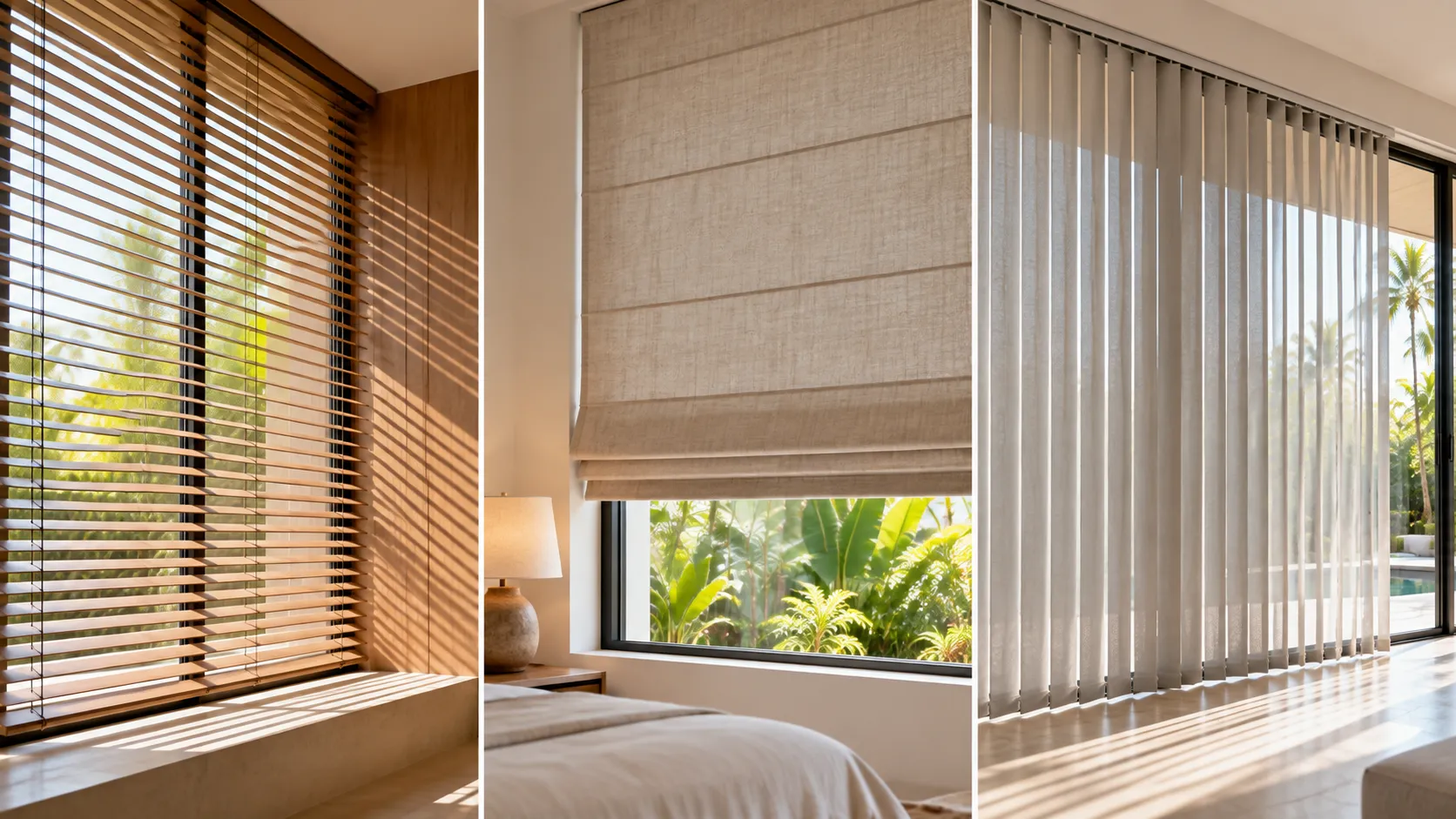
Venetian blinds use horizontal slats that can be tilted to control incoming light. Depending on the material, they can create a clean architectural appearance or a warmer natural look.
They are useful where adjustable privacy is important. The slat angle can be changed without fully raising the blind, which can be practical for rooms that need daylight while reducing direct views.
Check Before Choosing Venetian Blinds
- Available recess depth.
- Slat material and moisture exposure.
- Handle clearance.
- Cleaning access.
- Required privacy position.
Roman Shades
Roman shades use fabric that folds as the shade is raised. They provide a softer appearance than a slatted blind and can coordinate closely with curtains and upholstery.
Fabric choice is important because the same colour can behave differently depending on weave, weight and lining. For bedrooms, a lined Roman shade can provide stronger light control than decorative fabric alone.
Check Before Choosing Roman Shades
- Fabric weight and fold behaviour.
- Required light control.
- Stack height when open.
- Window handle clearance.
- Cleaning and maintenance access.
Vertical Blinds
Vertical blinds use vertical vanes and can suit wide openings where the treatment needs to move sideways. The operating direction should be planned around doors, furniture and the preferred stack-back position.
For large sliding doors, the treatment should not interfere with normal panel movement. Measure the full opening and surrounding clearance before selecting the system.
Which One Fits Which Room?
| Room / opening | Possible starting point | Why |
|---|---|---|
| Bedroom | Roman or Venetian | Privacy and controlled daylight |
| Living room | Roman or Venetian | Design flexibility and light control |
| Large sliding door | Vertical or curtain system | Side movement and wide coverage |
| Home office | Venetian | Adjustable glare and privacy |
| Hospitality space | Depends on opening | Durability, guest use and maintenance |
Do Not Ignore the Installation Condition
The product name does not tell you whether the window can accept the system. Recess depth, handles, wall projection, ceiling position and nearby doors can change the practical specification.
For large or unusual openings, measure the actual installation zone rather than relying only on glass dimensions.
Common Mistakes
- Choosing based only on catalogue appearance.
- Ignoring the window handle or door movement.
- Forgetting stack space when the blind is open.
- Choosing fabric without checking light-control requirements.
- Applying the same blind type to every room.
Final Checklist
- Identify the window type and opening direction.
- Define privacy and daylight requirements.
- Check recess depth and surrounding obstructions.
- Consider material and fabric behaviour.
- Plan operation and stack-back.
- Confirm installation access.
For a broader comparison, see our roller blinds vs. curtains guide and our guide to layered window treatments.